
Share:

Open-Ended vs Closed-Ended Questions: When to Use Each (With Examples)
3. Brand perception

Choose: both, open first so the list can't plant ideas, then closed to track against competitors.
4. Employee feedback

Choose: closed for the trend line, open as an optional follow-up. HR needs comparable scores by department, and free text can identify people in small teams.
5. UX and usability testing

Choose: both. The rating tells you which task is broken; the comment tells you which button.
Can you mix both?
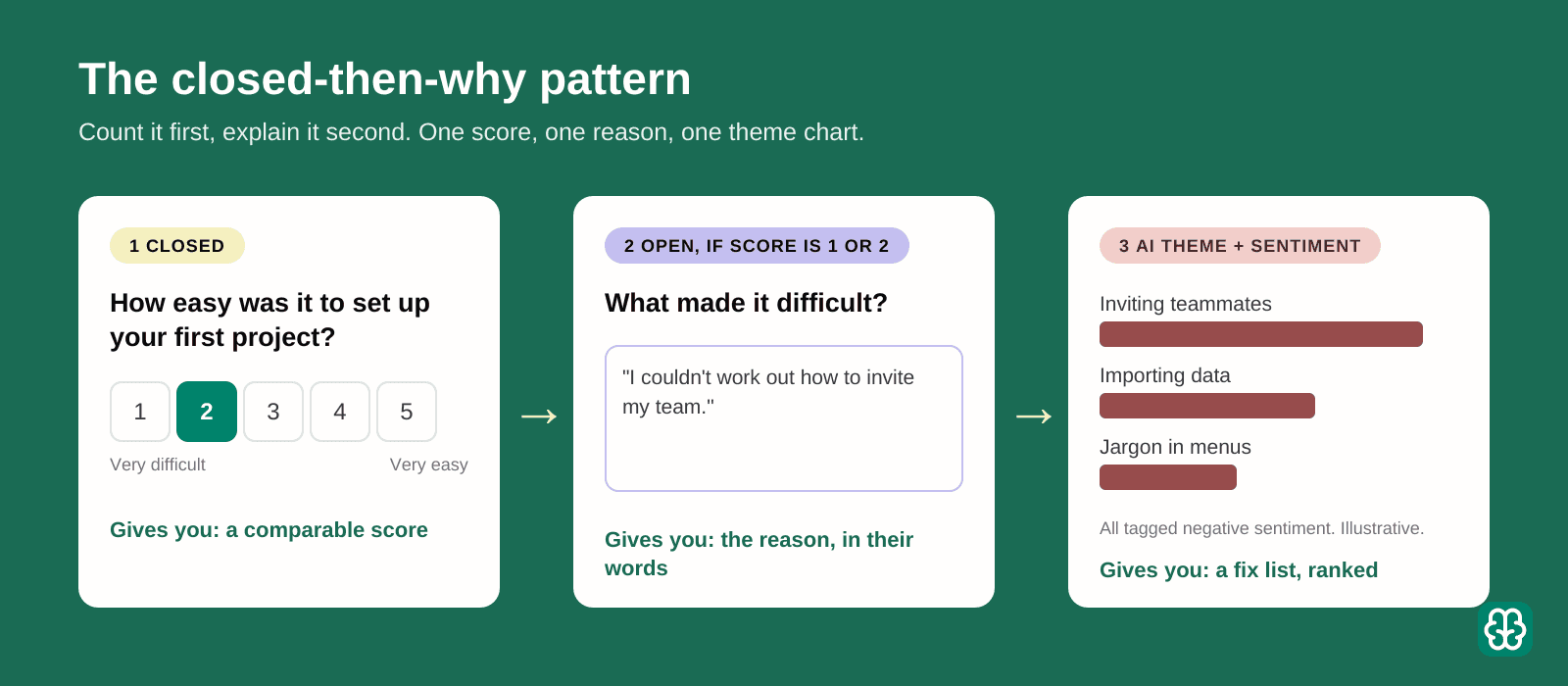
Yes, and most strong questionnaires do. Hybrid formats give you a countable answer plus the reason behind it.
"Other (please specify)"
The cheapest hybrid. If more than a small slice of people pick Other, your list is missing a category, and the text tells you which.
Closed question plus a "why?" follow-up
Ask the rating, then an optional open prompt. A cousin is Schuman's "random probe": Singer and Couper (2017) describe asking open follow-ups of a random subset after closed questions, which clarifies reasons cheaply and still generalises to the full sample.
Open questions in a pilot to build the closed list
Ask it open with 30 to 50 people, code the answers, and turn the top themes into closed options. Our guide on how to write good survey questions covers how to pilot test the rest of the questionnaire.
Analysing open text at scale with AI
The old objection to open ended questions was coding cost. AI theme and sentiment coding changes the maths: thousands of comments grouped and tagged in minutes, then checked by a human. In MindProbe, open-text responses get AI sentiment analysis and sit beside closed results in real-time dashboards.
Rule of thumb: how many open questions?
Share:
More in Marketing
View categoryCuci 100 Platform Overview for First-Time Visitors
Cuci 100 Platform Overview for First-Time Visitors
READ ARTICLEB1g Player for Fire TV Stick: Complete Setup Overview
B1g Player for Fire TV Stick: Complete Setup Overview
READ ARTICLEBest 5 Options to Explore Before You Buy Verified Bing Ads Account Access
➤WhatsApp:+1(231)392-4219 ➤Telegram:@onusaseoit
READ ARTICLEHow to Configure B1g Player for Streaming
How to Configure B1g Player for Streaming
READ ARTICLE