
Share:

Open-Ended vs Closed-Ended Questions: When to Use Each (With Examples)
Use open ended questions in small doses. One sharp prompt beats five "any other comments?" boxes, which mostly measure survey fatigue.
HOW MINDPROBE HELPS
Open answers only pay off if someone reads them. MindProbe runs AI sentiment and thematic analysis on every open response as it arrives, so a pile of comments becomes a list of themes, each with its share of mentions and real quotes, in your live dashboard.
When to use closed-ended questions
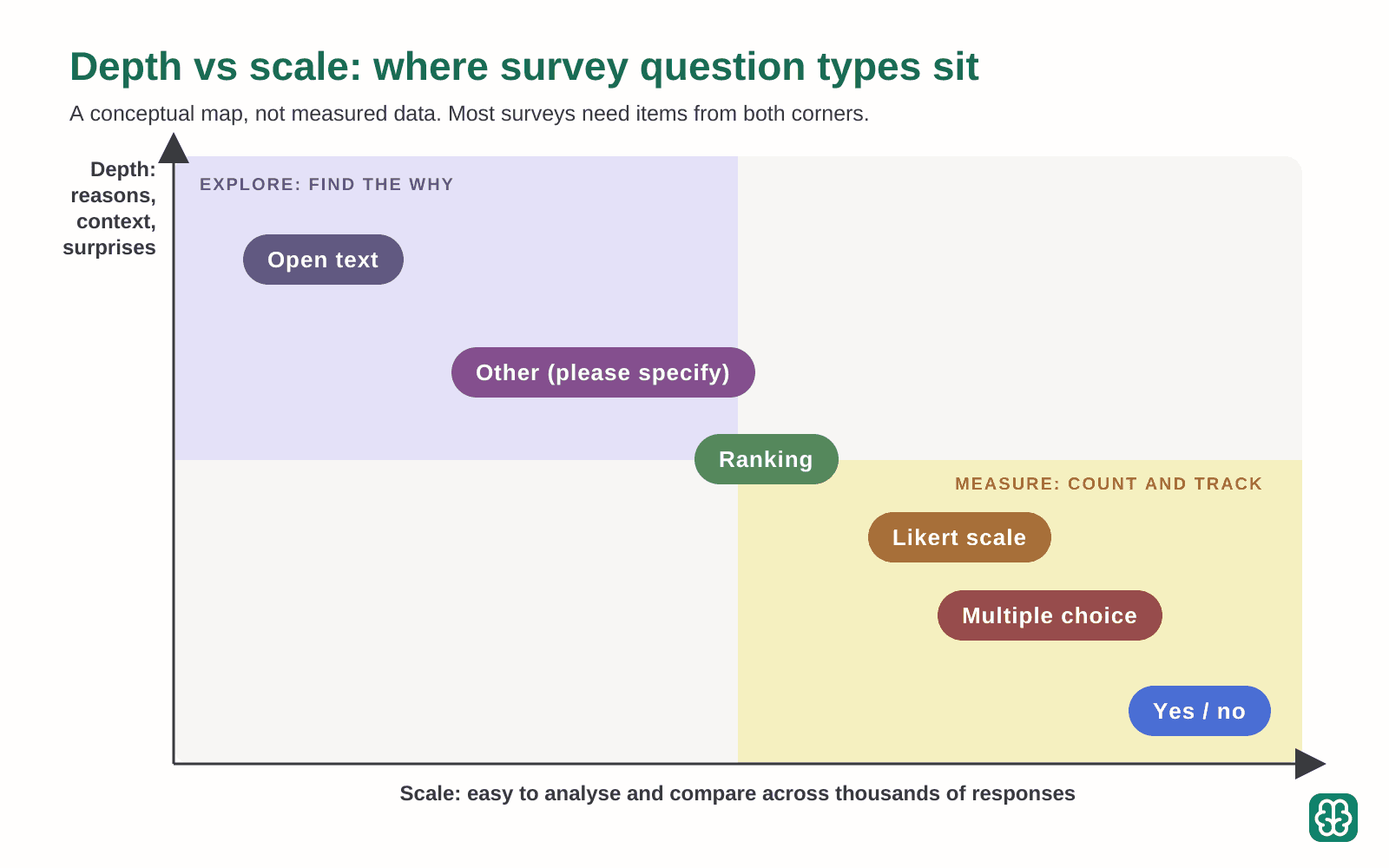
Use closed ended questions when you already know the realistic answer range and need to measure it: sizing a problem, comparing segments, or tracking change over time.
- Tracking. Brand, engagement and CSAT trackers need identical options every wave.
- Segmentation. You can't cut by "first-time buyers in the North West" unless those are closed fields. Our guide to demographic survey questions covers how to set up those bands.
- Large samples. At 5,000 responses, each open box is 5,000 texts. Closed items scale for free.
- Mobile-first audiences. Tapping beats typing on a phone.
- Thresholds. "Would you pay £9 a month?" needs a yes/no split, not an essay.
The hard part is the list. Schuman and Presser's classic paper, " The Open and Closed Question" (1979), tested how closely coded open answers matched a pre-written list about what people value in work. The lesson: write closed options from real open answers, not a whiteboard.
HOW MINDPROBE HELPS
Every closed answer in MindProbe lands in a real-time dashboard you can cut by segment and compare across waves. Need a fresh audience rather than your own list? Send the same survey to an on-demand consumer panel.
Open ended question examples across 5 research contexts
Here are open ended question examples paired with closed equivalents in five research contexts, with a pick for each.
1. Customer experience (NPS follow-up)

Choose: open for the first few waves. A fixed list freezes last year's assumptions. Once themes stabilise, promote the top five to a closed list.
2. Product discovery

Choose: open. The workaround nobody listed is the insight.
Share:
More in Marketing
View categoryCuci 100 Platform Overview for First-Time Visitors
Cuci 100 Platform Overview for First-Time Visitors
READ ARTICLEB1g Player for Fire TV Stick: Complete Setup Overview
B1g Player for Fire TV Stick: Complete Setup Overview
READ ARTICLEBest 5 Options to Explore Before You Buy Verified Bing Ads Account Access
➤WhatsApp:+1(231)392-4219 ➤Telegram:@onusaseoit
READ ARTICLEHow to Configure B1g Player for Streaming
How to Configure B1g Player for Streaming
READ ARTICLE