
Share:

Open-Ended vs Closed-Ended Questions: When to Use Each (With Examples)
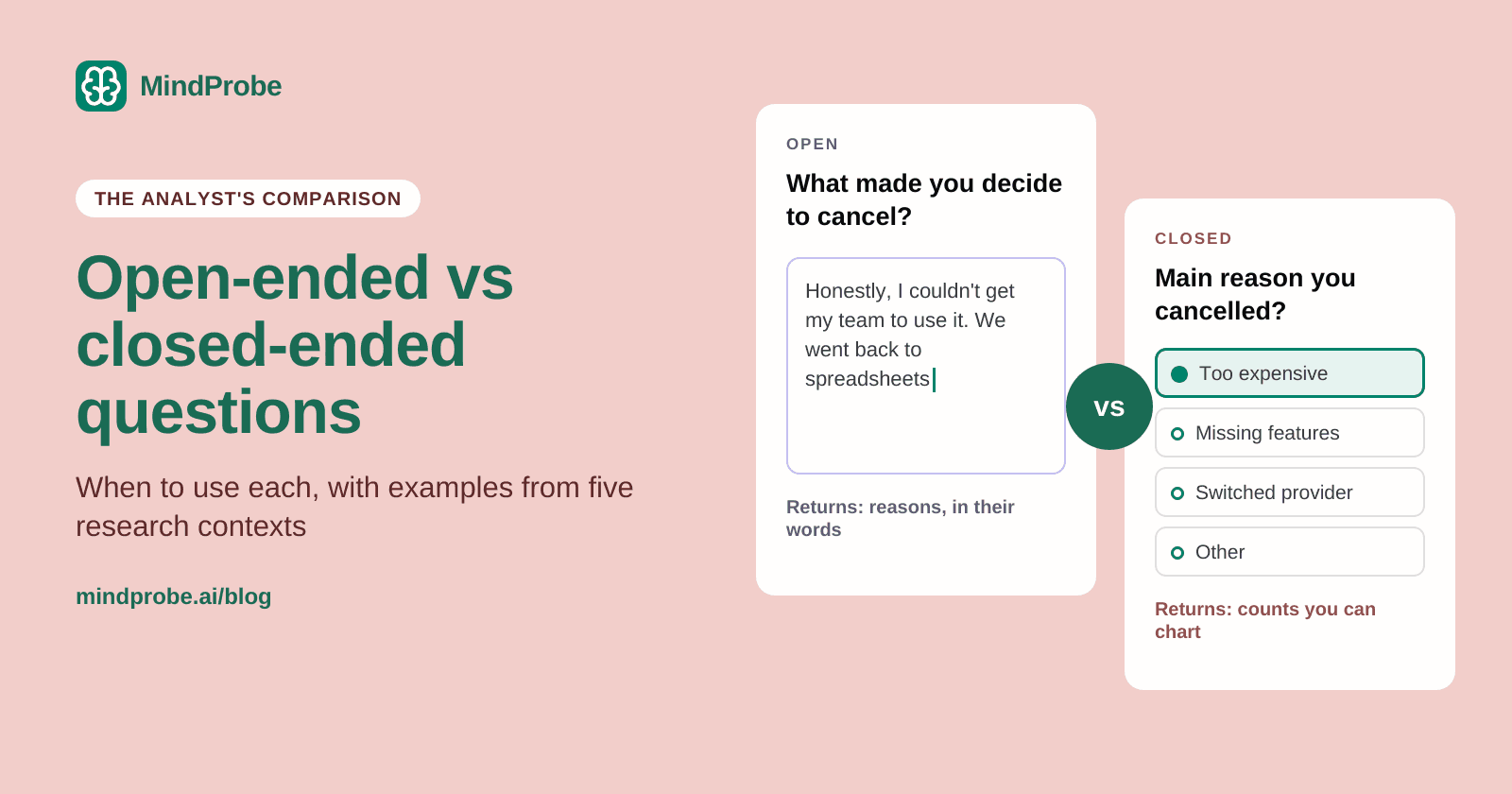
An open-ended question has no answer options. Respondents reply in their own words, so you capture reasons, language and ideas you didn't think to list.
What are open-ended questions?
An open-ended question has no answer options. Respondents reply in their own words, so you capture reasons, language and ideas you didn't think to list.
"What's the one thing you'd change about checkout?" is open. There's no list to anchor on, which is the point. The GESIS survey guideline on open ended questions by Cornelia Züll (2016) lists the classic uses: topics where the answer range is unknown, answers that would need an impossibly long list (occupation is the textbook case), and cases where you want to avoid steering people towards the researcher's own categories.
For a shareable definition, see our glossary entry on the open-ended question.
What are closed-ended questions?
A closed-ended question gives respondents a predefined set of answers to choose from, such as yes/no, multiple choice, rating scales or rankings. Every response maps to a category you can count.
Closed ended questions are the backbone of quantitative surveys because the output is ready to chart. Our glossary has the one-line version of the closed-ended question, and our guide to close-ended questions covers each format and how to write answer options that don't overlap. Likert items are the most common closed format of all, and they get their own treatment in our Likert scale examples.
Key differences: comparison table
Open questions trade scale for depth; closed questions trade depth for scale. Here's how they compare on ten design dimensions.
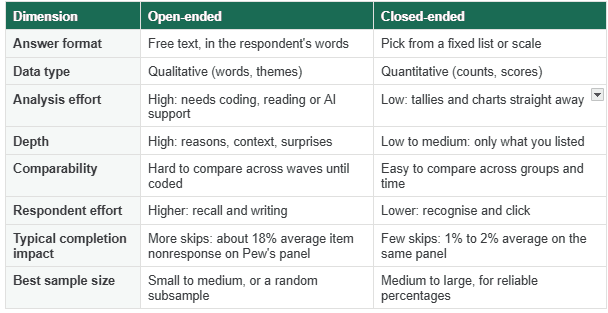

The completion row comes from Pew Research Center's analysis of 92 open-ended questions: open items averaged about 18% nonresponse (range 3% to just over 50%), closed items 1% to 2%. Cognitive burden was the biggest driver, and skips ran higher on mobile.
Bias cuts both ways. Züll notes that dissatisfied people answer open questions more often and at greater length, so angry comments aren't a random sample. Closed questions steer people towards what you show them.
When to use open-ended questions
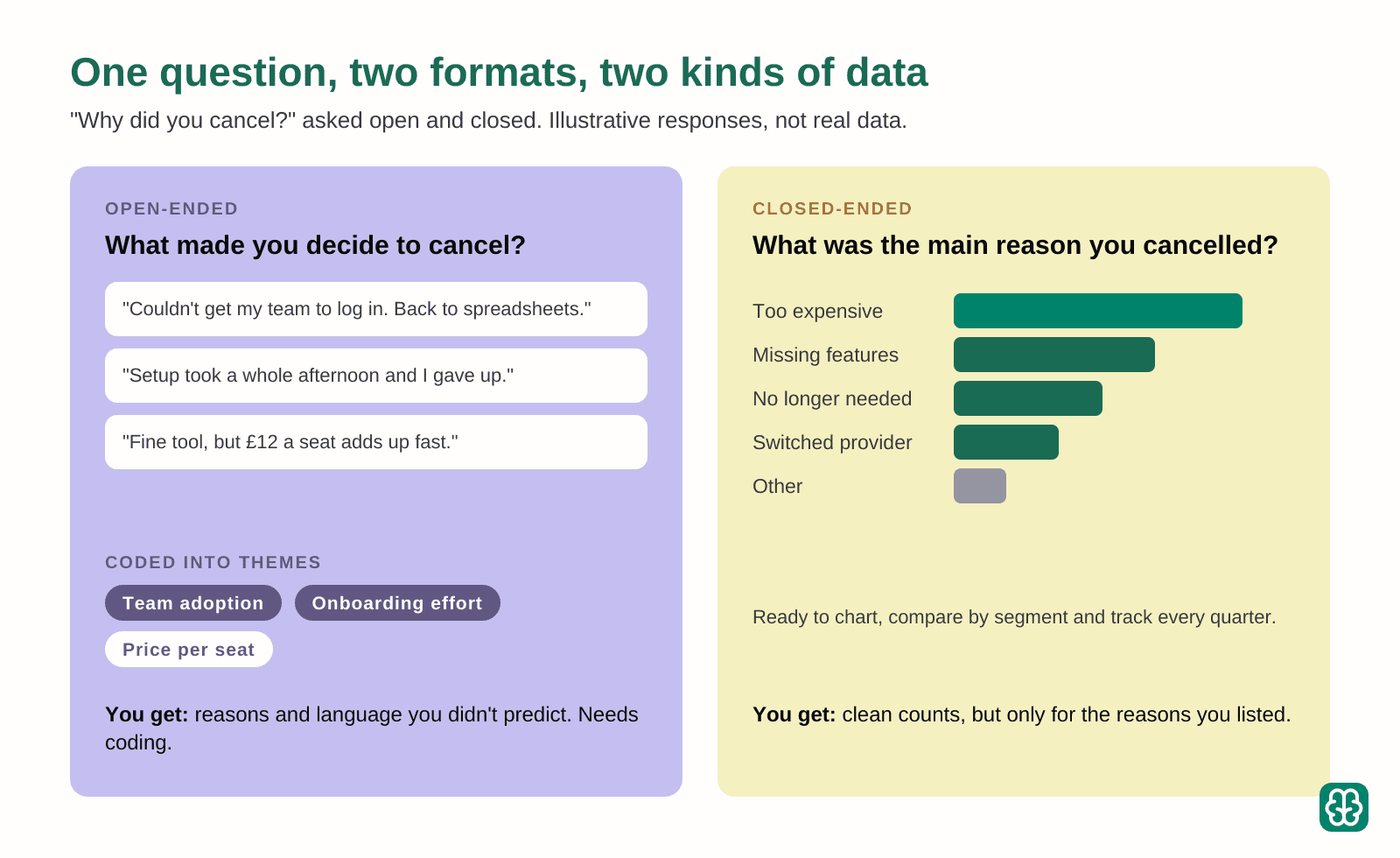
Use open ended questions when you can't confidently list every likely answer, when you need the reason behind a number, or when the customer's own wording is the deliverable.
- Discovery. An open box tells you what the list should contain.
- Explaining a score. An NPS of 31 is a number; "the app keeps logging me out" is a fixable ticket.
- Language mining. Brand teams want customers' exact phrases, not your paraphrase.
- Sensitive counts. Singer and Couper's review cites experiments where open questions drew higher reports of drinking than closed ones.
- Catching mistakes. The same review describes open replies revealing that a closed question's codes had been reversed.
Share:
More in Marketing
View categoryHow to Effectively Buy Telegram Accounts in 2026
Buy Telegram accounts through a simple and user-friendly process. Explore available options, compare important details, and discover convenient solutions for communication, community management, and professional messaging requirements.
READ ARTICLESafe Platform to Buy Twitter Accounts in 2026
Find the right Twitter account for your online activities. Explore available choices, compare important details, and make informed decisions that support your social media presence and branding objectives.
READ ARTICLEHow To Buy Old Gmail Account: Everything You
Discover convenient email account solutions for your online needs. Established Gmail profiles can help organize communications, separate personal and professional messages, and simplify everyday email management across multiple projects and platforms.
READ ARTICLETrusted Site to Buy Instagram Account in 2026
Looking to grow your social media presence? Buy an Instagram account with an existing audience and save time building followers from scratch while creating new opportunities for branding, engagement, and business growth.
READ ARTICLE