Biodegradable Mulch Films Market By Region, Material, Crop, And Trends
The biodegradable mulch films market is set for strong growth, driven by the rising need for sustainable agricultural practices, increasing food production demands, and enhanced material technologies.
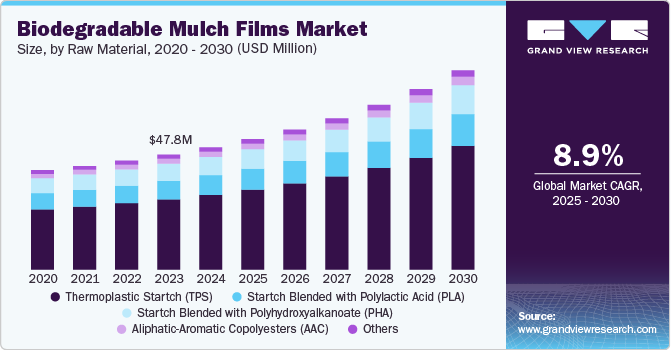
The global biodegradable mulch films market was valued at USD 50.75 million in 2024 and is projected to reach USD 82.82 million by 2030, growing at a CAGR of 8.9% from 2025 to 2030. Market growth is driven by increasing demand for food crops due to the growing global population, as well as the need for sustainable alternatives to conventional plastic films in modern agriculture.
Depleting arable and agricultural land in developed economies poses a significant challenge to global food production. Biodegradable mulch films provide a partial solution by improving crop yields while addressing critical issues such as water conservation, soil pollution, and climate change.
Sustainability is becoming a central focus in agriculture, prompting farmers and agribusinesses to adopt eco-friendly practices. Regulations in several regions are aimed at reducing plastic usage, and biodegradable films offer an environmentally friendly alternative that eliminates the need for disposal or incineration post-harvest. Advances in material technologies have further enhanced the performance and durability of these films, supporting broader adoption. Consequently, government initiatives and organizational endorsements are fueling market expansion worldwide.
Key Market Trends & Insights
- Asia Pacific dominated the global biodegradable mulch films market, accounting for the largest revenue share of 62.36% in 2024.
- By raw material, the thermoplastic starch segment led the market with over 61.25% revenue share in 2024.
- By crop type, the fruits & vegetables segment accounted for the largest share, exceeding 50.16% in 2024.
Download a free sample PDF of the Biodegradable Mulch Films Market Intelligence Study by Grand View Research.
Market Size & Forecast
- 2024 Market Size: USD 50.75 Million
- 2030 Projected Market Size: USD 82.82 Million
- CAGR (2025–2030): 8.9%
- Asia Pacific: Largest regional market in 2024
Competitive Landscape
The biodegradable mulch films market is highly competitive, with several leading players driving innovation and market growth. Major companies are investing in research and development to enhance the performance, cost-effectiveness, and sustainability of raw materials.
Key players include:
- BASF SE
- Kingfa Sci & Tech Co Ltd
- BioBag International AS
- AEP Industries Inc.
- RKW SE
- British Polythene Industries PLC
- Armando Alvarez
- Al-Pack Enterprises Ltd.
- Novamont
- AB Rani Plast OY
Explore Horizon Databook – the world’s most comprehensive market intelligence platform by Grand View Research.
Conclusion
The biodegradable mulch films market is set for strong growth, driven by the rising need for sustainable agricultural practices, increasing food production demands, and enhanced material technologies. With growing adoption across fruits, vegetables, and other crop segments, biodegradable films are expected to play a key role in advancing environmentally responsible and efficient agriculture worldwide.