Share:

Why Voluntary Employee Benefits Programs Are Becoming a Retention Strategy, Not Just a Perks List
Learn why voluntary employee benefits programs boost retention and satisfaction — plus 5 steps to build a program employees actually use.
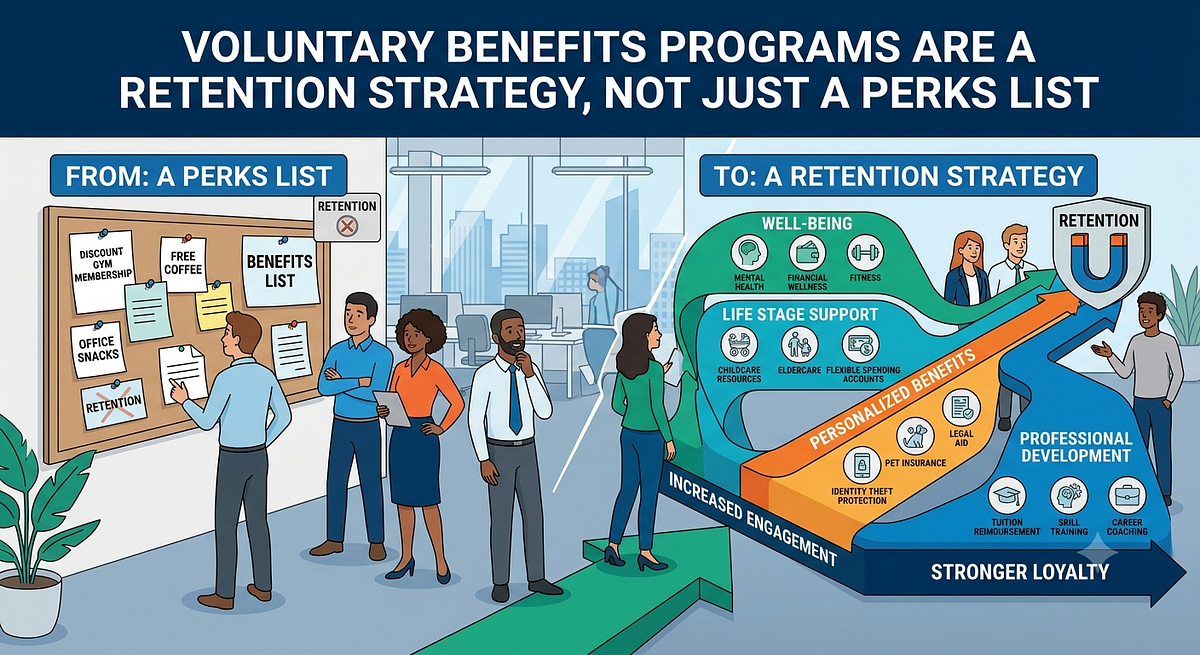
Ask ten employees what they value most about their job, and health insurance will almost always make the list. Ask what would make them stay another three years, and the answer gets more personal: student loan help, pet insurance, legal support, a financial coach who can explain their 401(k) in plain English. That's the gap voluntary employee benefits programs are built to close — and in 2026, it's a gap smart employers can no longer afford to ignore.
Voluntary benefits are optional, employee-paid (or partially employer-subsidized) offerings that sit alongside core benefits like medical, dental, and retirement plans. Think accident and critical illness insurance, life insurance, identity theft protection, legal services, pet insurance, and financial wellness tools. Employees choose what they need; employers get a powerful recruiting and retention lever that rarely requires a bigger benefits budget.
The catch? A voluntary benefits program only works if people actually understand and use it. Too many employers build a strong menu of options and then watch enrollment stall because nobody explained what's on offer. Below is a practical look at why these programs matter right now, what's driving demand, and how to structure one that employees actually engage with.
The Business Case for Voluntary Employee Benefits Programs
Healthcare costs keep climbing, and most employers can't expand core benefits every year without straining the budget. Voluntary benefits offer a way around that constraint. Because employees typically cover some or all of the premium — often at a group discount unavailable to individuals — employers can dramatically widen their benefits menu with minimal added cost.
That flexibility matters more than ever. Voluntary benefits have shifted from being seen as supplemental add-ons to becoming a central part of a holistic benefits strategy, largely because they let employers respond to a workforce that no longer wants a one-size-fits-all package. A 25-year-old paying off student loans and a 55-year-old planning for long-term care need very different things from their benefits package — and a strong voluntary lineup lets both feel supported without forcing the employer to pick sides.
There's also a hard data point worth sitting with: medical care remains the most widely available benefit, reaching 72% of private industry workers as of March 2024, according to the Bureau of Labor Statistics. Medical coverage is table stakes. It's the voluntary layer — discount programs, supplemental insurance, financial counseling — where employers can actually differentiate themselves in a tight labor market.
Retention Is the Real ROI
Turnover is expensive, and replacing a departing employee routinely costs half to twice their annual salary once recruiting, onboarding, and lost productivity are factored in. A well-designed voluntary benefits program won't single-handedly stop someone from leaving, but it does something subtler and just as valuable: it signals that the employer is thinking about the employee's whole life, not just their job description. That signal compounds over time into loyalty that's hard to buy any other way.
Share:
More in Business
View categoryYour Essential Guide to Basic Plumbing in Chapel Hill
Learn basic plumbing Chapel Hill homeowners should know, from leaks and clogged drains to water pressure issues, maintenance tips, and when to call a professional plumber.
READ ARTICLESoundproof Aluminium Windows: Benefits, Cost & Best Options in 2026
Choose **soundproof aluminum windows** for excellent noise reduction, modern design, durability, and improved indoor comfort for homes, offices, and commercial spaces.
READ ARTICLEWhat Are the Signs That Your Car Needs More Than a Regular Car Wash in Dallas?
A car wash is primarily designed to remove loose dirt and surface contaminants. Professional car detailing goes further by addressing the condition of the paint, wheels, tires, glass, interior surfaces, carpets, upholstery, and protective finishes. Knowing the warning signs can help you choose the appropriate service at the right time.
READ ARTICLE