
Share:

Why Voluntary Employee Benefits Programs Are Becoming a Retention Strategy, Not Just a Perks List
Learn why voluntary employee benefits programs boost retention and satisfaction — plus 5 steps to build a program employees actually use.
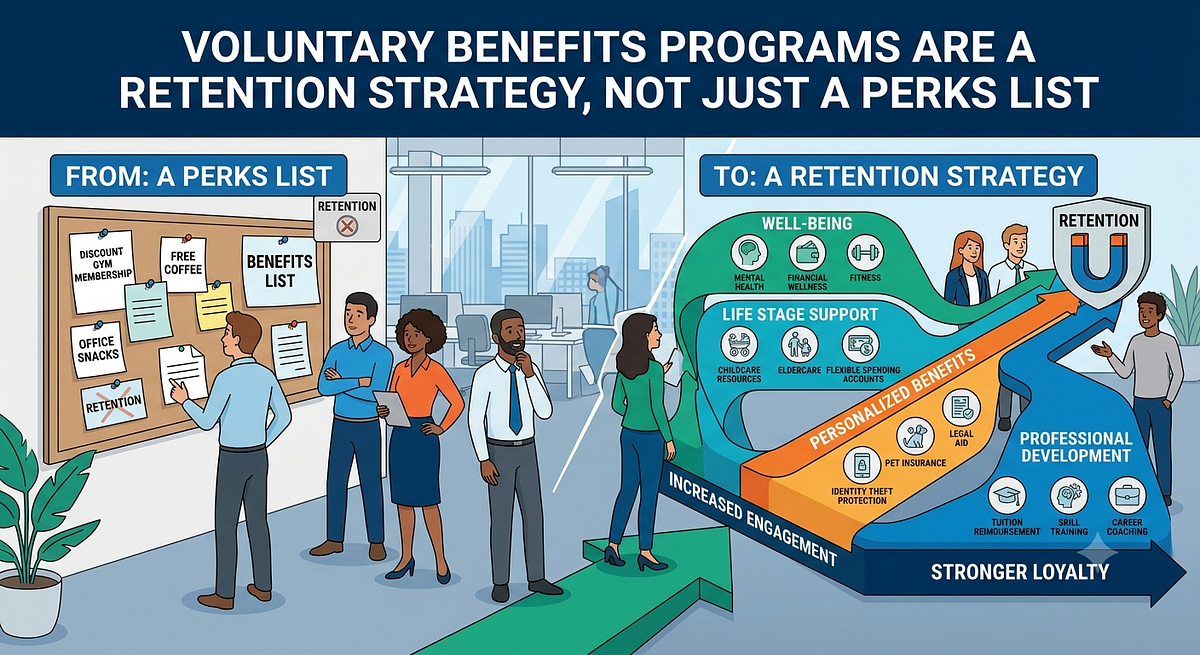
Ask ten employees what they value most about their job, and health insurance will almost always make the list. Ask what would make them stay another three years, and the answer gets more personal: student loan help, pet insurance, legal support, a financial coach who can explain their 401(k) in plain English. That's the gap voluntary employee benefits programs are built to close — and in 2026, it's a gap smart employers can no longer afford to ignore.
Voluntary benefits are optional, employee-paid (or partially employer-subsidized) offerings that sit alongside core benefits like medical, dental, and retirement plans. Think accident and critical illness insurance, life insurance, identity theft protection, legal services, pet insurance, and financial wellness tools. Employees choose what they need; employers get a powerful recruiting and retention lever that rarely requires a bigger benefits budget.
The catch? A voluntary benefits program only works if people actually understand and use it. Too many employers build a strong menu of options and then watch enrollment stall because nobody explained what's on offer. Below is a practical look at why these programs matter right now, what's driving demand, and how to structure one that employees actually engage with.
The Business Case for Voluntary Employee Benefits Programs
Healthcare costs keep climbing, and most employers can't expand core benefits every year without straining the budget. Voluntary benefits offer a way around that constraint. Because employees typically cover some or all of the premium — often at a group discount unavailable to individuals — employers can dramatically widen their benefits menu with minimal added cost.
That flexibility matters more than ever. Voluntary benefits have shifted from being seen as supplemental add-ons to becoming a central part of a holistic benefits strategy, largely because they let employers respond to a workforce that no longer wants a one-size-fits-all package. A 25-year-old paying off student loans and a 55-year-old planning for long-term care need very different things from their benefits package — and a strong voluntary lineup lets both feel supported without forcing the employer to pick sides.
There's also a hard data point worth sitting with: medical care remains the most widely available benefit, reaching 72% of private industry workers as of March 2024, according to the Bureau of Labor Statistics. Medical coverage is table stakes. It's the voluntary layer — discount programs, supplemental insurance, financial counseling — where employers can actually differentiate themselves in a tight labor market.
Retention Is the Real ROI
Turnover is expensive, and replacing a departing employee routinely costs half to twice their annual salary once recruiting, onboarding, and lost productivity are factored in. A well-designed voluntary benefits program won't single-handedly stop someone from leaving, but it does something subtler and just as valuable: it signals that the employer is thinking about the employee's whole life, not just their job description. That signal compounds over time into loyalty that's hard to buy any other way.
What's Actually Driving Demand in 2026
A few forces are reshaping what "good benefits" means right now, and it's worth understanding them before building or refreshing a program.
Mental and Financial Wellness Have Gone Mainstream
Mental health support used to be a differentiator. Now it's an expectation. Over 90% of U.S. employers now offer mental-health coverage in their medical plans, according to SHRM, and demand continues to rise, with employees turning to counseling, teletherapy, and stress-management tools more than ever. Financial wellness is following a similar trajectory, as employees look for help navigating debt, budgeting, and long-term planning — not just a retirement match.
Personalization Beats a Bigger Menu
More options isn't automatically better. Personalized benefits packages, blending voluntary offerings with employer-supported perks, tend to work well because they're often available at group-discounted rates arranged through the employer, rather than requiring a bigger benefits budget. The goal isn't to offer everything; it's to offer the right mix for a workforce that spans several generations, income levels, and life stages under one roof.
Underutilization Is the Silent Budget Killer
Here's the uncomfortable truth many HR teams already suspect: a great voluntary benefits program that nobody uses is functionally no program at all. Low utilization usually points to a communication or accessibility problem rather than a lack of interest — and that's a solvable issue. Regional and industry data backs this up starkly: enrollment rates for benefits like short-term disability, long-term disability, and accidental death coverage can swing by as much as 20 percentage points between regions, a gap that has far more to do with how benefits are communicated and administered than with genuine differences in employee need.
How to Structure a Voluntary Benefits Program That Actually Gets Used
Building the program is only half the job. Getting it into employees' hands — and keeping it there — is where most of the value is won or lost.
1. Start With Data, Not Guesswork
Before adding a new voluntary benefit, look at what your workforce is telling you: exit interview themes, engagement survey results, demographic shifts, and current utilization of existing benefits. A workforce that skews younger may respond more to student loan assistance and pet insurance; one with more employees nearing retirement may prioritize long-term care and legal planning services.
Share:
More in Business
View categoryVerified BitPay Accounts
BitPay is a cryptocurrency payment platform that helps individuals and businesses make and receive eligible digital currency payments. A BitPay account can provide access to supported payment services, wallet-related features, and tools designed to simplify cryptocurrency transactions. Understanding the account registration and verification process is important for users who want to use these services responsibly.
READ ARTICLEBuy LinkedIn Accounts
✉️ Gmail : bestreviewshop247@gmail.com ☛ Telegram: @bestreviewshop247 ☎️ WhatsApp :+1(657)294-0994
READ ARTICLEHow Long Does Auto Body Repair Take in Livingston, NJ
Find out how long auto body repair takes in Livingston, NJ, from minor dents to major collision damage, plus what can delay your vehicle's return.
READ ARTICLELooking for Jaipur Escort Service? Explore Your Options Today!
A quick online search for Jaipur Escort Service may bring up numerous websites and advertisements.
READ ARTICLE