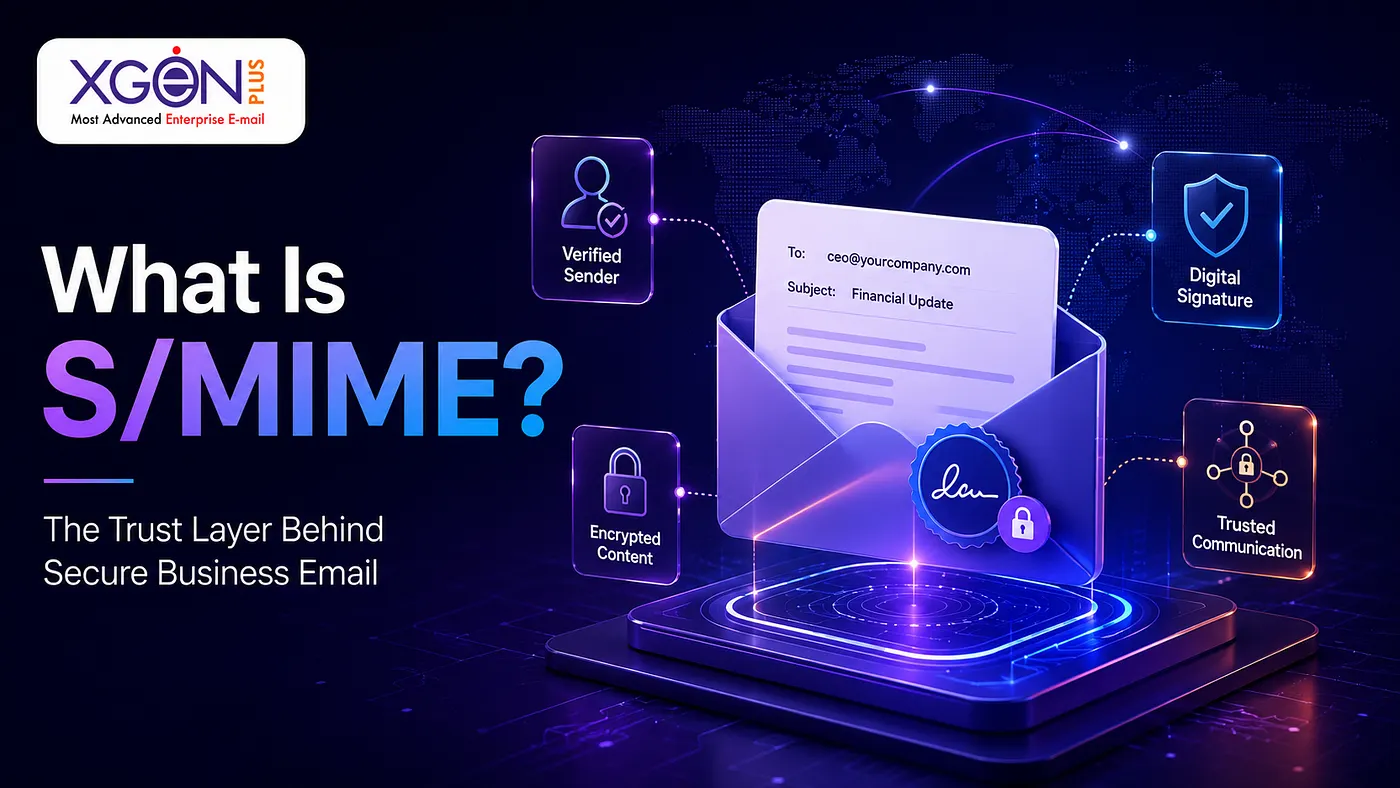
Learn how S/MIME encryption, digital signatures, and Public Key Infrastructure (PKI) secure business email communication. Discover how S/MIME helps prevent Business Email Compromise (BEC), email spoofing, and cyber threats with enterprise-grade email security.
Email remains the most important channel for business communication, yet it is also one of the most targeted attack vectors for cybercriminals. As organizations face increasing threats such asBusiness Email Compromise (BEC), phishing, spoofing, and data breaches, traditional email security measures are no longer enough.
S/MIME (Secure/Multipurpose Internet Mail Extensions) is a widely adopted email security standard that encrypts email content and digitally signs messages to verify sender identity. For businesses handling confidential information, S/MIME provides a critical layer of protection that helps ensure secure, authenticated, and tamper-proof email communication.
In simple terms, S/MIME enables organizations to send encrypted emails that only intended recipients can read while allowing recipients to verify that the message genuinely came from the claimed sender.
Understanding S/MIME: The Foundation of Secure Email Communication
S/MIME is an email security protocol that uses cryptography and Public Key Infrastructure (PKI) to encrypt email messages and digitally sign them. This ensures confidentiality, authenticity, integrity, and trust in email communication.
What Does S/MIME Stand For?
S/MIME stands for:
Secure/Multipurpose Internet Mail Extensions
It extends the standard MIME format used in email systems by adding advanced cryptographic security features.
S/MIME allows users to:
Encrypt email content
Digitally sign messages
Verify sender identity
Prevent message tampering
Protect sensitive attachments
Today, S/MIME is supported by most enterprise email platforms and is considered a best practice for organizations that exchange confidential information.
Key Takeaway
S/MIME transforms ordinary email into a secure communication channel by combining encryption and digital signatures.
How S/MIME Works
S/MIME relies on Public Key Infrastructure (PKI), digital certificates, and cryptographic key pairs to secure email communication. Encryption protects message confidentiality, while digital signatures verify authenticity.
The email is digitally signed using the CFO's private key.
The recipient verifies the signature using the CFO's public key.
The message is encrypted using the recipient's public key.
Only the recipient's private key can decrypt the email.
This process ensures secure email communication from end to end.
Key Takeaway
PKI is the trust framework that makes S/MIME secure and scalable.
Why Businesses Need Encrypted Email Communication
Businesses need encrypted email communication because email remains the primary target for cyberattacks, data theft, espionage, compliance violations, and Business Email Compromise attacks.
The Rising Threat of Business Email Compromise
Business Email Compromise (BEC) is among the most costly cybercrimes worldwide.
BEC attacks typically involve:
CEO fraud
Vendor impersonation
Invoice scams
Payroll fraud
Executive account takeover
Attackers often exploit trust rather than technical vulnerabilities.
Real-World Scenario
A finance manager receives an email appearing to come from the CEO requesting an urgent wire transfer.
Without digital signatures:
The email appears legitimate.
Employees may comply.
Financial losses can be substantial.
With S/MIME:
Recipients can verify sender authenticity.
Spoofed messages become easier to detect.
Key Takeaway
S/MIME significantly reduces risks associated with Business Email Compromise and email impersonation.
Core Benefits of S/MIME for Organizations
S/MIME provides confidentiality, authenticity, integrity, compliance support, and trust, making it one of the most effective enterprise email security technologies available.
1. Email Encryption
Encryption ensures only intended recipients can read the content.
Protected data may include:
Financial reports
Customer records
Contracts
Intellectual property
Government communications
Practical Application
Legal firms exchanging confidential agreements can prevent unauthorized access even if messages are intercepted.
2. Digital Signatures
Digital signatures verify:
Sender identity
Message authenticity
Message integrity
Recipients immediately know whether an email has been altered.
Practical Application
Executives can securely authorize sensitive transactions.
3. Data Integrity
S/MIME detects unauthorized modifications.
If even a single character changes:
Signature validation fails.
Recipients receive a warning.
Practical Application
Organizations can ensure contractual and legal communications remain unchanged.
4. Regulatory Compliance
Many industries require secure communication.
Examples include:
Healthcare
Government
Banking
Insurance
Defense
S/MIME helps support compliance requirements involving data confidentiality and integrity.
5. Enhanced Brand Trust
Customers trust organizations that prioritize security.
Secure communication demonstrates:
Professionalism
Security maturity
Commitment to privacy
Key Takeaway
S/MIME protects data while strengthening organizational credibility.
S/MIME vs Traditional Email Security
Traditional email security tools protect email servers and gateways, while S/MIME secures the actual message content itself.
Feature
Traditional Email
S/MIME
Encryption
Limited
Yes
Digital Signature
No
Yes
Identity Verification
Limited
Strong
Message Integrity
No
Yes
End-to-End Protection
No
Yes
Anti-Spoofing Support
Limited
Strong
Why This Difference Matters
Spam filters and firewalls protect networks.
S/MIME protects the message itself.
Even if an email is intercepted:
Content remains unreadable.
Identity remains verifiable.
Key Takeaway
S/MIME provides security at the message level rather than only at the network level.
Industries That Benefit Most from S/MIME
Organizations handling sensitive information derive the greatest value from encrypted email communication.
Government Agencies
Government departments exchange:
Citizen records
National security information
Policy documents
S/MIME helps protect sensitive communications.
Healthcare Organizations
Healthcare providers must secure:
Medical records
Patient data
Insurance information
Encrypted email reduces privacy risks.
Financial Institutions
Banks and financial institutions exchange:
Account information
Loan documents
Investment reports
S/MIME strengthens trust and compliance.
Legal Firms
Law firms regularly handle:
Contracts
Litigation documents
Confidential client information
Digital signatures provide additional evidentiary value.
SMEs and Startups
Smaller organizations are increasingly targeted by cybercriminals.
S/MIME provides enterprise-grade security without requiring massive cybersecurity budgets.
Key Takeaway
Every organization exchanging confidential information can benefit from S/MIME protection.
Common Mistakes Organizations Make
Many businesses invest in email platforms but overlook encryption, certificate management, user education, and identity verification.
Mistake 1: Relying Solely on Spam Filters
Spam filters cannot stop every impersonation attempt.
Organizations need sender authentication.
Mistake 2: Ignoring Digital Signatures
Without signatures:
Employees cannot verify identities.
Trust becomes vulnerable to spoofing.
Mistake 3: Lack of Security Awareness Training
Technology alone is insufficient.
Employees should understand:
Signature indicators
Certificate warnings
Phishing red flags
Mistake 4: Delayed Certificate Renewal
Expired certificates create trust issues and communication disruptions.
Key Takeaway
People, processes, and technology must work together for effective email security.
Best Practices for Implementing S/MIME
Successful S/MIME deployments require strong certificate management, employee training, policy enforcement, and integration with enterprise email platforms.
Recommended Best Practices
Establish a Certificate Management Policy
Define:
Issuance procedures
Renewal schedules
Revocation processes
Train Employees
Educate users to:
Verify signatures
Recognize certificate warnings
Report suspicious messages
Encrypt Sensitive Communications
Create policies identifying data that must always be encrypted.
Monitor Security Events
Track:
Certificate failures
Authentication anomalies
Suspicious communication patterns
Conduct Regular Audits
Periodic reviews ensure compliance and operational effectiveness.
Key Takeaway
Technology implementation should be accompanied by governance and user education.
Why Modern Organizations Need an Enterprise Email Solution
Modern organizations need an Enterprise Email Solution that combines encryption, identity verification, collaboration, compliance, and advanced security controls.
Email is no longer just a messaging tool.
It has become:
A business workflow platform
A collaboration environment
A compliance requirement
A cybersecurity asset
Organizations should seek secure business email solutions that provide:
S/MIME support
Anti-phishing protection
Data sovereignty controls
Administrative visibility
Scalability
Key Takeaway
The future of business communication requires a security-first email infrastructure.
How XgenPlus Helps Organizations Secure Email Communication
XgenPlus provides secure business email solutions designed to help organizations protect communications, strengthen trust, and support enterprise-grade security requirements.
Organizations evaluating modern email platforms should prioritize:
Secure communication
Data protection
Identity verification
Scalability
Compliance readiness
XgenPlus empowers businesses with a robust Enterprise Email Solution that supports secure communication practices while helping organizations strengthen their email security posture against evolving cyber threats.
Whether serving enterprises, government organizations, SMEs, startups, or regulated industries, XgenPlus helps organizations establish trusted digital communication environments.
Key Takeaways
S/MIME is a globally recognized standard for encrypted email communication.
It uses Public Key Infrastructure (PKI) and digital certificates.
S/MIME protects confidentiality, authenticity, and message integrity.
Business Email Compromise remains one of the biggest threats to organizations.
Digital signatures help prevent impersonation and spoofing attacks.
Secure business email solutions should include encryption and identity verification capabilities.
Government agencies, healthcare providers, financial institutions, legal firms, SMEs, and startups can all benefit from S/MIME.
Enterprise Email Solution providers should support security, compliance, and scalability requirements.
Frequently Asked Questions (FAQs)
What is S/MIME used for?
S/MIME is used to encrypt email messages and digitally sign communications to verify sender identity and ensure message integrity.
Is S/MIME better than standard email encryption?
S/MIME provides stronger identity verification and digital signature capabilities, making it more suitable for enterprise environments.
How does S/MIME prevent Business Email Compromise?
Digital signatures allow recipients to verify sender authenticity, making impersonation and spoofing attacks significantly more difficult.
Does S/MIME require Public Key Infrastructure?
Yes. S/MIME relies on Public Key Infrastructure (PKI) to manage certificates, public keys, and private keys.
Which industries need S/MIME the most?
Healthcare, finance, government, legal, defense, and any industry handling sensitive information benefit significantly from S/MIME.
Can small businesses use S/MIME?
Yes. SMEs and startups can implement S/MIME to gain enterprise-grade email security and improve customer trust.
Is S/MIME compatible with enterprise email platforms?
Most major enterprise email platforms support S/MIME integration.
What is the difference between encryption and digital signatures?
Encryption protects confidentiality, while digital signatures verify identity and ensure message integrity.
Conclusion
As cyber threats continue to evolve, organizations can no longer rely solely on traditional email defenses. Business Email Compromise, phishing attacks, and email spoofing remain major risks for enterprises, government agencies, startups, and SMEs alike.
S/MIME provides a proven and trusted framework for secure email communication by combining encryption, digital signatures, and Public Key Infrastructure. It helps organizations protect sensitive information, verify identities, maintain compliance, and build trust across every interaction.
For businesses seeking a secure future, encrypted email communication is no longer optional it is a strategic necessity.
Ready to Strengthen Your Email Security?
Protect your organization from Business Email Compromise, email spoofing, and data breaches with a modern, security-first approach to communication.
Working with a trademark attorney California businesses trust can mean the difference between a protected brand and a costly legal dispute. Adams Law Office can help.