Share:

VR Training: Benefits, Use Cases and ROI for Industry
Explore how virtual reality training reduces onboarding time, eliminates operational risks, and delivers measurable ROI across manufacturing, logistics, and complex spatial environments.
Experience Centre Design: The Complete B2B Playbook
When enterprise organizations seek to validate high-value digital investments, traditional slide presentations and standard sales calls often fall short. Industrial and commercial buyers require tangible, risk-free evidence of technological capability before committing capital budgets.
Modern corporate facilities designed for interactive engagement bridge this gap by turning complex technical systems into hands-on demonstrations. Forward-thinking technology consultancies like ViitorX demonstrate how physical architecture and digital simulations combine to turn abstract offerings into measurable business outcomes.
A well-engineered facility moves enterprise decision-makers from passive observation to direct procedural engagement. Within the technology and industrial sectors, interactive facilities serve as dedicated environments for high-impact workforce enablement.
When integrated into modern facilities, VR Training and spatial computing establish a controlled setting where prospective clients, partners, and internal operators can explore digital twins and automated workflows. The sections below outline the core design principles, technological integrations, operational frameworks, and business metrics that define an enterprise-grade briefing and simulation space.
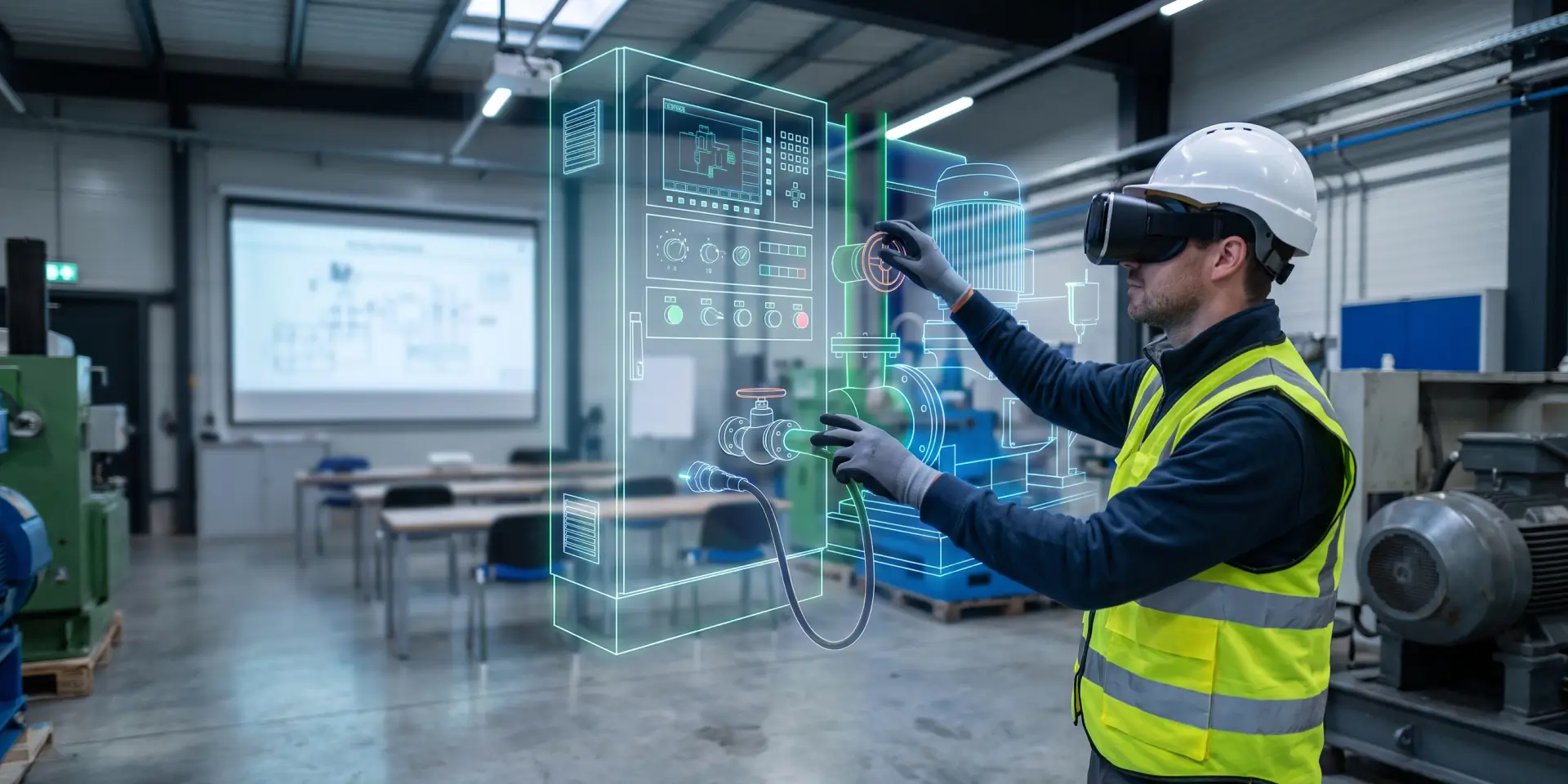
Strategic Value of VR Training in Enterprise Briefing Spaces
Integrating advanced simulations into a client-facing or corporate facility transforms how organizations communicate value. Rather than discussing complex technical workflows in theory, teams run live operations inside dedicated virtual environments. Deploying VR Training across client demonstrations and workforce programs delivers several operational advantages:
· Elimination of Operational Downtime: Complex production sequences can be explored and tested on 1:1 virtual models while physical assembly lines and plant machinery remain active.
· Rapid Consensus Across Buyer Teams: Both technical evaluators (architects, engineers) and executive sponsors (finance, operations) validate capabilities simultaneously within a single session.
· Accelerated Competence Acquisition: Hands-on procedural interaction reduces learning curves by establishing muscle memory before personnel handle live equipment.
· Standardized Knowledge Transfer: Operational workflows are delivered with identical precision across distributed facilities, removing regional discrepancies in procedural execution.
By moving away from static diagrams, organizations allow enterprise buyers to experience complex software, automated robotics, and industrial systems in action.
Architectural Pillars of Enterprise VR and Spatial Design
Constructing an interactive corporate center requires deliberate spatial planning. Displays, sensor networks, and interactive stations must serve a clear narrative purpose rather than acting as decorative technology.
1. Narrative-Driven Spatial Flow
Visitors should move through a logical sequence that supports technical discovery:
· The Orientation Zone: An ambient entry space that outlines industry-wide operational challenges and introduces the organizational context.
· The Technical Discovery Lab: Hands-on simulation stations where visitors explore software mechanics, infrastructure maps, and virtual models.
· The Immersion Theater: A central space supporting Enterprise VR simulations, allowing teams to test operational environments under realistic conditions.
· The Executive Briefing Suite: A collaborative conference setting equipped for roadmapping, pilot planning, and commercial agreements.
2. Physical and Digital Convergence
Share:
More in Technology
View category7 Reasons Businesses Trust Law Certis for Trademark Registration Services
Discover 7 reasons businesses choose Law Certis for trademark registration, including expert guidance, trademark search, online filing, objection handling, transparent pricing, and application tracking.
READ ARTICLEIdentity and Access Management (IAM): Strengthening Enterprise Security and Access Control
Identity and Access Management (IAM) is a critical cybersecurity framework that enables organizations to manage digital identities and control access to enterprise resources.
MT5 clone solution for forex broker and trading companies
Explore how MT5 Clone Script solutions help forex brokers and trading firms build customizable trading platforms with advanced charts, order management, automation, liquidity integration, and security controls. Learn which features and technologies matter when planning a reliable trading platform for long-term growth.
READ ARTICLE