
Share:

Unpacking the Difference Between a Survey and Questionnaire: Why It Matters for B2C
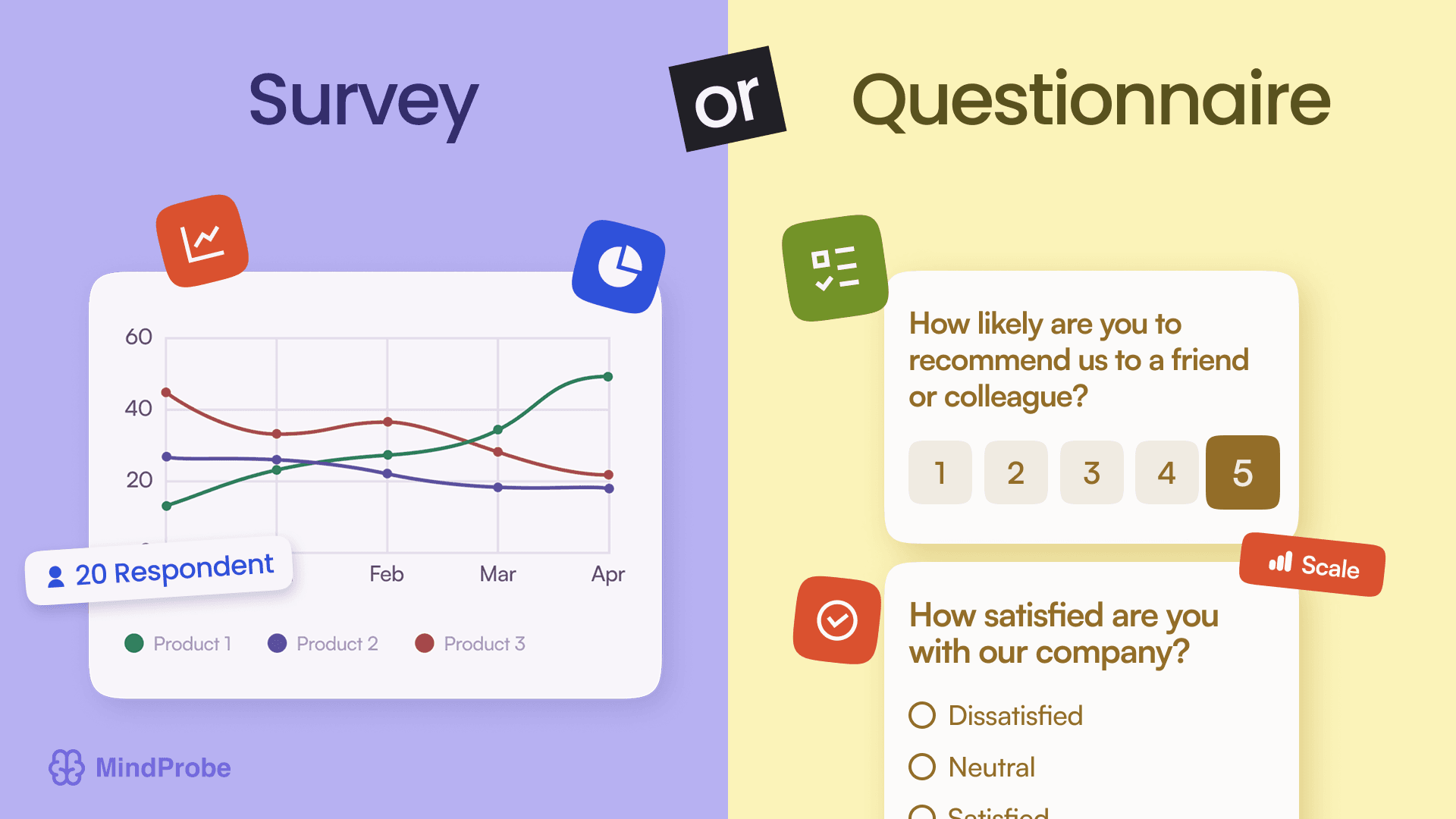
This guide unpacks the difference between surveys and questionnaires, explaining why it matters for B2C companies seeking genuine insights. We’ll examine key definitions, break down core differences, and highlight how to choose the right method for specific objectives
1. Introduction
In today’s competitive B2C market, understanding your customers and employees is more crucial than ever. Whether you're gauging customer satisfaction, launching a new product, or measuring employee engagement, collecting feedback is the bedrock of informed decision-making. Yet many in marketing or product management circles use the terms “survey” and “questionnaire” interchangeably, as though they’re synonymous.
Although both involve asking questions, a closer look reveals that “survey” and “questionnaire” each offer distinct advantages, focus areas, and design principles. Pinpointing these nuances can affect how you collect, analyse, and act on data - and ultimately shape your ability to meet ever-changing consumer demands.
This guide unpacks the difference between surveys and questionnaires, explaining why it matters for B2C companies seeking genuine insights. We’ll examine key definitions, break down core differences, and highlight how to choose the right method for specific objectives - be it capturing employee feedback or mapping consumer buying behaviours. Whether you’re a marketing manager or a product lead, clarity on these fundamentals can help you gather higher-quality data and drive better decisions.
2. What Is a Survey?
At its core, a survey is a systematic method of collecting information from a defined group of people, often on a larger scale. Typically, surveys aim for statistical relevance, employing features like sampling, controlled question order, and randomisation. Although surveys often contain questionnaires (the list of questions), the term “survey” generally implies additional rigour in terms of how data is collected, analysed, and extrapolated.
When to Use a Survey
1. Large-Scale Research
- If you need representative data from hundreds or thousands of respondents, such as measuring brand awareness or estimating the total market for a new product.
2. Statistical Significance
- Surveys often require sample-size calculations, confidence intervals, and margin-of-error considerations.
3. Comparative Studies
- In brand tracking, you might repeat the same survey over time to observe trends or to benchmark your performance against competitors.
Common Types of Surveys
- Customer Satisfaction Surveys: Gauging overall sentiment and identifying improvement areas.
- Employee Engagement Surveys: Gathering internal feedback for HR and management insights.
- Market Research Surveys: Exploring consumer buying habits, product preferences, and brand perceptions.
- Net Promoter Surveys: Measuring how likely customers are to recommend your brand.
Key Insight: Surveys typically produce data suitable for statistical testing (e.g., correlation, factor analysis), enabling deeper analysis that can guide broad strategic decisions.
3. What Is a Questionnaire?
A questionnaire is the instrument itself - essentially, the structured set of questions. It can be as formal or informal as you like, ranging from short, casual queries to more detailed forms. However, not every questionnaire is part of a formal survey; sometimes, a questionnaire exists simply as a quick feedback form, collecting immediate, less structured insights.
When to Use a Questionnaire
Share:
More in Marketing
View categoryWebshark: A New Approach to Enterprise Technology and Digital Innovation
Webshark: A New Approach to Enterprise Technology and Digital Innovation
READ ARTICLEModern Silver Mangalsutra Designs for the Contemporary Indian Woman
Explore modern silver mangalsutra designs for the contemporary Indian woman, from minimalist pendants and geometric styles to traditional black-beaded necklaces and statement designs. Discover everyday styling ideas, online buying tips, and simple care advice to help you choose a mangalsutra that reflects your personal style and lifestyle.
READ ARTICLETop Digital Marketing Institute with Practical Projects and Expert Guidance
DIGI Brooks Academy is a reputable training institute based in India that offers a wide range of training courses like digital marketing, content writing, PPC training, and many more. We have a team of professionals who have years of experience. Contact us now!
READ ARTICLE