
Share:

The Table Tennis Size Dimensions and Rules Worth Knowing Before You Buy.
Learn the official table tennis table size, room clearance, net height, bounce test, and maintenance tips. Explore ARGMAC's Bounzai luxury table tennis table.
Bounce is the whole product. A table tennis table is a flat plane held rigid at a fixed height, and everything else on it exists to keep that plane honest. If the ball comes off the far corner differently from the near one, the game stops rewarding skill and starts rewarding luck. Nobody enjoys that for long.
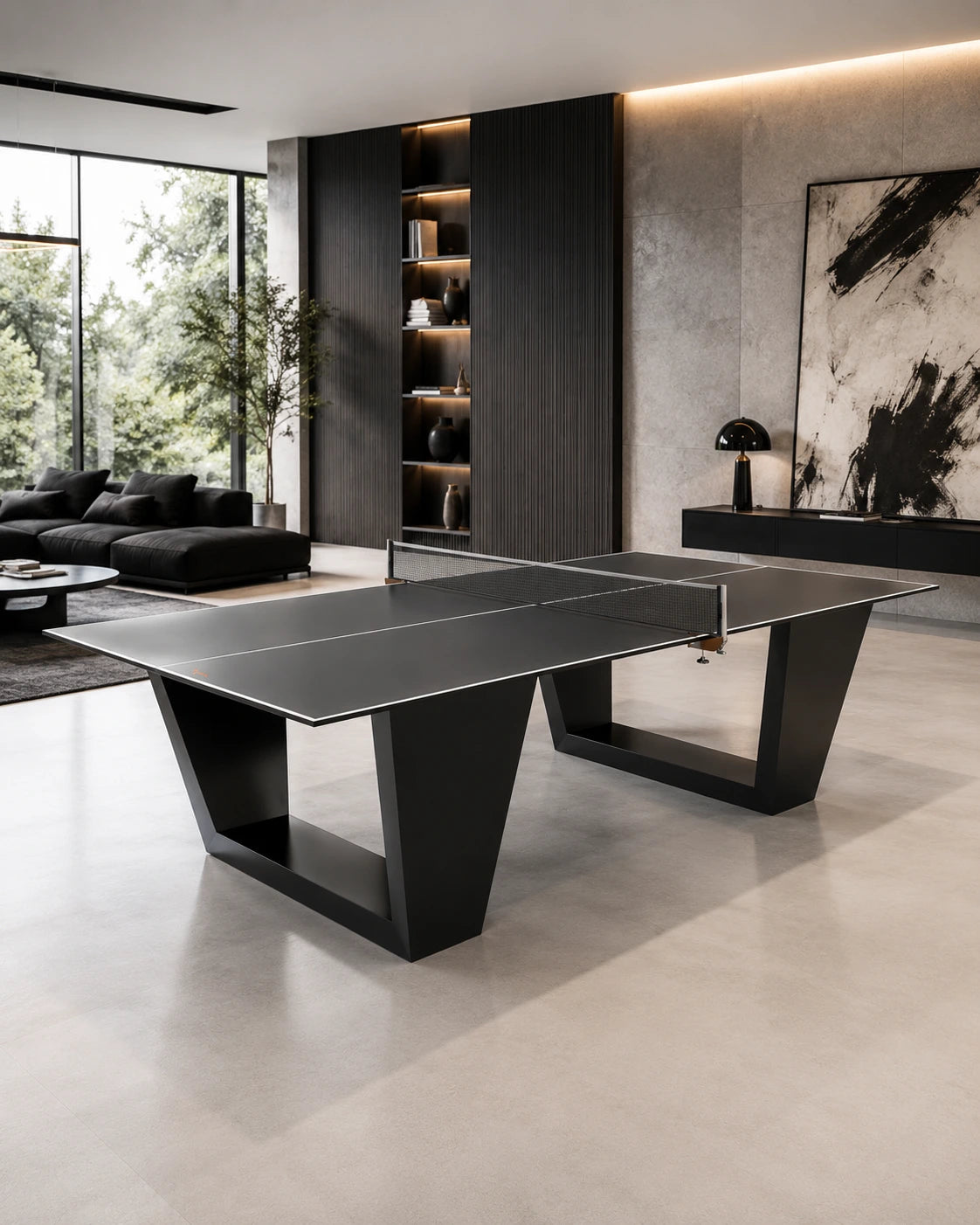
Which is why the numbers are worth learning before you shop. The standard table tennis size dimensions are not a suggestion from a governing body that only matters at tournaments; they are the reason the game feels right. ARGMAC's Bounzai is built to those numbers, at 9 ft by 5 ft, 150 kg, and finished in PU paint over a solid wood base with a powder-coated MS frame underneath.
The Table Tennis Size Dimensions That Decide Everything
Three measurements define the game, and they have not changed in decades. Get any one of them wrong and the play changes noticeably, even if the table looks correct in a photograph.
Table, Net, and Ball
The playing surface is 2.74 m long, 1.525 m wide, and sits 76 cm off the floor. In feet, that is the familiar 9 by 5, at two and a half feet high. Anything shorter is a mid-size or compact table, which is fine for children but plays a different game.
The net stands 15.25 cm high and extends the same distance past each side edge. That overhang is what makes wide angles playable, and cheap sets often skip it.
The ball is 40 mm and plastic. There is a simple test for a good surface: drop a ball from 30 cm, and it should rebound around 23 cm. Try it in four different spots on the table. If the corners give you a noticeably different result from the middle, walk away.
What Makes a Surface Bounce True
The top and the frame together make consistency. The top is thick and evenly pressed so it retains its flatness, and a rigid frame keeps the whole thing from flexing when someone leans in for a smash.
Most of what you need to know is the weight. The Bounzai doesn’t sway or wobble mid-rally at 150 kg, and a table that doesn’t move is a table that plays the same on the fiftieth game as it did on the first.
The Tennis Table Rules That Matter at Home
Nobody needs the full rulebook for a Sunday evening. But a handful of tennis table rules settle almost every argument that comes up in a living room.
Games are played to 11 points, and you must win by two. Serve changes every two points, not every five, which is the single most common mistake in casual play.
The server itself has a rule people forget. The ball must sit on an open palm, be tossed at least 16 cm straight up, and be struck on the way down, behind the end line. No hiding it, no spinning it off the fingers. In singles you can serve anywhere on the opposite side. Only in doubles does the diagonal rule apply.
Edge balls count. Side balls do not. That one distinction ends more disputes than any other, so it is worth settling before the first point rather than during it.
Fitting the Table Tennis Size Dimensions Into Your Room
Clearance, Ceiling, and Floor
Allow at least 5 m by 3 m of clear floor for comfortable recreational play, which is roughly 16 ft by 10 ft. Competition venues use far more, but at home this is the practical floor. Less than that, and every deep shot ends with somebody backing into a wall.
Ceiling height matters more than people expect. High lobs need headroom, so anything under about 2.6 m will clip the top of a defensive rally.
The floor matters too. Hard tile sends a stray ball rolling across the house, and a rug under one end changes how players plant their feet. Even flooring on both sides keeps things fair.
Indoor, Semi-Outdoor, and Everyday Care
Share:
More in Business
View category11 Best Websites to Buy Yelp Accounts – Reliable Options for Businesses and Marketers
Looking to buy Yelp accounts? Purchase aged, trusted Yelp profiles instantly. Perfect for businesses wanting more reviews and better search rankings. Safe & reliable service. https://buymailaccounts.com/service/buy-yelp-accounts/
READ ARTICLE11 Best Websites to Buy LinkedIn Accounts – Secure, Aged & Ready-to-Use Profiles
Looking to Buy LinkedIn Accounts? Premium, high-quality accounts available with authentic activity. Fast delivery & 24/7 support. Start scaling now! https://buymailaccounts.com/service/buy-linkedin-accounts
READ ARTICLE11 Best Websites to Buy Aged GitHub Accounts – Secure, Verified Profiles with Real History
Looking to buy aged GitHub accounts? Get fully aged, active GitHub profiles with commits, stars & contributions. Fast, secure delivery and best prices available now. https://buymailaccounts.com/service/buy-aged-github-accounts
READ ARTICLE11 Best Websites to Buy Old GitHub Accounts – Reliable Aged Profiles for Developers & Marketers
Looking to buy old GitHub accounts? Choose premium aged accounts with real activity. Cheap prices, fast delivery & 100% safe. Buy today and boost your projects! https://buymailaccounts.com/service/buy-old-github-accounts
READ ARTICLE