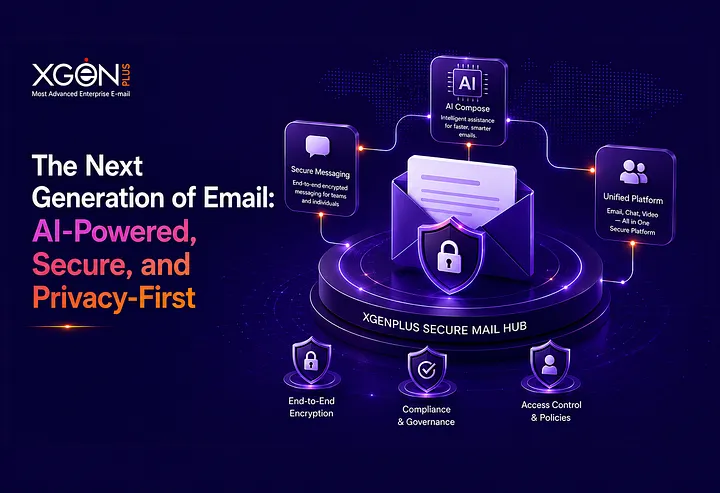
Discover how AI-powered, secure, and privacy-first email enhances productivity, protects data, prevents phishing, and strengthens compliance.
Introduction
Email remains the backbone of business communication, but the traditional email systems that many organizations rely on were designed for a very different era. Today, businesses face sophisticated cyber threats, increasing compliance requirements, growing concerns around data privacy, and the need for greater productivity.
The next generation of email combines artificial intelligence, advanced security controls, privacy-first architecture, and centralized management to create a communication platform built for modern enterprises. These solutions go beyond sending and receiving messages—they help prevent cyberattacks, protect sensitive information, improve employee productivity, and support regulatory compliance.
For CIOs, CTOs, IT managers, government organizations, SMEs, and business leaders, adopting an AI-powered, secure, and privacy-first email platform is becoming a strategic necessity rather than a technology upgrade.
Why Is Email Evolving?
Email is evolving because cyber threats, regulatory requirements, remote work, and AI-driven productivity demands have transformed how organizations communicate and protect information.
Email remains one of the most targeted attack vectors in the digital world. At the same time, employees expect smarter tools that reduce manual work and improve communication efficiency.
A government agency handling citizen records cannot rely solely on basic email filtering. It requires encryption, identity verification, audit logs, and AI-powered threat prevention to protect sensitive communications.
Key Takeaway
The future of email is no longer about communication alone; it is about secure, intelligent, compliant digital collaboration.
What Is an AI-Powered Email System?
An AI-powered email system uses artificial intelligence to enhance productivity, improve security, automate workflows, and help users create more effective communications.
Traditional email systems are reactive. AI-powered platforms are proactive.
Core AI Capabilities
AI-Assisted Email Composition
AI can help users:
Draft emails faster
Improve grammar and tone
Suggest responses
Summarize long conversations
Translate messages
Generate professional communications
Intelligent Prioritization
AI identifies:
High-priority emails
Time-sensitive messages
Follow-up requirements
Important contacts
Automated Workflows
Examples include:
Ticket generation
Approval routing
Document classification
Compliance tagging
Security Intelligence
AI analyzes:
Sender behavior
Communication patterns
Suspicious attachments
Unusual login activity
Example
A finance manager receives hundreds of emails daily. AI automatically highlights vendor invoices, flags suspicious payment requests, drafts responses, and categorizes communications.
Key Takeaway
AI transforms email from a passive inbox into an intelligent productivity and security platform.
Why Data Privacy Is Now a Business Priority
Data privacy has become essential because organizations must protect sensitive information, maintain customer trust, and comply with evolving regulations.
Data privacy is no longer just a legal concern. It is a competitive advantage.
Organizations manage sensitive information such as:
Customer records
Financial data
Intellectual property
Healthcare information
Government documents
Employee information
Failure to protect data can lead to:
Financial losses
Regulatory penalties
Reputation damage
Customer attrition
Privacy-First Email Architecture
A privacy-first email platform typically includes:
Data Ownership Controls
Organizations retain ownership and control over their information.
Minimal Data Exposure
Only authorized individuals can access sensitive communications.
Secure Storage
Data is protected during:
Transmission
Processing
Archiving
Privacy-by-Design
Security and privacy controls are built into the platform rather than added later.
Key Takeaway
Data privacy is now a boardroom-level issue that directly impacts trust, compliance, and business continuity.
Understanding Modern Business Email Security
Modern business email security combines AI, authentication protocols, encryption, threat detection, and centralized management to protect communications from evolving cyber threats.
Email remains the primary attack surface for cybercriminals.
Reduce administrative complexity and support requirements.
Example
A multinational enterprise can enforce encryption, authentication, retention policies, and security controls across all locations from one centralized management platform.
Key Takeaway
Centralized management simplifies governance while improving security and compliance.
AI-Powered Email vs Traditional Email Systems
AI-powered email systems provide enhanced security, productivity, automation, and compliance capabilities that traditional email platforms often lack.
Feature
Traditional Email
AI-Powered Email
Email Drafting
Manual
AI-Assisted
Threat Detection
Rule-Based
AI-Driven
Phishing Protection
Limited
Advanced
Workflow Automation
Minimal
Extensive
Compliance Monitoring
Manual
Automated
Prioritization
User-Driven
Intelligent
Security Analysis
Reactive
Predictive
Productivity
Moderate
High
Key Takeaway
AI-powered email platforms deliver measurable improvements in both operational efficiency and cyber resilience.
Best Practices for Deploying a Secure, Privacy-First Email Platform
Successful deployments require a combination of security controls, user training, governance policies, and continuous monitoring.
Recommended Best Practices
Enable Email Encryption
Protect sensitive communications by default.
Deploy S/MIME Certificates
Verify identities and secure messages.
Implement DMARC, SPF, and DKIM
Prevent spoofing and phishing attacks.
Use Multi-Factor Authentication
Reduce account compromise risks.
Train Employees Regularly
Human error remains a major security challenge.
Monitor Threat Intelligence
Stay ahead of emerging attack techniques.
Conduct Security Audits
Validate controls and identify vulnerabilities.
Centralize Administration
Improve governance and policy enforcement.
Key Takeaway
Technology alone cannot secure email. Security requires people, processes, and platforms working together.
Case Study: Modernizing Enterprise Email Security
Organizations that modernize email security often experience fewer phishing incidents, stronger compliance outcomes, and improved employee productivity.
Scenario
A mid-sized financial services company faced:
Increasing phishing attempts
Regulatory compliance pressure
Growing email management complexity
Solution
The company implemented:
AI-powered email security
S/MIME certificates
Email encryption
DMARC, SPF, and DKIM
Centralized email management
Results
Reduced phishing exposure
Improved regulatory compliance
Faster email administration
Better user productivity
Enhanced customer trust
Key Takeaway
Modern email platforms provide measurable business and security benefits.
Expert Insights: What Enterprise Leaders Should Prioritize
Enterprise leaders should prioritize security, privacy, compliance, and AI-driven productivity when evaluating email platforms.
Key evaluation criteria include:
Data privacy architecture
Encryption capabilities
AI-assisted productivity tools
Regulatory compliance support
Authentication standards
Centralized management
Scalability
Vendor trustworthiness
Future-ready organizations view email as a strategic infrastructure rather than a commodity service.
Key Takeaways
Email remains the most important business communication channel.
AI-assisted email composition improves productivity and communication quality.
Data privacy is now a critical business requirement.
Business email compromise continues to be a major enterprise threat.
Email encryption protects sensitive information throughout its lifecycle.
S/MIME certificates strengthen trust through authentication and encryption.
DMARC, SPF, and DKIM help prevent phishing and domain impersonation.
HIPAA-compliant email is essential for healthcare organizations.
Centralized email management improves governance and operational efficiency.
AI-powered email platforms deliver stronger security, automation, and compliance outcomes.
Frequently Asked Questions (FAQs)
What is an AI-powered email platform?
An AI-powered email platform uses artificial intelligence to improve productivity, automate workflows, enhance security, and assist with email creation and management.
How does AI-assisted email composition benefit organizations?
It helps employees write emails faster, improve communication quality, reduce errors, and increase productivity.
Why is business email compromise dangerous?
Business email compromise attacks often impersonate executives or trusted contacts to trick employees into transferring money or sharing sensitive information.
What is the purpose of email encryption?
Email encryption protects messages from unauthorized access during transmission and storage.
How do S/MIME certificates improve email security?
They provide encryption, digital signatures, sender verification, and message integrity protection.
What are DMARC, SPF, and DKIM?
They are email authentication technologies that help prevent spoofing, phishing, and domain impersonation attacks.
What makes an email solution HIPAA-compliant?
HIPAA-compliant email includes encryption, access controls, audit logging, authentication, and secure handling of protected health information.
Why is centralized email management important?
It allows IT teams to manage users, security policies, compliance requirements, and email infrastructure from a single platform.
Can AI help stop phishing attacks?
Yes. AI can analyze behavioral patterns, detect anomalies, identify suspicious messages, and help prevent phishing attempts before they reach users.
Conclusion
The future of business communication is being shaped by three critical forces: artificial intelligence, cybersecurity, and data privacy. Organizations can no longer afford to rely on legacy email systems that were not designed for today's threat landscape, regulatory requirements, or productivity expectations.
AI-powered, secure, and privacy-first email platforms offer a comprehensive solution by combining intelligent automation, advanced threat protection, encryption, authentication, compliance support, and centralized management. These capabilities not only reduce risk but also enable organizations to communicate more efficiently and confidently.
As cyber threats continue to evolve and privacy regulations become increasingly stringent, investing in next-generation email infrastructure is a strategic decision that directly impacts security, compliance, operational efficiency, and long-term business success.
Ready to Future-Proof Your Business Email?
Discover howXgenPlus helps organizations implement secure business email solutions with advanced security, privacy-first architecture, AI-powered capabilities, email encryption, S/MIME support, and centralized email management.
Contact the XGenPlus team today to explore a modern email platform built for security, compliance, and the future of enterprise communication.
Running an event in Gold Coast? Learn how to spot risks early, hire licensed guards, and work smoothly with local emergency services. Book your guard services early!
Planning car shipping from california to virginia is easier with a trusted auto transport provider. Whether you're relocating, purchasing a vehicle, or moving for work, professional auto transport services offer a safe and efficient way to transport your car across the country. Ship A1 Auto Transport provides reliable door-to-door vehicle shipping, open and enclosed transport, and fully insured nationwide delivery. Our experienced carriers prioritize timely pickup, secure handling, and customer satisfaction throughout the shipping process. We offer competitive pricing, flexible scheduling, and dependable service for sedans, SUVs, trucks, motorcycles, and luxury vehicles. Request a personalized car shipping quote today and enjoy a hassle-free transportation experience backed by industry expertise and professional support from pickup to final delivery.
Explore premium 2BHK flats in Datta Mandir Road Wakad at Platinum Royale. Enjoy modern amenities, excellent connectivity, and a smart investment opportunity.