
Share:

The Complete Likert Scale Guide: Examples, Tips and Best Practices
Every list of Likert scale examples traces back to one monograph. In 1932 Rensis Likert, a Columbia doctoral student, published "A Technique for the Measurement of Attitudes" in the Archives of Psychology, number 140 (Wellcome Collection record). The leading method then, Louis Thurstone's, needed panels of judges to sort statements first. Likert dropped the judges. Respondents simply marked each statement on five steps, from "strongly approve" through "undecided" to "strongly disapprove", and the steps were scored 1 to 5.
Key Takeaways
- A Likert item is one statement with ordered response anchors. A Likert scale is several items summed or averaged to measure one attitude.
- Five points suit most surveys, especially on mobile. Seven points add precision for expert or repeat audiences.
- Label every point, keep the midpoint genuinely neutral and match the anchor set to the question.
- Report distributions, medians and top-2-box first; means suit multi-item scales.
- Chart results as a diverging stacked bar.
What is a Likert scale?
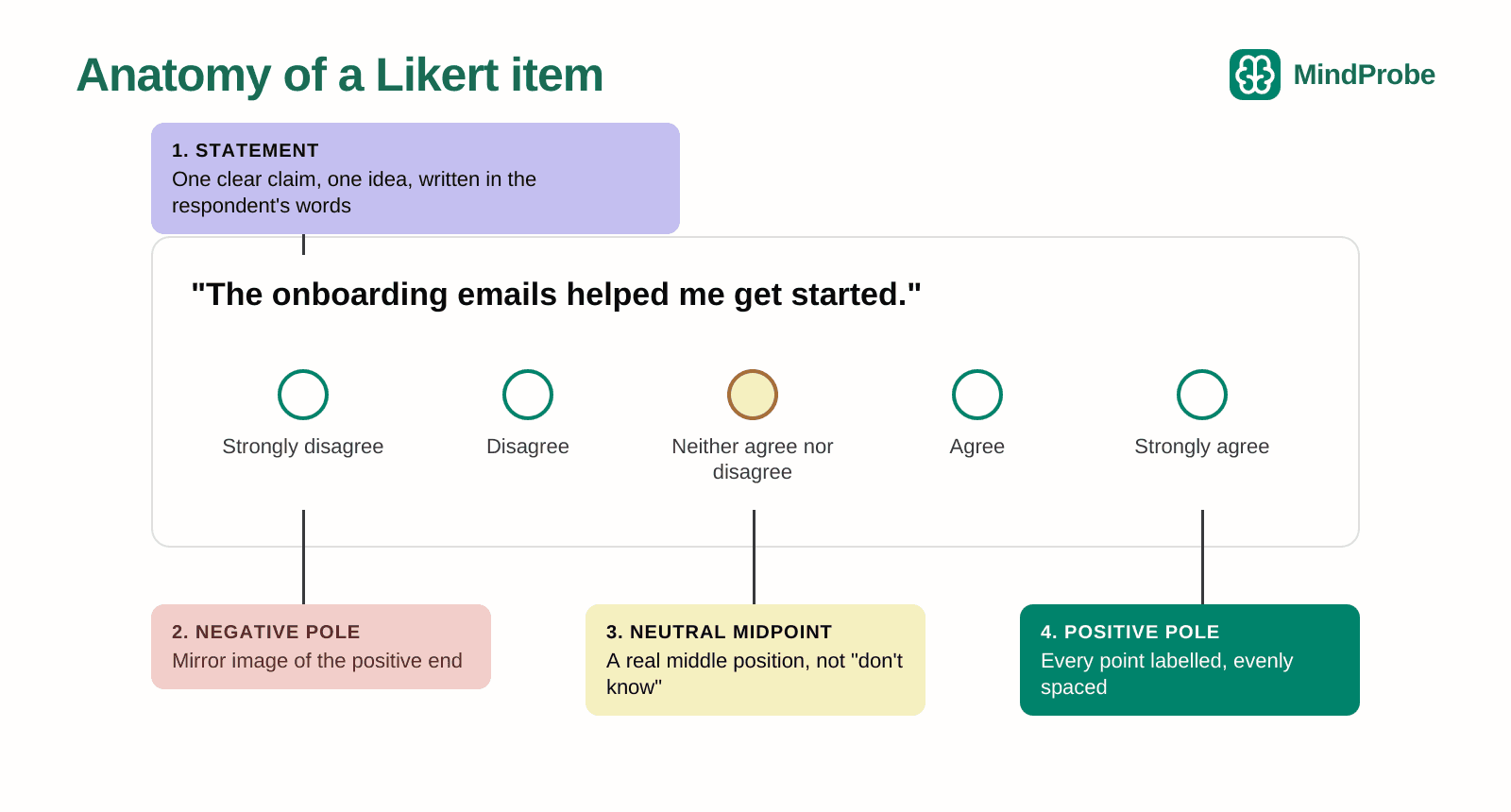
A Likert scale is a set of statements, each answered on the same ordered agreement scale, whose scores are combined to measure one underlying attitude, such as trust in a brand or satisfaction with a service.
People call any 1 to 5 question a Likert scale, which muddles analysis later. Keep three terms apart:
- Likert item: a single statement with ordered response options, usually agree to disagree. "The app is easy to use" with five anchors is one item.
- Likert scale: the combined score from several items that tap the same construct. Likert's own method summed responses across statements, which is what makes it a scale.
- Rating scale: the broader family. Star ratings, 0 to 10 scores and frequency scales are all rating scale formats; a Likert item is one kind.
So a ten-statement engagement battery is a Likert scale; a lone "How satisfied were you?" is a rating question. For a short definition you can link colleagues to, see our Likert scale glossary entry. For where Likert items sit among every other format, the complete guide to survey question types maps the whole family.
Should you use a 5-point or 7-point Likert scale?
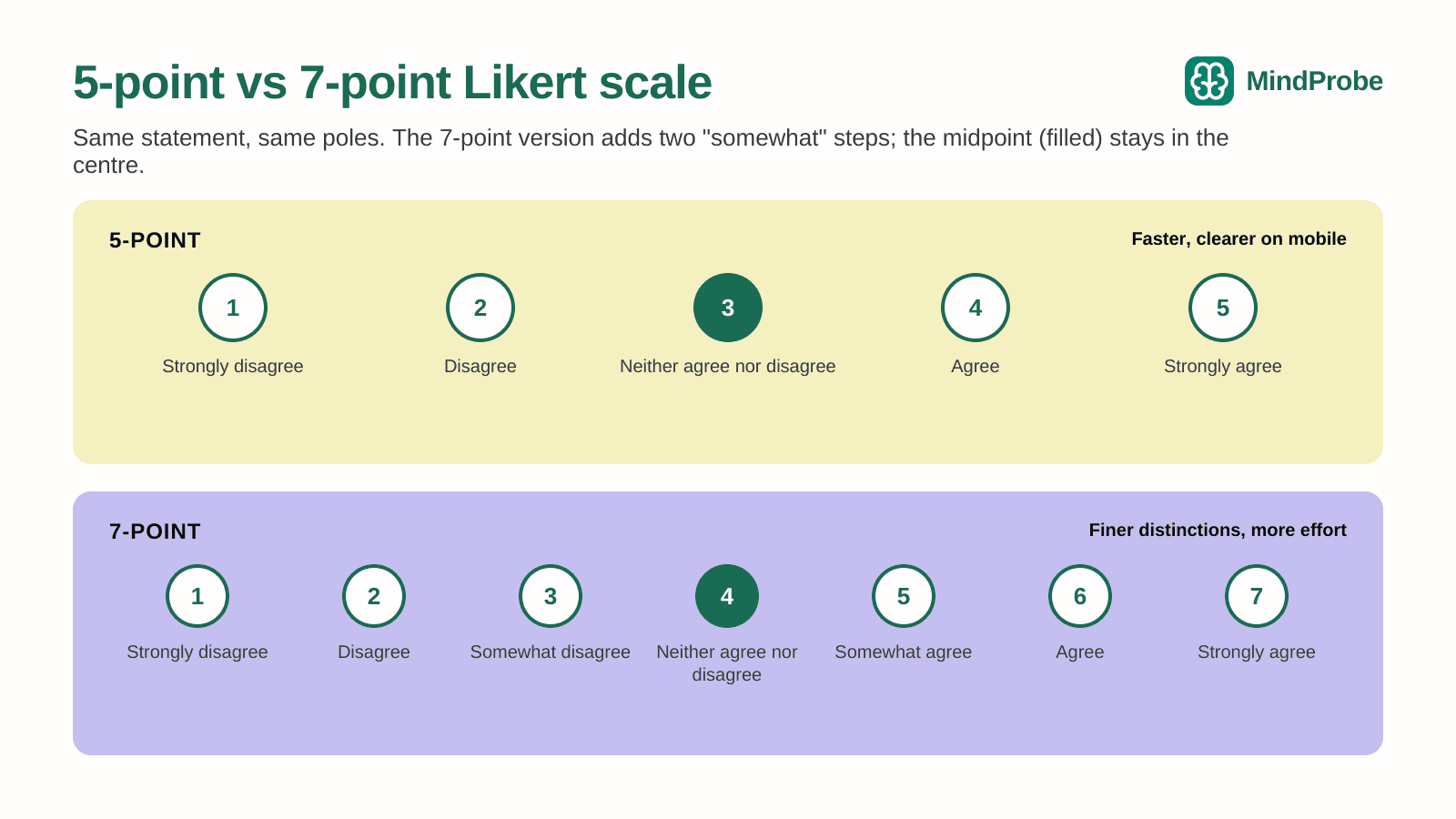
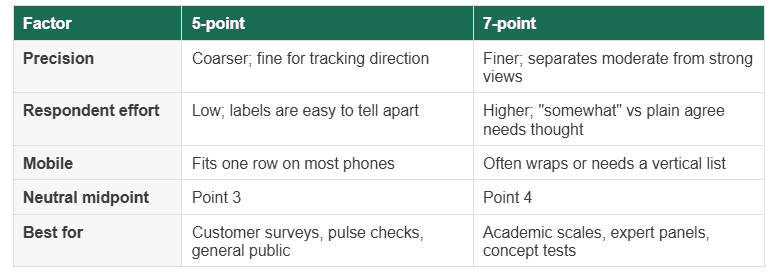
Use five points by default. Choose seven when respondents are experienced and you need finer resolution between moderate and strong views.
The evidence points two ways. Preston and Colman (2000) tested scales from 2 to 11 points with 149 respondents. Two, three and four points performed poorly; reliability, validity and discriminating power rose up to around seven points; test-retest reliability tended to fall beyond ten; and respondents themselves preferred the 10-point version, with 7 and 9 close behind. Working with European Social Survey experiments, Revilla, Saris and Krosnick (2014) reached a narrower conclusion for agree-disagree items specifically: five categories gave better quality data than seven or eleven.
EXPERT PERSPECTIVE
Revilla, Saris and Krosnick analysed multitrait-multimethod experiments from round three of the European Social Survey and concluded that agree-disagree items should offer five answer categories rather than seven or eleven, because the longer versions produced lower-quality data.
HOW MINDPROBE HELPS
Share:
More in Travel
View categoryOnline Saudi eVisa Photo Requirements and Submission Guidelines
Applying for a Saudi Arabia eVisa involves submitting a recent photograph that clearly shows the applicant's face and matches the required digital photo guidelines.
READ ARTICLEWhat Distinguishes the Best Legal Minds: A Guide to Top-Tier Immigration Representation
What Distinguishes the Best Legal Minds: A Guide to Top-Tier Immigration Representation
READ ARTICLENavigating the Specialized Challenges of London’s Road Network
Navigating the Specialized Challenges of London’s Road Network
READ ARTICLE