
Share:

Survey Fatigue: What It Is and How to Design Surveys That Avoid It
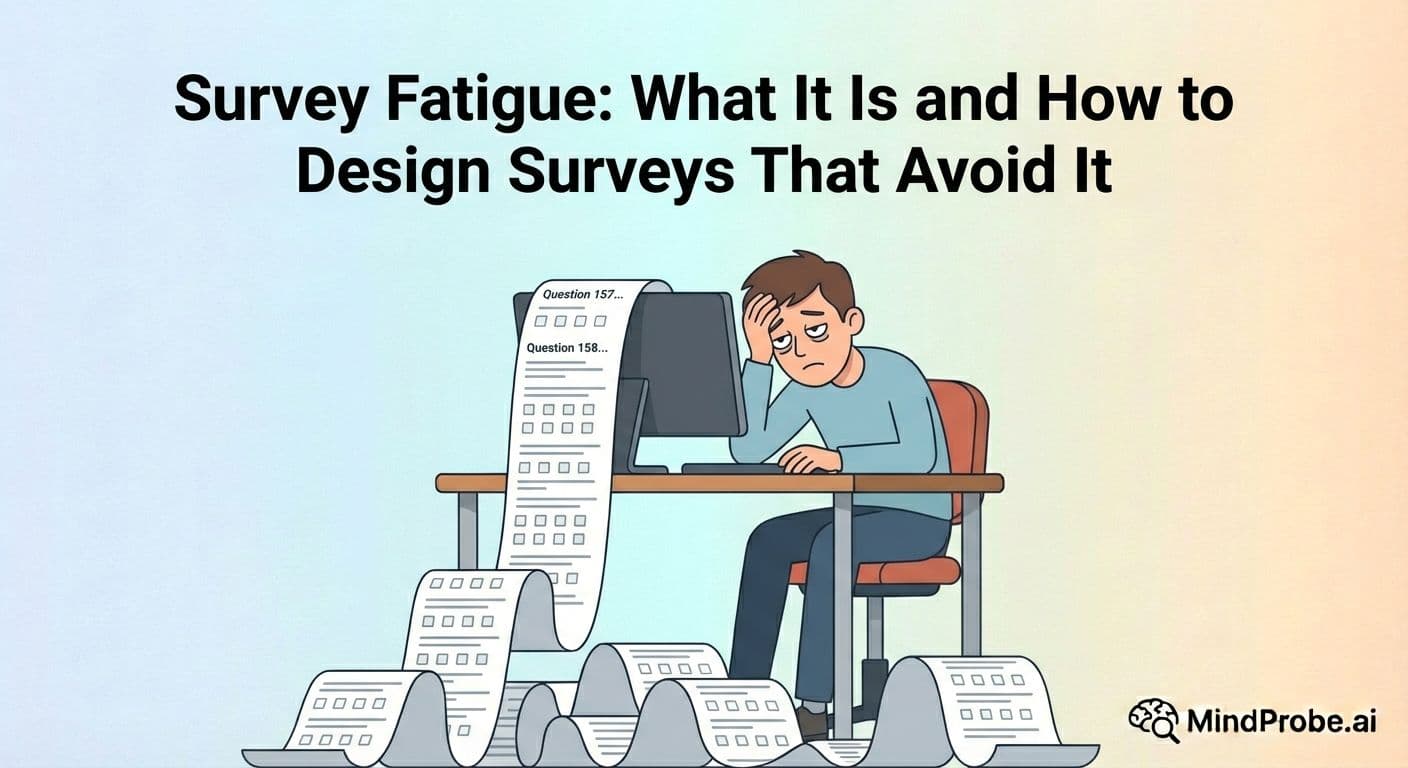
Survey fatigue is a decline in respondent engagement that damages your data quality before it damages your response rates. Here is how to spot it, prevent it and design surveys that respect your audience.
Your response rates are declining. Open-text answers are getting shorter. More people abandon the survey halfway through. Someone on your team mentions that respondents seem tired of surveys.
They are probably right. Survey fatigue is one of the most common problems in market research and customer feedback programmes, and it is also one of the most underestimated. It gets worse as companies increase the number of surveys they send without adjusting their design or frequency. And the real damage is not the lower response rates you can see in your dashboard. It is the worse data you are getting from respondents who technically complete the survey but have mentally checked out by question eight.
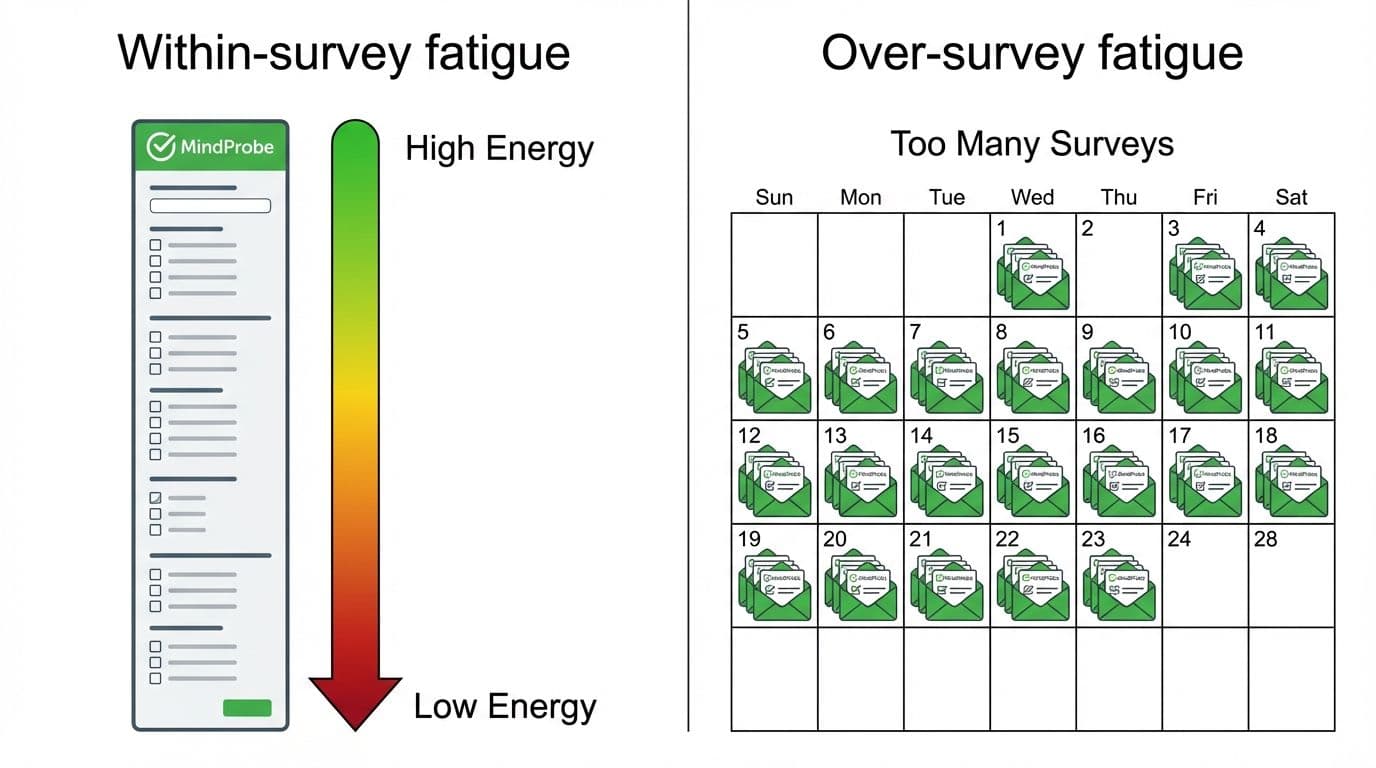
Key takeaway: Survey fatigue has two forms: within-survey fatigue (caused by long or poorly designed surveys) and over-survey fatigue (caused by surveying the same people too often). Both erode data quality before they visibly affect response rates.
What is survey fatigue?
Survey fatigue is a decline in respondent engagement that leads to lower response rates, more incomplete submissions, more careless answers and poorer data quality overall. The term covers two related but distinct problems, and the distinction matters because they require different fixes.
Within-survey fatigue
This happens during a single survey session. The respondent opens the survey, starts answering, and gradually loses interest as the questions keep coming. The symptoms are predictable: they start straight-lining through matrix questions (selecting the same answer for every row without reading), giving single-word open-text responses, or simply closing the tab and moving on with their day.
A 2018 study in the Journal of Business Research measured this effect directly. Cape (2018) found that data quality deteriorated measurably after the 15-minute mark, with satisficing behaviour (choosing the easiest rather than the most accurate answer) increasing sharply in the final third of longer surveys. The respondent is still clicking buttons, but what they are producing is noise dressed up as data.
Within-survey fatigue is driven by length, repetition and irrelevance. A survey that asks 30 questions when 12 would do, or that forces a respondent to rate 8 features they have never used, is creating its own fatigue problem.
Over-survey fatigue (respondent fatigue)
This happens across multiple surveys over time. When an organisation sends too many surveys too frequently, respondents begin ignoring them entirely. They stop opening survey invitation emails. They start unsubscribing from communications. They develop a reflexive "not another one" response to anything that looks like a feedback request.
A 2021 Qualtrics report found that 70% of consumers had abandoned at least one survey in the previous 12 months, with frequency being the most commonly cited reason. Gartner's Customer Experience practice (2022) projected that brand-initiated survey opt-out rates would continue to rise unless companies made significant changes to their survey frequency and design practices.
The irony is that the teams sending the most surveys are usually the ones with the best intentions. They want customer input. They want data-driven decisions. But without discipline on frequency, the surveys themselves become a source of customer friction, the exact opposite of what a feedback programme should achieve.
How to spot survey fatigue in your data
Survey fatigue rarely announces itself with a single dramatic drop. It accumulates gradually across multiple metrics, and you only notice it when someone looks at trends over time rather than individual survey results.
• Completion rates declining across successive survey waves, even though your distribution list size is stable or growing.
• Straight-line response patterns increasing in grid or matrix questions, particularly in the second half of the survey.
• Open-text response length decreasing compared to earlier surveys using similar questions.
• Drop-off rates concentrating in the second half of the survey rather than being evenly distributed.
Share:
More in Marketing
View categoryQuiet Luxury Meets Silver Jewellery: The 2026 Styling Trend
Discover how quiet luxury and silver jewellery are shaping fashion in 2026. Explore minimalist rings, delicate necklaces, classic earrings, and versatile bracelets, along with outfit styling ideas and tips for building a timeless 925 sterling silver jewellery collection.
Amity MBA Finance Project Report
Book Amity MBA Finance Project Report at an affordable price. We provide an Amity MBA Finance project report & synopsis in budget. Book your Amity MBA Finance sample project at an extremely affordable prices.
READ ARTICLE