
Share:

SMTP-Level Spam Filtering: How It Works & Benefits
Learn what SMTP-level spam filtering is, how it rejects unwanted email before DATA, how it differs from content filtering, and how businesses can deploy it safely.
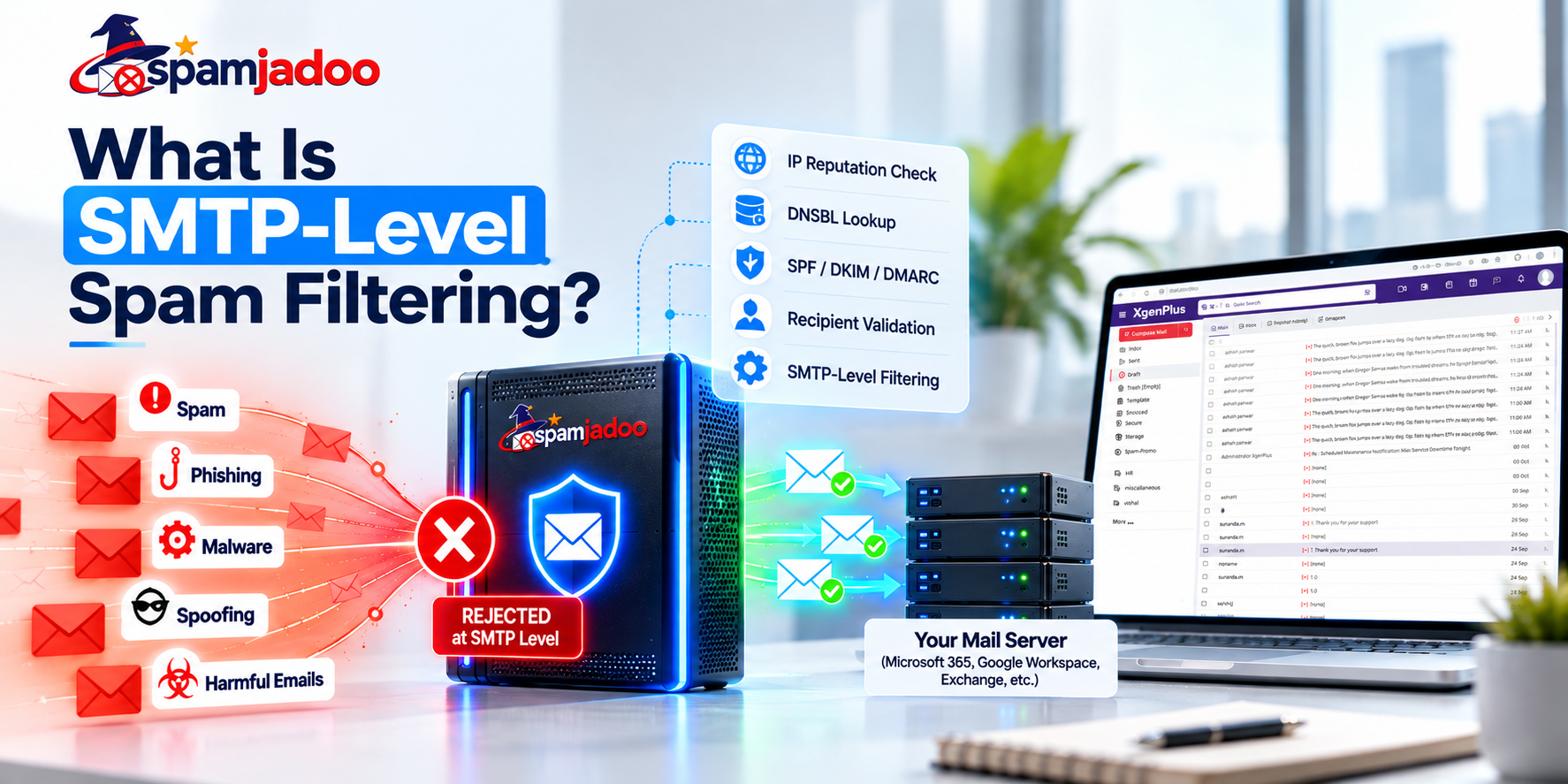
Email spam is more than an inbox nuisance. For businesses, it can introduce phishing attempts, malware, spoofed messages, and unnecessary mail-server load. SMTP-level spam filtering examines incoming email during the Simple Mail Transfer Protocol (SMTP) transaction and can reject unwanted messages before accepting their full content. This helps organizations enforce email security policies earlier in the delivery process, reduce unnecessary processing, and strengthen their broader email security gateway strategy.
Unlike filtering that happens after a message has been accepted, SMTP-level filtering can use connection details, sender information, IP reputation, DNS-based checks, and SMTP commands to make an early decision. Its effectiveness depends on the checks configured, the mail-server architecture, and how legitimate senders are handled.
What Is SMTP-Level Spam Filtering?
SMTP-level spam filtering is a method of evaluating an email during the SMTP conversation, before the receiving server accepts the complete message. Based on configured rules and available signals, the server can accept the message, temporarily defer it, or reject it. It is commonly used as an early layer of protection in an email security gateway.
SMTP is the protocol that mail servers use to transfer email. During an SMTP session, the sending server identifies itself, specifies the envelope sender and recipient, and then attempts to transmit the message.
An SMTP-aware filtering system can assess signals such as:
- The connecting IP address and its reputation.
- Reverse DNS and other DNS-based information.
- Sender and recipient details.
- DNS-based blocklist (DNSBL) results.
- Connection behaviour and sending patterns.
- Applicable authentication and anti-abuse policies.
For example, if an incoming server connection matches a configured blocklist policy, the receiving server may reject the connection or the message during the SMTP transaction rather than accepting the full email.
Key takeaway: SMTP-level filtering moves certain security decisions earlier in email delivery. It complements, rather than replaces, content inspection, malware scanning, and other security controls.
How Does SMTP-Level Spam Filtering Work?
SMTP-level filtering works by checking available information at different stages of the SMTP session. The receiving server applies its rules as the conversation progresses and decides whether to continue, defer, or reject the transaction. The exact checks and their order depend on the mail server and gateway configuration.
Step 1: The server establishes an SMTP connection
The receiving server identifies itself, and the sending server normally introduces itself using EHLO or HELO. Depending on the configuration, the receiving system can evaluate the connecting IP address, connection behaviour, and greeting information before proceeding.
Step 2: The server evaluates the envelope sender
The sending system provides the envelope sender through the MAIL FROM command. The receiver can apply sender policies and relevant anti-abuse checks. The envelope sender is not necessarily the same address that appears in the email's visible From header.
Step 3: The server checks the recipient
The RCPT TO command identifies the intended recipient. The receiving server can verify whether the recipient is valid and apply recipient-specific rules, reducing unwanted traffic and invalid-recipient attempts.
Step 4: The server decides whether to accept the message data
If the transaction passes the relevant checks, the receiver may respond with 354 after the DATA command, allowing the sending server to transmit the message content. If a configured policy rejects the transaction earlier, the receiver can return an appropriate SMTP error instead.
SpamJadoo describes its approach as evaluating the connecting IP, greeting, sender, and recipient during the SMTP handshake, with policy-based rejection before message content is transmitted.
What do SMTP response codes mean?
Share:
More in Business
View categoryThe Power of Self-Leadership: 6 Habits That Help Professionals Grow
Discover six practical self-leadership habits to improve communication, emotional intelligence, and professional growth while building stronger leadership skills and achieving career success.
READ ARTICLEBest CPVC Y Strainers – Clean and Efficient Fluid Flow
At Petron Thermoplast, we specialize in manufacturing and supplying high-quality CPVC Y Strainers designed to deliver unmatched durability and filtration efficiency for industrial and chemical applications.
READ ARTICLEExperion One42 Gurugram: Why It Suits Business Owners
Discover why Experion One42 Gurugram can appeal to business owners seeking a premium home with modern amenities, convenient connectivity, spacious living, and a prestigious location. Explore its lifestyle benefits and key factors for luxury homebuyers.
READ ARTICLE