
Globhy
AllBusinessHealthMarketingTechnologyTravelUncategorized
DSDaniel Smith1 hour ago2 views

Share:

React Native App Development Services for AI Agent-Powered Mobile Apps with Real-Time Data and Tool Calling

Technology

Explore how React Native app development services enable AI agent-powered mobile apps with real-time data, tool calling, and intelligent workflows.

React Native App Development Services for AI Agent-Powered Mobile Apps with Real-Time Data and Tool Calling

AI-powered mobile applications are moving beyond the traditional chatbot model. Instead of simply responding to prompts, modern AI agents can understand user intent, retrieve live information, call external tools, execute multi-step workflows, and return actionable results.

This shift is creating a new category of mobile experiences where users can say what they want rather than manually navigating through multiple screens.

For example, instead of opening a travel app, searching flights, checking weather, comparing hotels, and creating an itinerary separately, a user could ask an AI agent to plan a five-day business trip within a specific budget. The agent can retrieve flight and hotel data, check calendars, calculate costs, and present the result for approval.
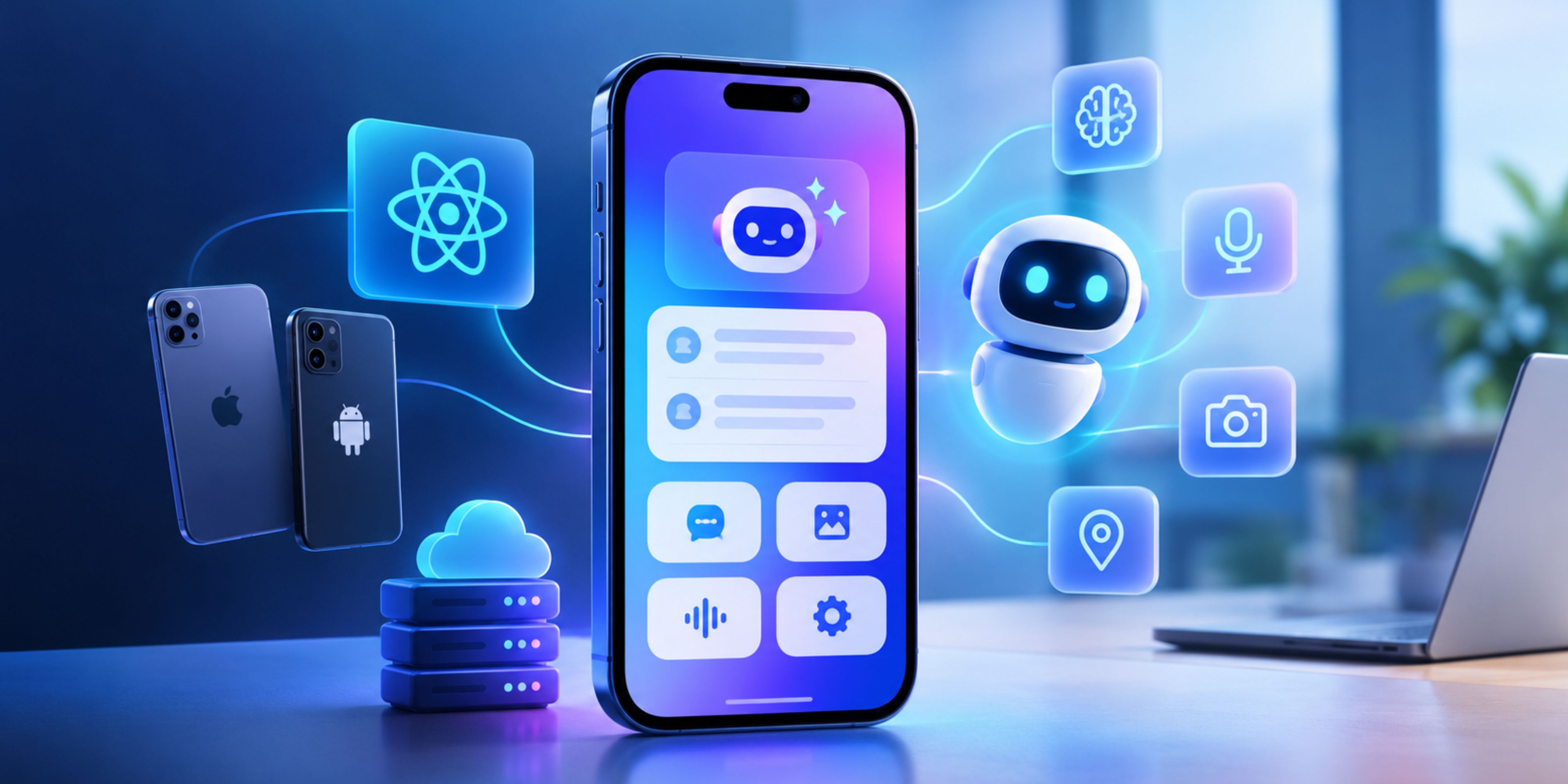
Building this type of application requires more than adding an LLM API to a React Native interface. It requires an architecture that connects the mobile experience with secure agent orchestration, real-time data sources, APIs, tool calling, streaming, and native device capabilities.

This is where modern react native app development services are becoming increasingly relevant for AI agent-powered products.

Why AI Agents Are Different From AI Chatbots

A conventional AI feature generally follows a simple pattern:

User → Prompt → AI Model → Response

An agent-powered application introduces several additional stages:

User Intent → Agent Reasoning → Tool Selection → Tool Execution → Real-Time Data → Reasoning → Action/Approval → Result

The difference is important.

A chatbot might answer:

“The weather in Dubai is 34°C.”

An AI agent can call a weather API, retrieve current conditions, compare them with the user's itinerary, identify unsuitable outdoor activities, and recommend alternatives.

The agent is therefore not the source of truth for every piece of information. It becomes an orchestration layer that knows when it needs external information or an external action.

Current agent architectures increasingly emphasize this separation between the mobile interface and the agent backend. The mobile layer handles interaction, consent, state, progress, and recovery, while the backend manages model credentials, authorization, tool policies, orchestration, and auditability.

How React Native Fits Into the AI Agent Architecture

A production-grade AI agent mobile app should not put the entire agent loop inside the React Native client.

A practical architecture can be divided into four layers:

1. React Native Experience Layer

React Native handles the user-facing experience:

  • Conversational interfaces
  • Voice input and output
  • Agent activity indicators
  • Streaming responses
  • Interactive cards
  • Authentication
  • Push notifications
  • Approval screens
  • Native device capabilities
  • Offline and reconnect states

This is particularly valuable because an agent may take several seconds to complete a task. The interface needs to communicate whether the agent is thinking, retrieving information, calling a tool, waiting for approval, or completing an action.

A generic loading spinner is not enough for an agentic application.

2. Agent Orchestration Backend

The backend becomes the control center.

It manages:

  • Model selection
  • Conversation state
  • Tool permissions
  • Authentication
  • API credentials
  • Retrieval
  • Agent planning
  • Tool execution
  • Error handling
  • Logging
  • Usage and cost monitoring

Keeping these capabilities server-side also prevents sensitive model keys and privileged API credentials from being exposed inside the mobile application.

3. Tool and Data Layer

This is what gives an AI agent access to real-world information.

Depending on the application, tools could include:

  • Flight and hotel APIs
  • Payment APIs
  • Maps and geolocation services
  • CRM systems
  • Inventory databases
  • Banking APIs
  • Calendar systems
  • Customer-support platforms
  • Internal enterprise databases
  • Search and retrieval systems

Instead of allowing the model to invent an answer, the agent can invoke the appropriate tool and reason over its response.

4. AI Model Layer

The AI layer provides reasoning, planning, structured outputs, and tool selection.

An application may use cloud-based models, on-device models, or a hybrid architecture depending on the task.

This hybrid approach is becoming increasingly relevant as on-device AI capabilities improve. Apple's Foundation Models framework, for example, now supports agentic experiences and improved tool-calling capabilities, while allowing developers to work with server or on-device models through its LanguageModel abstraction.

Real-Time Data Is Critical for Agent-Powered Apps

An agent becomes significantly more useful when it can work with current information.

Consider a personal finance application.

A static AI model might explain budgeting strategies. An agent connected to live financial data can:

  1. Retrieve recent transactions.
  2. Categorize expenses.
  3. Compare spending against a monthly budget.
  4. Detect unusual activity.
  5. Calculate remaining discretionary spending.
  6. Recommend an adjustment.
  7. Ask the user before executing a financial action.

The same architecture can work for logistics, healthcare administration, travel, retail, customer support, and enterprise operations.

Real-time data can arrive through REST APIs, WebSockets, Server-Sent Events, database queries, event streams, or other application-specific integrations.

For mobile applications, the transport mechanism should be abstracted from the UI. The React Native state layer should consume normalized events rather than being tightly coupled to whether the backend uses SSE, WebSockets, polling, or another transport mechanism.

Tool Calling Turns AI Into an Action Layer

Tool calling is one of the most important components of an AI agent architecture.

Suppose a user asks:

“Find me a cheaper flight to London and notify me if the price falls below $500.”

The agent could:

Step 1: Understand the destination, dates, and budget.

Step 2: Call a flight-search tool.

Step 3: Receive current flight information.

Step 4: Compare available options.

Step 5: Store a price-monitoring task.

Step 6: Run a background monitoring workflow.

Step 7: Send a push notification when the defined condition is met.

This workflow illustrates why agent-powered apps require more than an LLM integration. The AI needs controlled access to tools, persistent state, background processing, error recovery, and a reliable mobile notification layer.

MCP and the Growing Tool Ecosystem

Another important development for agentic applications is the movement toward standardized ways for AI systems to access tools and data.

The Model Context Protocol (MCP) is increasingly being discussed as an integration layer for connecting agents with external capabilities. Rather than building isolated integrations for every agent, MCP can provide a more standardized way to expose tools and resources.

For enterprise applications, this can become particularly useful when an agent needs access to multiple internal systems.

For example:

Mobile App → Agent Backend → MCP/Tool Layer → CRM + ERP + Knowledge Base + Internal APIs

The result is an architecture where the mobile app does not need to understand every backend capability. It communicates with the agent, while the agent determines which approved capability should be used.

The broader 2026 trend is clearly moving toward AI systems that interact with business processes rather than simply generating content.

React Native's New Architecture Matters for AI Applications

AI agent applications frequently involve complex interfaces, streaming updates, voice interactions, animations, native modules, and background state changes.

React Native's New Architecture is therefore an important foundation.

React Native 0.82 became the first React Native release to run entirely on the New Architecture, continuing the framework's transition away from the legacy architecture.

The New Architecture brings technologies such as Fabric and TurboModules into the core development model. This can be particularly useful when AI applications need to integrate React Native with native functionality.

For example, an AI productivity app might use React Native for the main experience while relying on native iOS or Android capabilities for:

  • Speech processing
  • Camera and vision features
  • Local AI inference
  • Secure storage
  • Notifications
  • Background capabilities
  • Platform-specific AI APIs

This hybrid approach avoids treating React Native and native development as mutually exclusive.

Where Native iOS Capabilities Still Matter

React Native can provide the cross-platform application layer, but AI-heavy products may still need platform-specific integrations.

Apple's current AI stack is a good example. The Foundation Models framework supports on-device intelligence and agentic experiences, while App Intents makes application actions accessible through natural-language interactions with Siri and other system experiences.

This creates opportunities for React Native applications that combine:

React Native UI + Native AI Capability + Cloud Agent Backend

For businesses that need deeper Apple ecosystem integration, experienced iOS App Development Solutions can complement the React Native layer rather than replacing it.

Designing for Agent Failures, Not Just Successful Prompts

A major mistake in AI mobile development is designing only for the successful path.

Agent workflows can encounter:

  • Tool timeouts
  • Invalid API responses
  • Network interruptions
  • Authentication failures
  • Model errors
  • Conflicting tool results
  • Duplicate actions
  • User cancellation
  • App backgrounding
  • Partial execution

Therefore, react native app development services for agentic products should include explicit recovery states.

Every agent run should ideally have an identifiable run ID and tool-call state. Completed messages and important run metadata can be persisted, while temporary streaming events should not unnecessarily overload local storage.

The application should also support cancellation, retries, reconnection, and manual fallback.

This becomes especially important on mobile because users frequently switch applications, lose connectivity, or move between Wi-Fi and cellular networks.

Security and Human Approval Need to Be Built In

An autonomous agent should not automatically execute every action it can technically perform.

Low-risk operations such as retrieving weather data may happen automatically.

High-impact operations such as:

  • Sending money
  • Placing an order
  • Deleting records
  • Sending sensitive communications
  • Changing account settings

should typically require explicit user approval.

This creates a useful model of progressive autonomy: the agent can automate routine operations while escalating consequential actions to the user.

For enterprise applications, this also means implementing authentication, authorization, tool-level permissions, audit logs, rate limits, and clear action boundaries.

How Debut Infotech Approaches AI Agent-Powered React Native Apps

Building an AI agent-powered mobile product requires expertise across mobile engineering, backend architecture, AI integration, APIs, real-time communication, and security.

Debut Infotech can help businesses design and develop React Native applications where AI is integrated into the actual product workflow rather than added as a standalone chatbot.

The development approach can include:

  • React Native cross-platform application development
  • AI agent integration
  • Real-time API and data integrations
  • Tool/function calling
  • Voice-enabled AI experiences
  • Backend agent orchestration
  • Secure authentication and authorization
  • Push notifications
  • Native iOS and Android integrations
  • Streaming agent responses
  • Human-in-the-loop approval workflows
  • Enterprise API and database integration

Businesses can also combine React Native expertise with iOS App Development Solutions when platform-specific AI or device capabilities are required.

Choosing the Right Architecture for Your AI Mobile App

Not every AI feature requires a fully autonomous agent.

A simple FAQ assistant may only need an LLM and retrieval system.

An AI-powered operations application, however, may require:

React Native → API Gateway → Agent Orchestrator → Model → Tool Registry → Real-Time Data → Business Systems

The right architecture depends on the level of autonomy, data sensitivity, latency requirements, device capabilities, and number of external systems involved.

The strongest react native app development services therefore focus less on adding an AI chat window and more on designing the complete execution system behind it.

The Future of AI Agent-Powered Mobile Apps

The direction of mobile AI is shifting from “ask and receive” toward “describe and accomplish.”

Users will increasingly expect mobile applications to understand intent, retrieve live information, coordinate multiple services, and execute tasks with minimal manual navigation.

Voice interfaces, real-time data, tool calling, on-device models, MCP-based integrations, and agentic workflows are all contributing to this shift.

For businesses planning their next AI product, React Native offers a strong foundation for delivering the same agent experience across iOS and Android while retaining the ability to integrate native capabilities where necessary.

The opportunity is not simply to build another AI chatbot.

It is to build a mobile application that can understand, retrieve, decide, act, and keep the user in control.

With the right architecture and an experienced mobile app development company, React Native can become the application layer for a new generation of AI agent-powered mobile products.

Share:

More in Technology

View category