
Share:

Online Survey Best Practices: 12 Things That Separate Good Surveys From Bad Ones
Send time is one of the easiest variables to test. Run the same survey with two send times and compare open rates and completion rates. Over a few survey waves, you will find the window that works best for your specific audience.
10. Send reminders, but not too many. A single well-timed reminder typically recovers 20 to 30% of initial non-responders. Send it 3 to 5 days after the original invitation. Use a slightly different subject line ("Quick reminder" rather than forwarding the same email) and keep the tone light. Two reminders are acceptable for important research. Three starts to feel aggressive and risks triggering unsubscribes that hurt your future surveys.
11. Test every path before you launch. Send the survey to yourself and at least two colleagues. Check question clarity, every skip logic path, mobile rendering, page load speed and total completion time. Every survey should be tested on an actual phone, not just previewed in a desktop browser window.
Ask your testers to think aloud while they complete the survey. Where do they hesitate? Which questions do they re-read? Where do they seem confused? Those moments of friction are exactly what causes real respondents to abandon.
12. Close the feedback loop.
This does not need to be elaborate. A short email, a banner in your app, or a note at the top of your next survey that says "Last time, you told us Y was a problem. Here is what we did about it" is enough. The message is: your input matters, and we are listening.
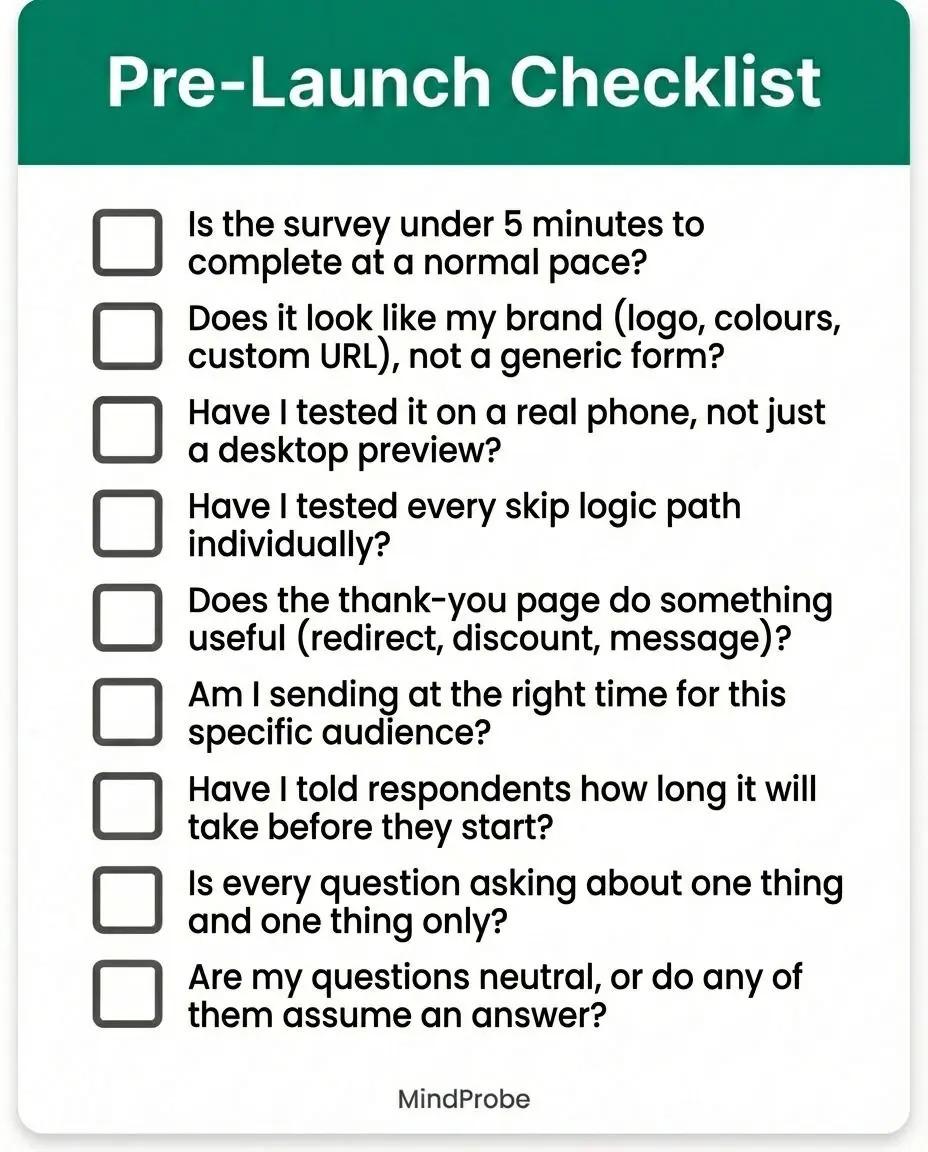
A pre-launch checklist
Before you send any survey, run through this list. It takes two minutes and catches the most common errors.
- Is the survey under 5 minutes to complete at a normal pace?
- Does it look like my brand (logo, colours, custom URL), not a generic form?
- Have I tested it on a real phone, not just a desktop preview?
- Have I tested every skip logic path individually?
- Does the thank-you page do something useful (redirect, discount, message)?
- Am I sending at the right time for this specific audience?
- Have I told respondents how long it will take before they start?
- Is every question asking about one thing and one thing only?
- Are my questions neutral, or do any of them assume an answer?
For a deeper dive into the full survey lifecycle, from research question through analysis and reporting, read The Complete Guide to Online Surveys. If low completion rates are a persistent problem across your programme, see How to Improve Survey Response Rates: 14 Proven Tactics.
Build better surveys with MindProbe. Start free at mindprobe.ai
Frequently asked questions
How long should an online survey be?
Aim for 5 minutes or fewer, which typically translates to 8 to 12 questions for most B2C research. Response rates drop measurably with every additional minute of survey length. If you need more depth, split the research across two shorter surveys and run them sequentially rather than packing everything into one.
What is the ideal number of questions in a survey?
There is no universal ideal, but 8 to 12 questions is the range that balances data richness with completion rates for most marketing research. Use skip logic to keep the effective question count low for each individual respondent, so different audience segments see only what is relevant to them.
Should I offer incentives for completing my survey?
Incentives can boost response rates by 10 to 20%, but they also attract respondents who rush through for the reward rather than giving thoughtful answers. Lottery-style incentives (a chance to win rather than a guaranteed payment) tend to produce better data quality. If you use guaranteed incentives, screen for satisficing behaviour in your analysis.
How do I know if my survey questions are biased?
Share:
More in Marketing
View categoryBetter With Age Clothing – Shop Trendy Streetwear & Hoodies
Explore Better With Age Clothing for stylish hoodies, vintage t-shirts, jackets, jeans and modern streetwear. Discover unique designs and upgrade your everyday fashion.
READ ARTICLEWR777 Login – A Simple Guide to Accessing Your Account
When users search for WR777 Login, they usually want a quick and convenient way to access their existing account. Whether you are a returning user or someone who has recently registered, understanding the login process can make account access easier.
READ ARTICLEFairbet ID – A Complete Guide to Online Account Access and Features
It is an online betting platform that provides the ideal blend of excitement, security, and ease of use. The site suits users with varying levels of expertise due to its user-friendly interface, fast identification process, and live betting.
READ ARTICLEExploring the Jojo66 Platform on Smartphones and Tablets
Exploring the Jojo66 Platform on Smartphones and Tablets
READ ARTICLE