
Share:

How to Write Good Survey Questions: A Practical Framework
AFTER: BOUNDED
In the past 30 days, how many times did you buy organic food?
- None \
- 1 to 2 times
- 3 to 5 times
- 6 or more times
- Not sure
Clear window, countable behaviour, ranges that don't overlap.
Quick test: ask two colleagues what your fuzziest word means. Two different answers means you need a boundary.
E: Easy to answer honestly
Rule: the answer format must fit the question, and no honest answer should feel embarrassing.
Start with format. Our breakdown of open-ended vs closed-ended questions shows when free text beats a list. For rating scales, Krosnick and Presser say 7 points is probably optimal in many cases and reliability is higher when every point has a verbal label; our Likert scale examples cover the 5 vs 7 point choice.
Then two quieter biases. Acquiescence is the pull to agree: Pew finds less educated and less informed respondents agree more, which distorts group comparisons. Social desirability inflates voting, church attendance and giving, and hides things like alcohol use. Pew's fixes: give a face-saving reason and make infrequent behaviour easy to admit. Format matters too: in a 2018 experiment, Pew found forced-choice questions produced estimates 8 points higher on average than select-all lists, and judged them more accurate.
EXPERT PERSPECTIVE
Krosnick and Presser argue that agree/disagree, true/false and yes/no formats invite acquiescence, and that reversing items doesn't fix it. Ask rating questions that show the full dimension (“how satisfied or dissatisfied”) instead.
Paraphrasing Jon A. Krosnick and Stanley Presser, Question and Questionnaire Design, Handbook of Survey Research (2010)
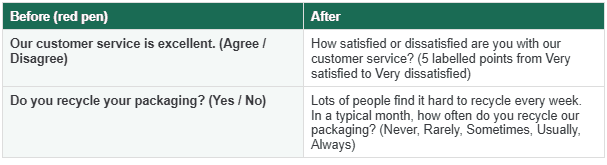
Quick test: would you answer truthfully with your manager watching? If not, soften the stem or add “prefer not to say”.
S: Sequenced
Rule: every question is read in the shadow of the one before it.
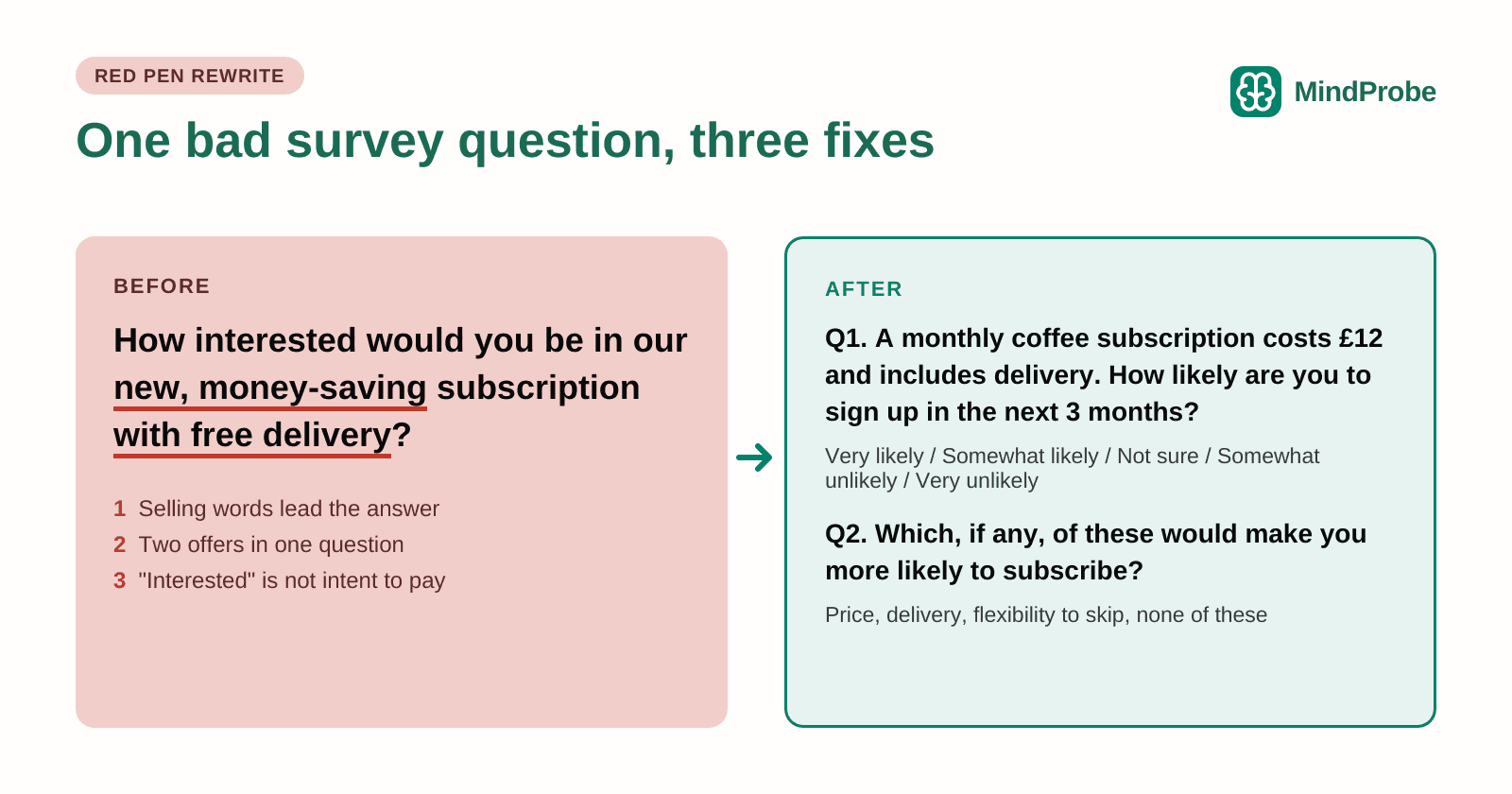
A well-worded question can still mislead in the wrong place. Quick test: read it straight after the previous one. Does that plant an idea, a brand or a mood?
Share:
More in Marketing
View categoryScissor Lift Rental in Dubai and the UAE: A Guide for Construction and Maintenance Projects
Learn how scissor lift rental in Dubai and the UAE supports construction, maintenance and warehouse work, and how to select the right access machine.
Where to Buy Old Facebook Accounts with Marketplace
═══════✮➤═══════✮➤═══════✮ ═══════✮➤Telegram➜❯ @getpvatop ═══════✮➤WhatsApp➜❯ +1(901)878-0196 ═══════✮➤Email➜ getpvatop@gmail.com ═══════✮➤Discord➜❯ getpvatop ═══════✮➤Telegram➜❯ @getpvatop ═══════✮➤═══════✮➤═══════✮ For more information, visit @getpvatop.com
READ ARTICLE36 Amazing Sites to Buy Old Facebook Accounts
═══════✮➤Telegram➜❯ @getpvatop ═══════✮➤WhatsApp➜❯ +1(901)878-0196 ═══════✮➤Discord➜❯ getpvatop ═══════✮➤Telegram➜❯ @getpvatop
READ ARTICLE