
Share:

How to Write Good Survey Questions: A Practical Framework
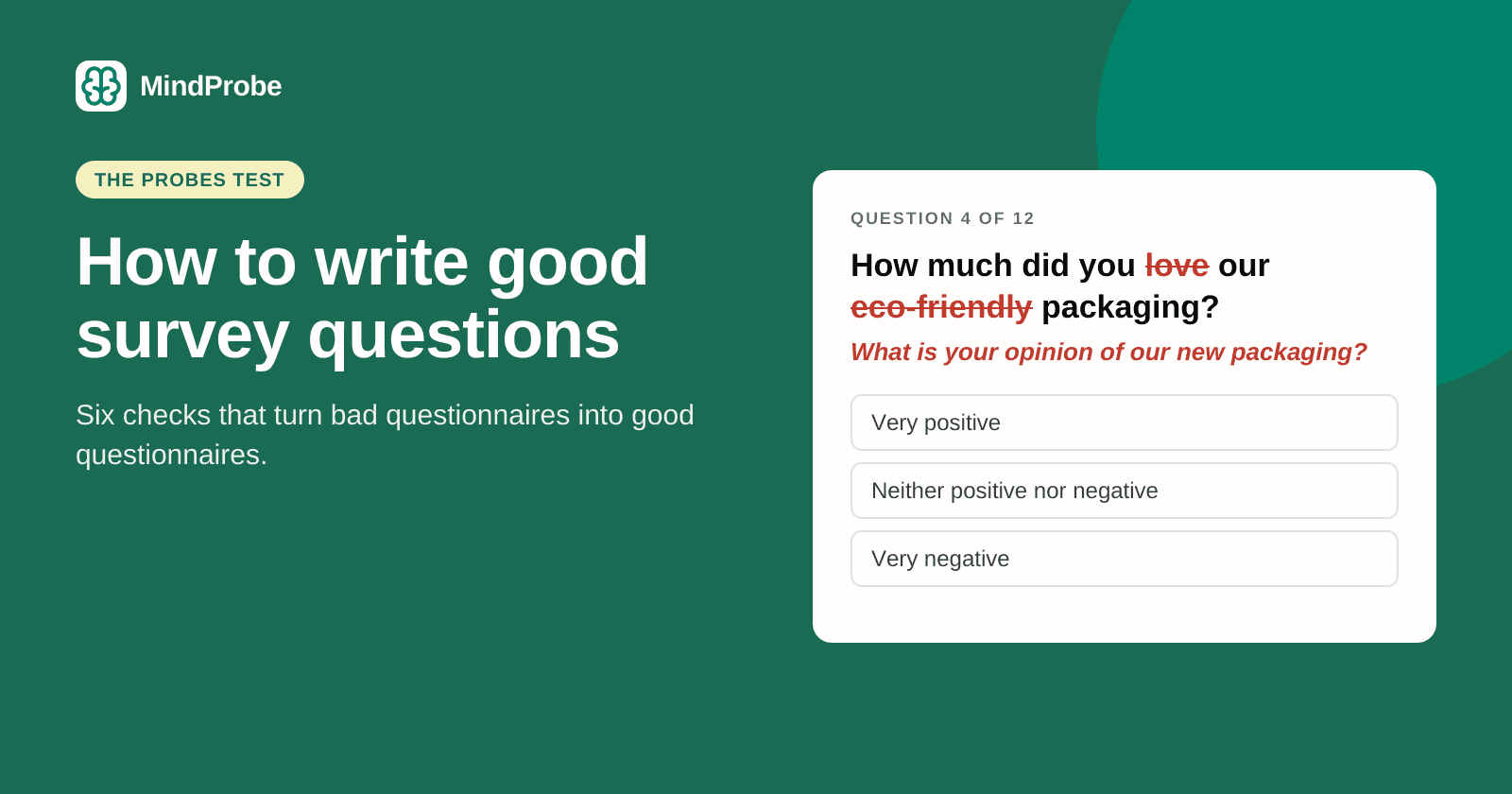
Good questionnaires are built one question at a time, and one bad question can sink a decision. Here's a made-up example you've probably lived a version of. A DTC coffee brand is weighing a subscription tier. The insights lead asks customers: “How interested would you be in our new, money-saving subscription with free delivery?” Interest comes back sky high. The tier launches. Three months later, sign-ups are a trickle.
The sample was fine. The question was the problem. “New”, “money-saving” and “free delivery” did the selling, and “how interested” measured curiosity, not willingness to pay. A leading, double-barrelled, vague question produced a confident wrong answer.
Below is a six-check system for survey questions, the PROBES test, that you can run on every item before launch. For the full menu of formats, start with our complete guide to survey question types.
Key Takeaways
- Good questionnaires ask one clear, neutral, specific thing per question, in an order that doesn't steer later answers.
- Run every draft through PROBES: Plain, Rid of slant, One idea, Bounded, Easy to answer honestly, Sequenced.
- Swap agree/disagree statements for rating questions that name the dimension.
- Order alone moves results: Pew recorded a 15 point swing from changing which question came first.
- Never launch cold: cognitive interviews, then a soft launch.
What separates good questionnaires from bad ones?
Good questionnaires are understood the same way by every respondent and are easy to answer honestly. Bad ones make people guess your meaning or nudge them towards the answer you hoped for.
Methodologists describe answering as four stages: understand the question, retrieve memories, form a judgement, then map it onto the options. The model comes from Tourangeau, Rips and Rasinski's The Psychology of Survey Response, and Krosnick and Presser use it in their review of question and questionnaire design.
Every bad question breaks a stage. Jargon breaks comprehension. “In the past” breaks retrieval. A loaded adjective bends judgement. A scale with no fitting option breaks the response. Each check below targets one failure point.
The PROBES test: six checks for every survey question
PROBES stands for Plain, Rid of slant, One idea, Bounded, Easy to answer honestly and Sequenced. A question that passes all six is ready for a pilot.
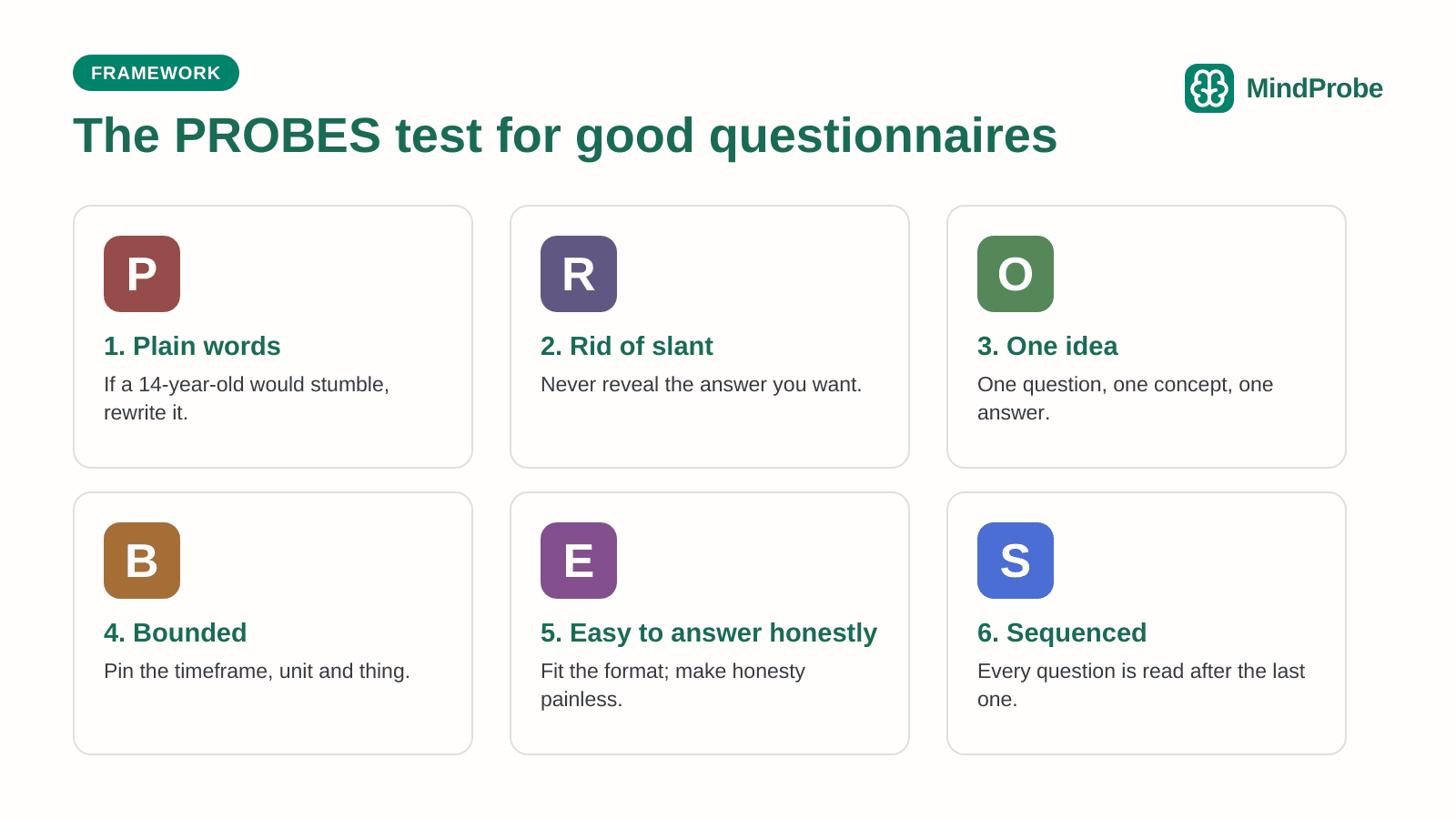
Each check has a rule, a reason, a red-pen rewrite and a one-minute test.
P: Plain words
Rule: if a 14-year-old couldn't read it aloud without stumbling, rewrite it.
Krosnick and Presser's conventional wisdom starts with simple, familiar words and syntax, and no ambiguous terms or double negatives. Your team's vocabulary (“SKU”, “omnichannel”) isn't your customers'. Confused respondents rarely skip. They guess.

Quick test: read it aloud to someone outside your team. If they ask “what do you mean by…”, you have your answer.
R: Rid of slant
Share:
More in Marketing
View categoryScissor Lift Rental in Dubai and the UAE: A Guide for Construction and Maintenance Projects
Learn how scissor lift rental in Dubai and the UAE supports construction, maintenance and warehouse work, and how to select the right access machine.
Where to Buy Old Facebook Accounts with Marketplace
═══════✮➤═══════✮➤═══════✮ ═══════✮➤Telegram➜❯ @getpvatop ═══════✮➤WhatsApp➜❯ +1(901)878-0196 ═══════✮➤Email➜ getpvatop@gmail.com ═══════✮➤Discord➜❯ getpvatop ═══════✮➤Telegram➜❯ @getpvatop ═══════✮➤═══════✮➤═══════✮ For more information, visit @getpvatop.com
READ ARTICLE36 Amazing Sites to Buy Old Facebook Accounts
═══════✮➤Telegram➜❯ @getpvatop ═══════✮➤WhatsApp➜❯ +1(901)878-0196 ═══════✮➤Discord➜❯ getpvatop ═══════✮➤Telegram➜❯ @getpvatop
READ ARTICLE