Share:

How On-Device AI Is Transforming Mobile Apps with Private, Offline Intelligence
Discover how on-device AI is transforming mobile apps with private, offline intelligence, lower latency, hybrid AI architectures, and smarter user experiences.
For years, mobile apps have depended on cloud APIs for artificial intelligence. A user sends data to a remote server, the server runs the model, and the result comes back to the phone. This architecture works well for large AI models, but it introduces network latency, recurring inference costs, privacy concerns, and a dependency on connectivity.
On-device AI is changing that architecture.
Instead of sending every request to the cloud, mobile apps can now run increasingly capable AI models directly on smartphones. Modern devices have CPUs, GPUs, and neural processing hardware designed to accelerate local inference, while platforms such as Apple and Android are providing developers with higher-level APIs for integrating generative AI directly into applications.
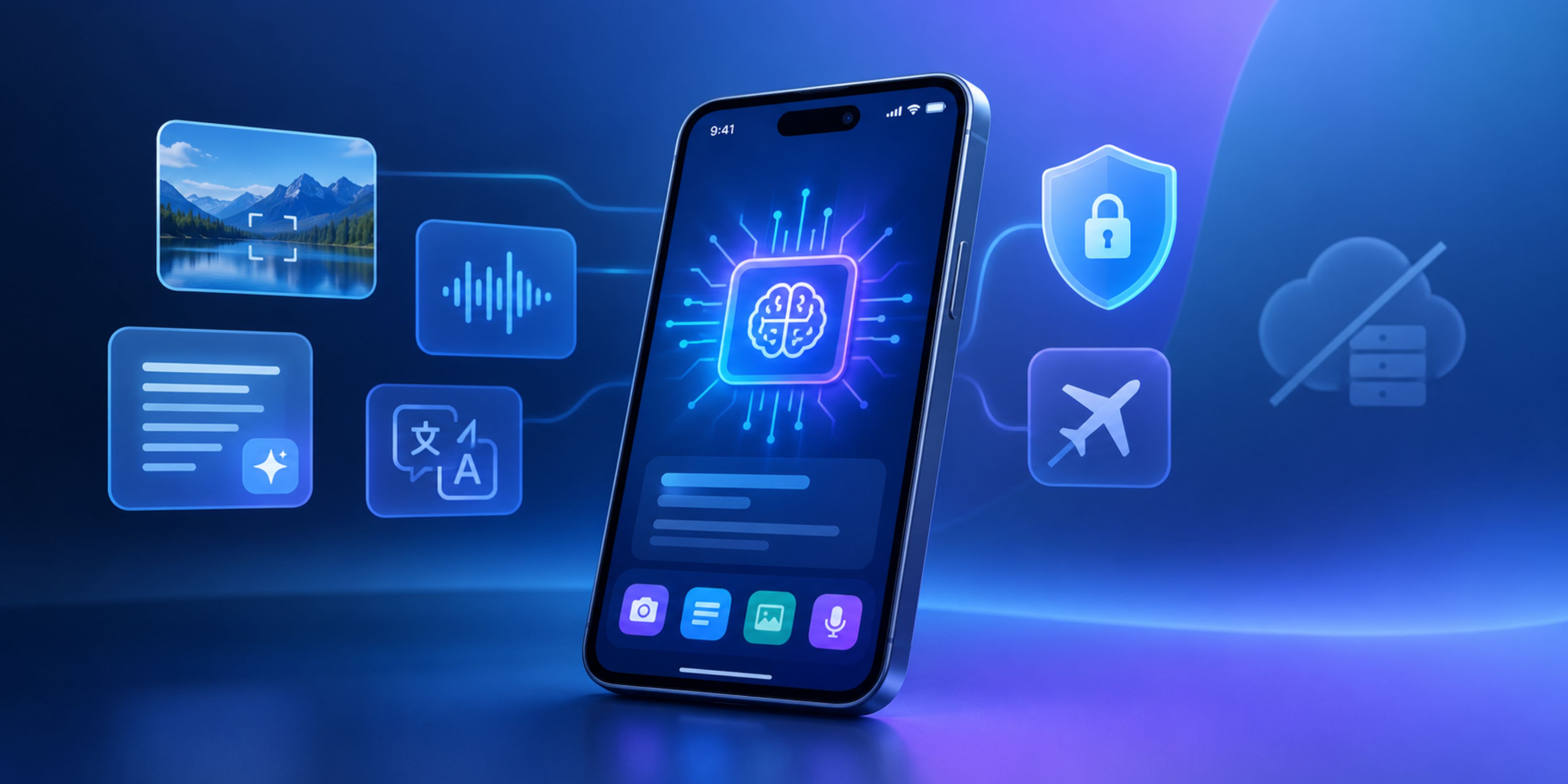
Apple's Foundation Models framework provides access to on-device language models for tasks such as summarization, extraction, text and image understanding, and structured generation. Android similarly provides Gemini Nano through AICore and ML Kit GenAI APIs for tasks including summarization, rewriting, proofreading, image description, and speech recognition.
For teams investing in AI-powered mobile app development, this means intelligence no longer has to mean “send everything to an AI server.”
What Makes On-Device AI Different?
On-device AI means that model inference happens locally on the user's smartphone rather than exclusively on a remote cloud server.
Consider a document-scanning application. A traditional AI workflow might upload an image to a server for OCR, classification, or summarization. An on-device implementation can process the image locally, extract relevant information, and return the result without sending the original document to a backend.
The difference is architectural, not merely technical.
A modern mobile AI architecture can look like:
User input → Mobile app → On-device model → Local result
Share:
More in Technology
View categoryYour App Works on iPhone but Breaks on Android (or the Other Way Around)
Does your app work on iPhone but break on Android? Learn why mobile apps behave differently across platforms and how to fix common issues.
READ ARTICLEHow Sage 50 Hosting Helps Accounting Firms Manage Multiple Clients
Learn how Sage 50 hosting helps accounting firms manage multiple clients, access financial data remotely, collaborate with teams, and protect accounting files securely.
READ ARTICLESpider Clothing: Discover the Streetwear Style of Sp5der and Sp5der Hoodies
Spider Hoodie is available at the sale price. Get the Amazing Spider Clothing at the Official Online Store. Big Discount With Free Shipping.
READ ARTICLE