
Globhy
CCCorporate Connect1 hour ago1 views

Share:

Google Workspace, Microsoft 365, or Sovereign Email? 5 Questions a Regulated Indian Bank Should Ask First

Business

Choosing between Google Workspace, Microsoft 365, and sovereign email? Discover the 5 critical questions regulated Indian banks should ask before selecting a secure business email solution.
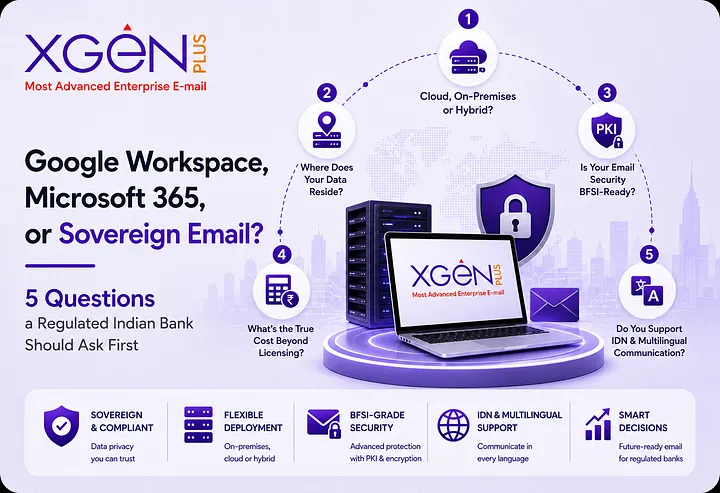
Google Workspace, Microsoft 365, or Sovereign Email? 5 Questions a Regulated Indian Bank Should Ask First

Financial institutions operate under some of the world's strictest security and compliance requirements. For regulated Indian banks, choosing an email platform isn't simply an IT decision it directly impacts cybersecurity, regulatory compliance, customer trust, operational resilience, and digital sovereignty.

The short answer: If your organization handles highly sensitive financial data, customer information, regulated communications, or critical government-related workloads, you should evaluate more than productivity features. Data residency, sovereignty, encryption, compliance, and deployment flexibility deserve equal or greater attention than collaboration tools.

This guide explains the five most important questions every regulated Indian bank should ask before selecting between Google Workspace, Microsoft 365, and a Sovereign Business Email Solution like XgenPlus.

Why Email Infrastructure Matters More Than Ever for Indian BFSI

Email remains the primary communication channel for banking operations, customer engagement, regulatory reporting, and executive collaboration. Because it carries sensitive financial information, banks must prioritize security, compliance, encryption, data sovereignty, and operational control, not just productivity features.

Modern banking email systems handle:

A compromised mailbox can expose:

This is why regulators increasingly emphasize:

Key Takeaway

Email infrastructure has become a core cybersecurity asset rather than just a communication tool.

Question 1: Where Does Your Email Data Actually Reside?

Banks should know exactly where email data is stored, processed, and backed up. Data residency affects regulatory compliance, audit readiness, legal jurisdiction, and operational risk. Sovereign email solutions provide greater visibility and control over data location.

Why Data Residency Matters

Many organizations assume cloud services automatically meet every compliance requirement.

In reality, questions include:

For regulated industries, these considerations become increasingly important during:

Practical Application

Before selecting any provider, request documented answers regarding:

Common Mistake

Selecting an email platform solely based on brand recognition without reviewing data governance policies.

Key Takeaway

Understanding where your data resides is foundational for compliance and long-term risk management.

Question 2: Do You Need Cloud, On-Premises, or Hybrid Deployment?

Not every bank has identical infrastructure requirements. While many organizations prefer cloud-based productivity, others require on-premises deployment or hybrid architectures to satisfy security, operational, or regulatory policies.

Comparing Deployment Models

Feature

Cloud Solution

On-Premises

Hybrid

Infrastructure Management

Vendor

Organization

Shared

Customization

Moderate

High

High

Scalability

Excellent

Moderate

Excellent

Administrative Control

Limited

Full

High

Compliance Flexibility

Moderate

High

High

Offline Control

Limited

Complete

Partial

When On-Premises Makes Sense

Organizations may prefer on-premises deployment when they require:

Hybrid Offers Flexibility

Many financial institutions combine:

Key Takeaway

Deployment should align with your organization's security strategy, not industry trends.

Question 3: How Strong Is Your Email Security Architecture?

Modern email security extends beyond spam filtering. Banks should evaluate encryption, identity verification, digital signatures, phishing protection, certificate-based authentication, and advanced access controls before selecting an enterprise email platform.

Essential Security Capabilities

A secure Business Email Solution should include:

Why PKI and Certificate Authority Matter

One increasingly important technology is PKI (Public Key Infrastructure).

PKI enables:

A trusted Certificate Authority (CA) issues digital certificates that help verify sender authenticity.

This significantly reduces risks from:

Example

A treasury department approving high-value transactions can digitally sign emails, allowing recipients to verify authenticity before acting.

Expert Insight

Financial institutions increasingly treat digital identity as a strategic cybersecurity control rather than an optional feature.

Key Takeaway

Email security should combine multiple layers including PKI, identity management, encryption, and user awareness.

Question 4: Can the Platform Support India's Digital Transformation Goals?

Banks increasingly seek solutions that align with national digital infrastructure, multilingual communication, regulatory expectations, and local innovation. Evaluating these capabilities early supports long-term modernization strategies.

Importance of IDN Email

India serves users across dozens of languages.

IDN (Internationalized Domain Name) Email enables organizations to use domain names in native languages.

Examples include domains using:

Potential benefits include:

Practical Application

Regional cooperative banks and financial institutions serving multilingual communities may benefit from IDN-enabled communication strategies.

Key Takeaway

Digital transformation increasingly includes language accessibility alongside technology modernization.

Question 5: What Is the True Cost Beyond Licensing?

Pricing should include more than subscription fees. Banks must consider migration, security management, compliance, storage, administration, support, training, and long-term operational costs when evaluating enterprise email platforms.

Total Cost of Ownership (TCO)

Consider:

Pricing Evaluation Checklist

Ask vendors:

Common Mistake

Choosing the lowest subscription price while overlooking long-term operational expenses.

Key Takeaway

The lowest monthly price is not always the lowest total cost.

Comparison: Google Workspace vs Microsoft 365 vs Sovereign Email

Each platform serves different organizational priorities. Google Workspace excels in collaboration, Microsoft 365 offers extensive enterprise productivity, while sovereign email platforms prioritize infrastructure control, deployment flexibility, and data governance.

Evaluation Criteria

Google Workspace

Microsoft 365

Sovereign Email (e.g., XgenPlus)

Productivity Suite

Excellent

Excellent

Available through integrated offerings

Cloud Deployment

Yes

Yes

Yes

On-Premises Option

No

Limited

Yes

Hybrid Support

Limited

Strong

Strong

Infrastructure Control

Limited

Moderate

High

Data Sovereignty Focus

Moderate

Moderate

High

PKI Integration

Supported through enterprise configurations

Supported through enterprise configurations

Can be tailored for enterprise requirements

IDN Email Support

Limited

Limited

Designed to support multilingual capabilities

Enterprise Customization

Moderate

High

High

BFSI-Specific Flexibility

Moderate

High

High

Note: Exact capabilities vary based on editions, licensing, deployment models, and implementation architecture. Organizations should validate requirements directly with vendors during evaluation.

Best Practices for Banks Selecting an Enterprise Email Platform

A structured evaluation process reduces security and compliance risks. Banks should involve IT, cybersecurity, compliance, legal, and business stakeholders to ensure the selected platform aligns with both operational and regulatory requirements.

Recommended Evaluation Framework

✔ Conduct a security assessment

✔ Review compliance obligations

✔ Evaluate deployment flexibility

✔ Validate encryption capabilities

✔ Assess identity management

✔ Review disaster recovery

✔ Perform vendor risk assessment

✔ Calculate total ownership costs

✔ Test migration procedures

✔ Pilot with selected departments

Key Takeaways

Frequently Asked Questions (FAQs)

1. Why is sovereign email important for regulated industries?

Sovereign email emphasizes greater control over data location, infrastructure, governance, and compliance, making it particularly relevant for organizations handling highly sensitive information.

2. What is PKI in email security?

Public Key Infrastructure (PKI) uses digital certificates to verify identities, enable encryption, and support digital signatures, helping reduce risks such as spoofing and business email compromise.

3. Is cloud email always suitable for banks?

Cloud platforms offer scalability and collaboration benefits, but suitability depends on an organization's regulatory requirements, risk profile, and operational policies.

4. What is IDN email?

Internationalized Domain Name (IDN) email allows email addresses and domains to use non-Latin scripts, supporting communication in native languages.

5. Should banks choose cloud or on-premises email?

The choice depends on compliance obligations, security requirements, operational preferences, and infrastructure strategy. Many institutions adopt hybrid architectures to balance flexibility and control.

6. What factors influence enterprise email pricing?

Beyond licensing, organizations should evaluate migration costs, infrastructure, support, security features, compliance tools, storage, and long-term scalability.

7. What should banks evaluate before migrating to a new business email solution?

Key considerations include security architecture, compliance readiness, data residency, deployment options, integration capabilities, user adoption, disaster recovery, and vendor support.

Conclusion

Selecting an enterprise email platform is no longer just about productivity it is about building a secure, compliant, and resilient communication foundation for the future of banking.

Whether evaluating Google Workspace, Microsoft 365, or a sovereign Business Email Solution, regulated Indian banks should begin by asking the right strategic questions. Data sovereignty, on-premises or cloud solution flexibility, PKI/Certificate Authority, IDN capabilities, BFSI email security, and long-term pricing considerations all play a crucial role in making an informed decision.

Rather than focusing solely on features, organizations should evaluate how well each platform supports their security posture, regulatory obligations, and digital transformation goals.

Ready to Evaluate a Secure Business Email Solution?

If your organization is planning its next-generation email infrastructure, XgenPlus offers flexible deployment options including cloud, on-premises, and hybrid environments along with enterprise-grade security, multilingual IDN email capabilities, and solutions designed for organizations with demanding compliance requirements.

Talk to the XgenPlus team today to explore the deployment model that best aligns with your business, security, and regulatory needs.

Share:

More in Business

View category