
Share:

Energy-Intensive Industries Face a New Carbon Cost Equation
Energy pricing intelligence covers primary energy and secondary energy commodities.
Beyond the Utility Bill: The Emerging Carbon Arbitrage
A fundamental decoupling is underway across global energy markets: physical fuel prices and carbon compliance liabilities are no longer moving in tandem.
This divergence creates immediate margin risk for energy-intensive manufacturers. In the U.S. market alone, crude oil benchmarks in the U.S. recently surged by 23.8% while natural gas prices plunged by 12.1% over the exact same period. When you superimpose new regulatory mandates on top of these opposing commodity trends, most notably the European Union’s Carbon Border Adjustment Mechanism (CBAM), evaluating energy risk purely on a dollars-per-thermal-unit or dollars-per-barrel basis becomes dangerous.

Cross-border carbon tariffs have turned environmental compliance into an active, non-negotiable line-item charge on primary fuels and industrial inputs. Overseas suppliers that fail to document verified low-carbon production profiles now face direct financial penalties at the border, forcing procurement teams to completely overhaul their global sourcing criteria and risk models.
Schedule a free demo of Grand View Signal to get real-time preview of price fluctuations in the Energy Sector
The Regulatory Shifter: How Carbon Tariffs Override Pure Fuel Economics
Environmental compliance is no longer a peripheral corporate sustainability target; it is an aggressive, non-negotiable line-item charge built directly into primary fuel pricing. The transition of the European Union’s Carbon Border Adjustment Mechanism (CBAM) into its full financial compliance phase illustrates how legislative mandates are restructuring baseline energy costs globally across four core areas:
- CBAM Embedded Emission Certificates: Importers of energy-intensive goods (hydrogen, electricity, steel, aluminum, fertilizers) must buy carbon certificates tied directly to EU ETS allowance prices. Overseas suppliers with high-carbon footprints face immediate border tariffs, making unmitigated energy sourcing financially unviable.
- Global Carbon Allowance Markets: Stricter regional emissions trading schemes compel heavy fuel buyers to integrate carbon allowance pricing directly into thermal budgets. This forces purchasing teams to track carbon market volatility alongside raw thermal or barrel costs.
- Renewable Fuel & Blend Mandates: Enforced quotas for Sustainable Aviation Fuel (SAF), renewable diesel, and green hydrogen integration require continuous rebalancing of physical fuel blends to avoid severe non-compliance penalties.
- Tactical Export Duty Shifts: Governments unilaterally adjust national energy export tariffs to protect domestic reserves. This alters global trade flows overnight for thermal coal, crude, and refined products, exposing single-region buyers.
Get historical, current, and forecast energy price assessments. Request Free Access to Grand View Signal
5 Structural Forces Reshaping Global Energy Markets
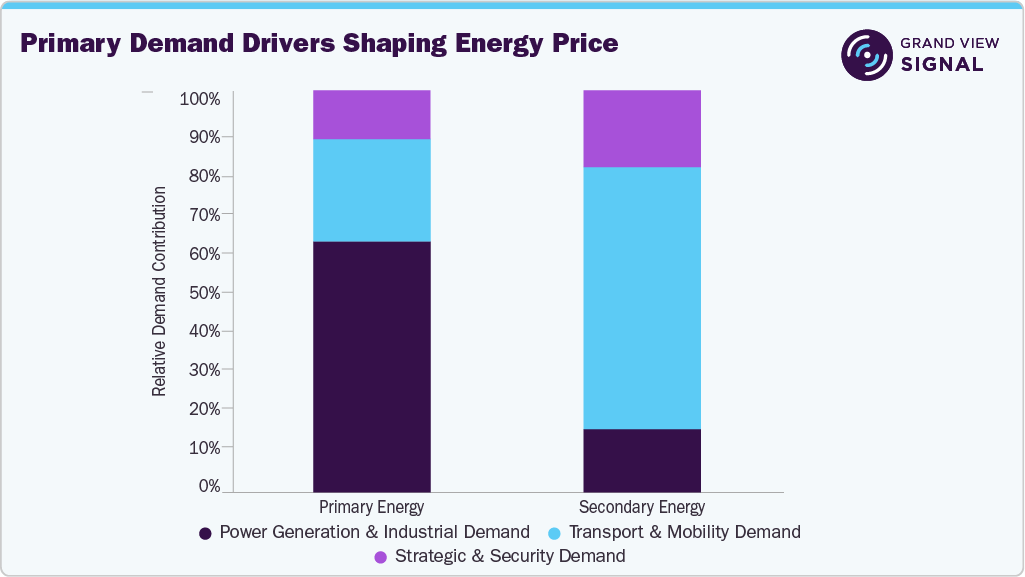
To protect operating balance sheets, manufacturing and energy executives must evaluate five interconnected market drivers:
1. Upstream Crude Shifts & Transit Bottlenecks
Geopolitical threats across vital maritime corridors force shippers to execute extended detours around regional capes. These detours add up to two weeks to cargo transit schedules while driving up bunker fuel surcharges and ocean rates. Rallies in primary crude benchmarks directly lift production expenditures for downstream refiners, expanding regional feedstock spreads to multi-month highs.
2. Regional Gas Disruption & Infrastructure Strain
Unexpected pipeline overhauls, liquefaction terminal outages, and rapid inventory drawdowns frequently contract local gas supplies. When primary hubs experience physical capacity constraints, the disconnect between continuous industrial thermal demand and restricted physical supply triggers sharp price spikes that immediately squeeze fixed-rate buyers.
3. Evolving Environmental Policy & Carbon Tariffs
As CBAM demonstrates, regulatory compliance directly drives fuel costs. Sourcing teams must evaluate carbon-neutral, low-emission, and renewable fuel alternatives side-by-side with baseline fossil quotes to prevent border adjustments from wiping out gross margins.
4. Asymmetric Industrial Demand & Cost Pass-Through Friction
Despite upstream volatility, industrial purchasing across major manufacturing centers (metals, automotive, packaging) remains cautious. Because end-user demand is soft, manufacturers struggle to pass energy surcharges down to customers. Unbudgeted fuel spikes must be absorbed internally, compressing operating margins.
5. Shift to Localized Power & Dynamic Fuel-Switching
To insulate operations from international logistics shocks, major industrial hubs are investing in regional power infrastructure and dual-fuel generation. Following transit disruptions in the Middle East that caused acute natural gas shortfalls across South and East Asia, single-fuel gas consumers in fertilizer and garment hubs suffered severe output curbs and plant shutdowns. In contrast, manufacturing complexes in India that had proactively integrated dual-fuel capabilities (switching dynamically between PNG, LPG, and fuel oil) alongside localized rooftop solar bypassed grid curtailments, maintained baseline output, and protected operating margins.
Access commodity-wise monthly forecast datasets for the next 6 months. Request Free Access to Grand View Signal
Share:
More in Business
View categoryTop 10 Secure Websites for Buying Verified PayPal Accounts
https://mexvoit.com/product/buy-verified-paypal-accounts/ Buy Business PayPal Accounts Our service gives- Cheap Rated Accounts Phone Number Verified SSN Number Verified Debit or credit card access Driving licenses and Selfi Verified. Uses a valid USA IP address Personal & Business Verified Accounts 100% Satisfaction Guaranteed Bank Accounts and Bank Card Access Real Gmail & Active Phone Number Linked 100% verified accounts, USA, UK, CA and other countries 24 Hours Reply/Contact ➤WhatsApp:+1(215)239-4035 ➤Telegram: @Mexvoit ➤Email:mexvoitofficial@gmail.com
READ ARTICLETransparent Roll Up Shutters: Security, Visibility, and Modern Design
Transparent roll up shutters, transparent roller shutters, and transparent safety roll up shutters provide a modern solution for businesses that want to balance visibility, security, and efficient use of space. Their clear panels help showcase products while creating a physical barrier across commercial entrances.
READ ARTICLESheet Molding Compound (SMC) Market Growth 2034: Eyes US$ 6.24 Billion Revenue
The Sheet Molding Compound (SMC) Market size is expected to reach US$ 6.24 Billion by 2034 from US$ 3.39 Billion in 2025. The market is estimated to record a CAGR of 7.00% from 2026 to 2034.
READ ARTICLESelf-Heating Coffee Mugs Market Growth 2034: Eyes US$ 5.2 Billion Revenue
Coverage: By Product Type (Wireless, Wired); Distribution Channel (Supermarkets and Hypermarkets, Specialty Store, Online retail, Others.) , and Geography (North America, Europe, Asia Pacific, and South and Central America)
READ ARTICLE