
Share:

My EMT Practice Test Experience: What I Learned About Emergency Medical Readiness
My EMT practice test experience helped me improve patient assessment, emergency care, trauma response, and medical decision-making before the EMT exam.
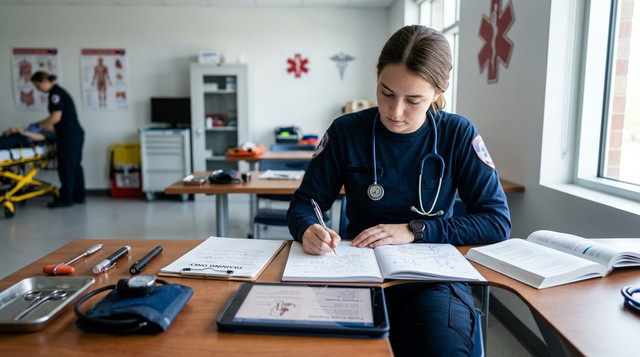
Preparing for the EMT exam made me realize that knowing individual medical concepts is only one part of being ready. I could remember terminology and basic procedures, but that did not always mean I could apply the information quickly when presented with a patient scenario. Working through practice tests gave me a better understanding of where I was prepared and where I still needed to slow down and review.
My first few practice sessions were useful because they exposed gaps that were not always obvious during regular studying. I noticed that I was more comfortable with some straightforward questions than with scenarios requiring several decisions in sequence. Patient assessment, airway and breathing, trauma care, medical emergencies, and emergency response priorities became some of the areas I concentrated on most.
Rather than treating every missed question as simply a wrong answer, I started looking at the reason behind each mistake. That change made my study sessions much more productive.
Understanding What EMT Questions Were Really Testing
One of my biggest lessons was that EMT questions often require more than recalling a definition. A scenario may provide several pieces of information, and I have to determine which detail matters most at that moment.
For example, I might understand the general signs associated with a medical emergency but still hesitate when deciding what should receive immediate attention. Practice scenarios helped me focus on priorities instead of trying to process every detail equally.
I began asking myself a few questions whenever I worked through a scenario:
- What is the immediate threat?
- What information should I assess first?
- Is there an airway, breathing, or circulation concern?
- What intervention or action takes priority?
- What information should be communicated or reassessed?
This approach helped me become more systematic. I was no longer simply searching my memory for an answer. I was trying to understand the situation as a whole and determine the safest next step within the EMT scope of practice.
Building a More Organized Study Routine
My study routine became more structured after I started using practice questions regularly. At first, I would take a test and move on after seeing the score. I eventually realized that the score itself was not the most useful part of the exercise.
Instead, I began reviewing every question that I answered incorrectly or found difficult. Sometimes I had selected the wrong answer because I misunderstood the topic. Other times, I knew the information but had overlooked an important detail in the scenario.
I divided my review into smaller sessions. One session might focus on patient assessment, while another would cover trauma or medical emergencies. This kept me from trying to review everything in one sitting.
I also kept short notes about recurring mistakes. If I repeatedly struggled with a particular concept, I marked it for another review later in the week. This gave me a simple way to measure progress without relying entirely on practice-test scores.
Focusing on Patient Assessment
Patient assessment became one of the most important areas of my preparation. I learned that a strong understanding of assessment provides a foundation for many other EMT topics.
When I encountered assessment-based scenarios, I tried to follow a consistent thought process. I considered the overall situation first and then worked through the patient's immediate needs, relevant history, signs and symptoms, and changes that might require reassessment.
The practice exam questions were particularly helpful when several answers appeared reasonable. Instead of choosing the response that sounded most familiar, I started looking for the answer that addressed the most immediate priority.
This was also where I noticed how important careful reading can be. A single phrase in a scenario can change what the question is asking. I became more deliberate about reading the entire question before looking at the answer choices.
Share:
More in Business
View categoryVerified Cryptomus Accounts
Explore the Cryptomus account registration and verification process with this comprehensive guide. Learn about account setup, identity verification (KYC), security features, cryptocurrency payment solutions, and account management best practices. Discover how to protect your account information, understand verification requirements, and use Cryptomus services responsibly while following the platform's official policies.
READ ARTICLELPS School: Choose the Right School for Your Child
Choosing the right school is one of the most important decisions parents make for their children.
READ ARTICLEUnited States Sports and Energy Drinks Market Size Trends & Growth Analysis Report 2034
The United States sports and energy drinks market size increased from USD 7.6 Billion in 2025 to USD 7.8 Billion in 2026 and is projected to reach USD 10.3 Billion by 2034. This expansion, exhibiting a compound annual growth rate (CAGR) of 3.46%
Interior Designer in Delhi: Transform Your Home into a Space You Love
Finding the right interior designer in Delhi can help you turn that vision into reality. Whether you have purchased a new apartment, are renovating an existing property, or want to upgrade a few rooms, a well-planned design can transform the way you experience your home.
READ ARTICLE