
Share:

Close-Ended Questions: Definition, Examples and When to Use Them
- Use "Other (please specify)" for open-ended lists like tools, reasons or channels. Better still, pilot it open-ended with 20 people and build options from their answers, as Pew suggests.
- Use "Prefer not to say" on sensitive items such as age, ethnicity, health or salary, so nobody is forced to guess or quit.
- Borrow standard lists where they exist. For ethnicity in the UK, the GOV.UK harmonised standard includes "Any other background, please describe" options.
- Add "None of these" to multi-select so you can tell a real zero from a skipped question.
- Keep scales in fixed order, but randomise long unordered lists: self-completers favour options near the top.
For wording the question stem itself, see how to write good survey questions.
HOW MINDPROBE HELPS
Not sure your list covers every answer? Run a short open-ended pilot, let MindProbe's thematic analysis group the replies, and turn the biggest themes into your closed options. Your "Other" box will thank you.
When to use a close ended questionnaire: a 5-question decision checklist
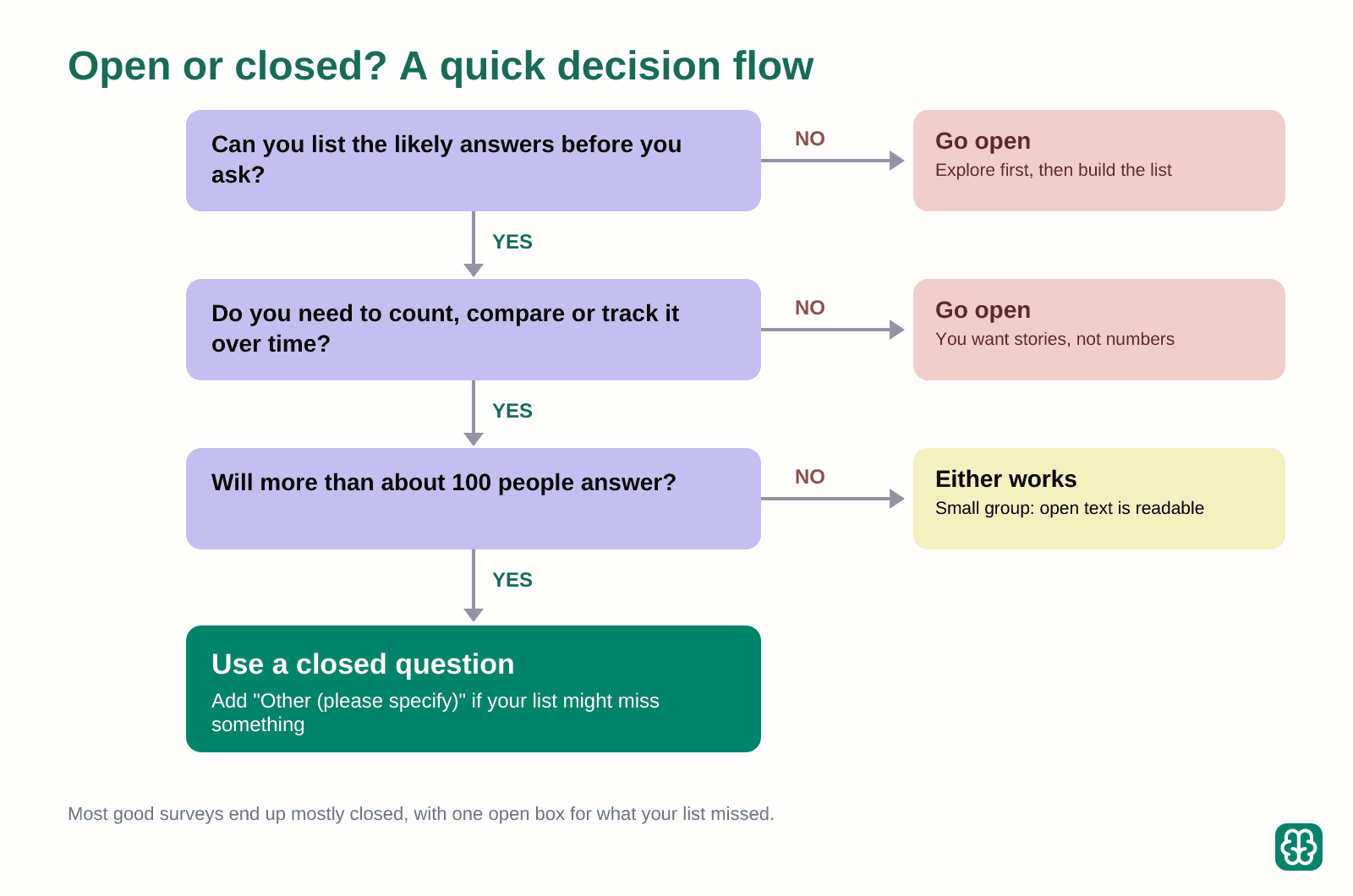
Use a close ended questionnaire when you know the likely answers, need comparable numbers, and expect more responses than you can read.
- Can you list the likely answers? If not, run an open pilot first.
- Do you need to compare groups or track change? Closed answers make 12 sites or 4 quarters comparable.
- Is the sample large? Above about 100 responses, reading every comment stops being realistic.
- Is the topic factual or attitudinal, rather than exploratory? Closed questions measure; they don't discover.
- Will respondents answer on a phone? Taps beat typing on small screens.
Four or five yeses: a close ended questionnaire will serve you well. Two or fewer: start open, then turn what you learn into a closed questionnaire next round.
When not to use closed questions
Skip them for discovery work, tiny samples and questions where the honest answer is "it depends". Five boxes for a complicated experience gives you a tidy, misleading chart.
Worked example: a 7-question employee pulse survey
A monthly pulse: six closed questions for trends, one open box for the rest.
- Which team do you work in? (single choice)
- "I'd recommend this company as a great place to work." (Likert, 5 points)
- How manageable has your workload been this month? (rating, 1 to 5)
- Have you had a one-to-one with your manager in the past four weeks? (yes/no)
- Which of these would most improve your week? (multi-select, with None of these)
- Rank these priorities for next quarter: pay review, hybrid policy, training, tooling. (ranking)
- Is there anything else you'd like leadership to know? (open text, optional)
In MindProbe you can start from a pre-built employee engagement survey in the template library, adjust the options, and send it by email or web link. Results land in a live dashboard, and AI sentiment analysis summarises the open box, so you get numbers and reasons without reading 400 comments.MindProbe recommends keeping a monthly pulse under three minutes.
Frequently asked questions about close-ended questions
What is a close ended questionnaire?
A close ended questionnaire is a survey where every question gives respondents a fixed set of answers to choose from, such as yes/no, multiple choice, rating scales or rankings. Answers are easy to count and compare.
What is the difference between closed and open-ended questions?
Share:
More in Marketing
View categoryBuilding a Travel-Friendly Wardrobe With Matching Clothing Sets
Create a comfortable travel wardrobe with matching sets that make packing and everyday styling easier.
READ ARTICLEWhat Makes Product Packaging Suitable for Retail Shelves?
Suitable product packaging for retail shelves combines attractive design, durable materials, clear branding, and practical sizing. Eye-catching colors and graphics help products stand out among competitors, while strong structures protect items and maintain their appearance. Well-designed packaging improves shelf appeal, builds customer trust, and encourages purchasing decisions. Sustainable materials and professional finishing also strengthen brand recognition and create a positive shopping experience.
READ ARTICLETips for Safely Buying Verified PayPal Accounts: A Full Guide
➥📞 Please Contact me : ╰┈➤📩Email: usaitemstore@gmail.com ╰┈➤☎️WhatsApp: +1 (518) 536-4136 ╰┈➤✈️Telegram: @Usaitemstore
READ ARTICLEBest Kitchen & Bathroom Remodeling Ideas to Know in 2026
This blog explores the latest kitchen and bathroom remodeling trends for 2026, highlighting modern cabinets, smart appliances, stylish fixtures, and spa-inspired bathroom designs. It also covers sustainable materials, space-saving storage solutions, and functional design ideas that improve everyday comfort. Discover how thoughtful remodeling choices can enhance your home's appearance, functionality, and long-term property value.
READ ARTICLE