
Share:

Close-Ended Questions: Definition, Examples and When to Use Them
Picture an HR lead on a Friday afternoon with 400 free-text exit survey comments and a Monday deadline to name the top reason people are leaving. Now picture the same survey built as a close ended questionnaire: one question listing eight reasons, one box for anything else. The answer is a bar chart, ready before the kettle boils. That's the trade. You give up some richness and get speed and numbers you can track quarter after quarter. This guide covers the main types with examples, pros and cons, answer options that don't leak, and a checklist for when closed is the right call.
Key Takeaways
- A close ended questionnaire gives respondents fixed answers to choose from, so results can be counted and compared straight away.
- The main types are single-choice, multi-select, yes/no, rating, Likert, ranking, semantic differential and matrix questions.
- Closed questions steer answers: in a Pew Research Center experiment, 58% picked the economy when it was offered, but only 35% named it unprompted.
- Answer options must be exhaustive and mutually exclusive. Use "Other (please specify)" and "Prefer not to say" deliberately, not by habit.
- Most good surveys are mostly closed, plus one open box.
What is a close ended questionnaire?
A close ended questionnaire is a survey made up of questions with predefined answer options, so respondents choose rather than write. Each answer maps to a category or number you can tally, chart and compare.
Each item is a closed-ended question, such as "Did you attend onboarding?" with Yes and No. The opposite is an open-ended question; we compare the two in Open-Ended vs Closed-Ended Questions.
You'll also hear "closed questionnaire" or "structured questionnaire". Same idea.
Types of closed ended questions: a quick-reference guide
There are six core types of closed-ended questions (single-choice, multi-select, yes/no, rating, Likert and ranking), plus two common variants: semantic differential and matrix grids.
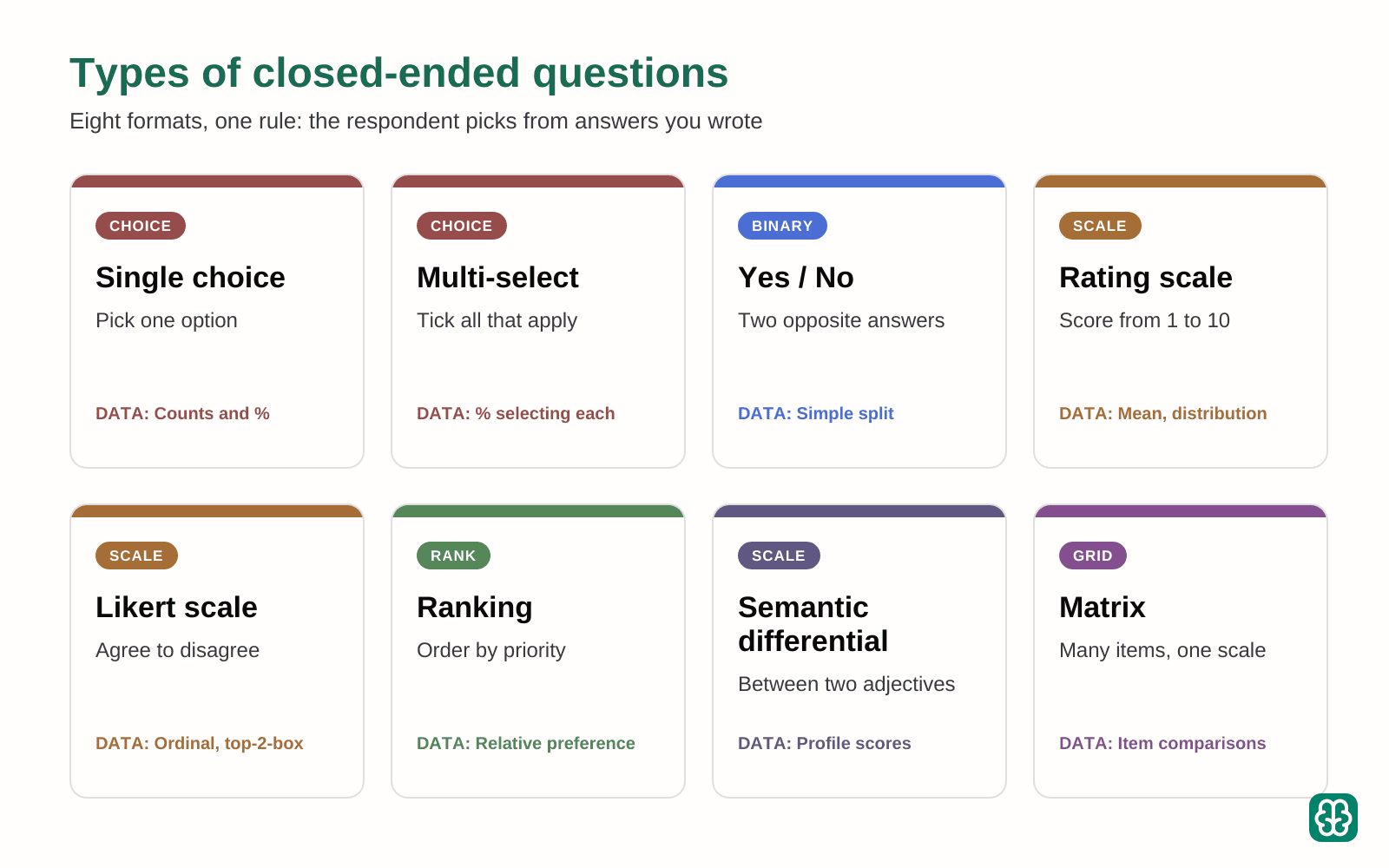
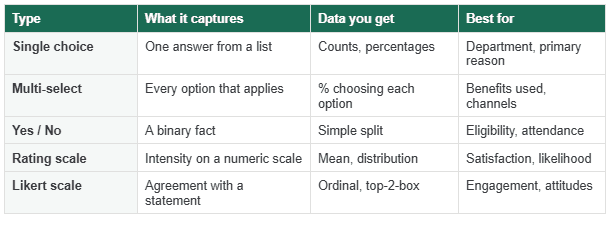
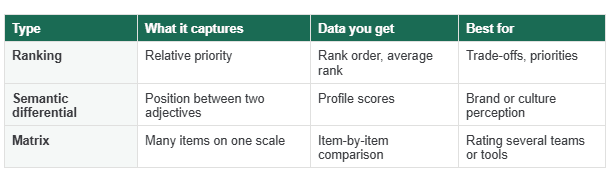
For every format, open and closed, see Survey Question Types: The Complete Guide. Here's each closed type in practice.
Multiple choice (single answer)
The workhorse. One question, a list, one pick. Use it when answers genuinely can't overlap.
SINGLE CHOICE
Which team do you work in?
Share:
More in Marketing
View categoryBuilding a Travel-Friendly Wardrobe With Matching Clothing Sets
Create a comfortable travel wardrobe with matching sets that make packing and everyday styling easier.
READ ARTICLEWhat Makes Product Packaging Suitable for Retail Shelves?
Suitable product packaging for retail shelves combines attractive design, durable materials, clear branding, and practical sizing. Eye-catching colors and graphics help products stand out among competitors, while strong structures protect items and maintain their appearance. Well-designed packaging improves shelf appeal, builds customer trust, and encourages purchasing decisions. Sustainable materials and professional finishing also strengthen brand recognition and create a positive shopping experience.
READ ARTICLETips for Safely Buying Verified PayPal Accounts: A Full Guide
➥📞 Please Contact me : ╰┈➤📩Email: usaitemstore@gmail.com ╰┈➤☎️WhatsApp: +1 (518) 536-4136 ╰┈➤✈️Telegram: @Usaitemstore
READ ARTICLEBest Kitchen & Bathroom Remodeling Ideas to Know in 2026
This blog explores the latest kitchen and bathroom remodeling trends for 2026, highlighting modern cabinets, smart appliances, stylish fixtures, and spa-inspired bathroom designs. It also covers sustainable materials, space-saving storage solutions, and functional design ideas that improve everyday comfort. Discover how thoughtful remodeling choices can enhance your home's appearance, functionality, and long-term property value.
READ ARTICLE