
Share:

Cervical Pillow vs Regular Pillow: Which Is Better for Neck Support?
Compare cervical and regular pillows to understand their differences, benefits, comfort, and neck support to choose the right pillow for better sleep.
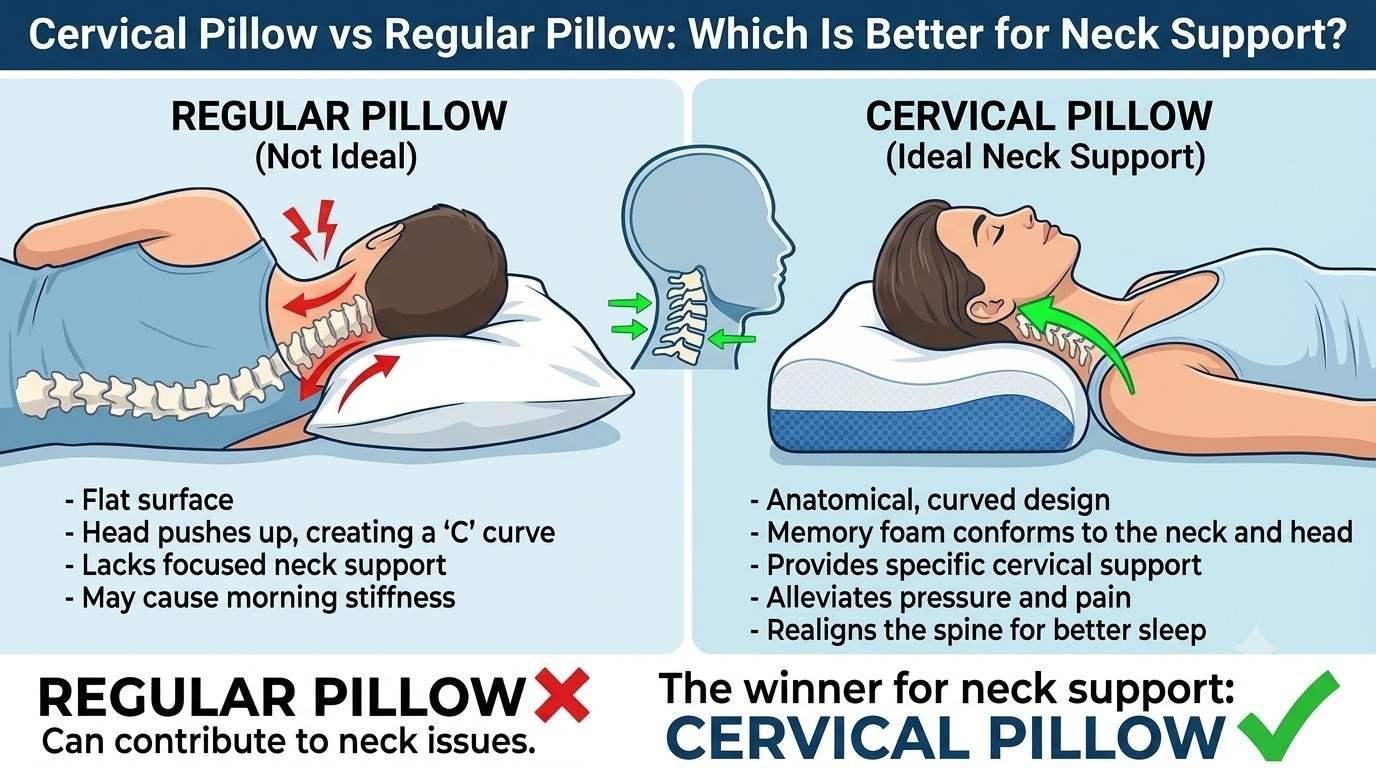
Most of us choose a pillow the way we choose a cup of chai: by habit. We buy the same soft, fluffy rectangle we grew up with and never ask whether it suits our neck. Then one morning the stiffness shows up, and a friend says, "You need a cervical pillow."
But is that true? Is a cervical pillow really better than a regular one, or is it just a more expensive way to sleep? The honest answer is: it depends on your neck, your sleeping position and your comfort preferences. This guide explains how the two types differ, who tends to benefit from each, and how to decide without guesswork. It draws on the range at Sleepsia, an Indian brand that makes orthopedic and memory foam pillows for everyday sleepers.
What Is a Cervical Pillow, and What Counts as a Regular One?
A regular pillow is the familiar flat or gently rounded rectangle. It is usually filled with polyester fibre, microfiber, cotton or feathers, and its job is simple: give your head something soft to rest on. Because the shape is even, the support is even too. It does not target any one part of your neck.
A cervical pillow is designed around the neck. The word "cervical" refers to the cervical spine, the seven vertebrae that make up your neck. These pillows typically have a raised curve that sits under the neck and a shallow dip that cradles the head. The idea is to support the natural inward curve of the neck so that your head stays in line with your spine, rather than tilting up or sagging down.
Many cervical pillows are made from memory foam, which softens with warmth and pressure and moulds to your shape. That is why you will often see the two terms together: an orthopedic cervical pillow in memory foam.
Cervical vs Regular Pillow at a Glance
A cervical pillow offers more targeted neck support, while a regular pillow offers more freedom to move and a softer, more familiar feel.
Feature | Cervical pillow | Regular pillow |
Shape | Contoured, with a neck curve and a head dip | Flat or evenly rounded |
Neck support | Targeted under the neck | General, depends on how you fold or place it |
Typical fill | Often memory foam | Polyester, microfiber, cotton or feather |
Feel | Firmer, more structured | Softer, more flexible |
Moving around at night | Can feel restrictive at first | Easy to shift and reshape |
Adjustment period | A few days to a couple of weeks | Little or none |
Best suited to | Back and side sleepers who want neck alignment | Stomach sleepers and people who like a soft pillow |
Price | Usually higher | Usually lower |
Who Should Consider Which?
A cervical pillow may suit you if:
- You often wake up with a stiff neck or tight shoulders.
- You sleep mostly on your back or side.
- You spend long hours at a desk or on a phone and want better support at night.
- Your current pillow flattens quickly and leaves your head tilted.
A regular pillow may be the better choice if:
- You sleep on your stomach, where a thick, contoured pillow can push the neck back.
- You change positions constantly and dislike a pillow that has a fixed shape.
- You love a soft, sink-in feel and have no neck discomfort.
- You are on a tight budget and your current pillow works well for you.
A note of care: if your neck pain is severe, lasts for weeks, or comes with numbness, tingling or pain that travels down the arm, please see a doctor or physiotherapist. A pillow can support comfortable sleep posture, but it is not a treatment for a medical condition.
How to Choose the Right One
Whichever type you pick, three things decide whether it works.
· Height. Your head should sit level with your spine. A side sleeper needs a higher pillow to fill the space between ear and shoulder. A back sleeper needs a lower one, with the neck curve doing most of the work. Check the pillow's height in centimetres before you buy.
· Firmness. Medium-firm is a safe starting point. Too soft and your head sinks, too hard and your neck tenses. Memory foam should feel supportive without pushing back sharply.
· Sleeping position. This is the deciding factor. Back and side sleepers usually get more out of a contoured pillow. Stomach sleepers generally do better with a thin, soft pillow, or sometimes none under the head at all.
If you cannot decide, start with a pillow that has a gentle contour rather than a steep one. It gives you some of the cervical benefit without feeling too different from what you are used to.
Share:
More in Health
View categoryWho Can Do a Botox Course in India? Eligibility for Doctors, Dentists & Nurses
Botox course in India is a prescription-only medicine under the Drugs and Cosmetics Act, thus is legally qualified and licensed medical practitioners who have been trained in Botox injections. This is a general term, which applies to doctors of MBBS, dentists of BDS/MDS, and AYUSH/nursing professionals working under the supervision of a registered medical practitioner. It cannot be legally carried out by beauticians, cosmetologists or anyone without a recognized medical or dental license, which was reiterated by the Government of India (CDSCO) in some recent circulars stating that injectable procedures are strictly medical, not cosmetology.
READ ARTICLECoolSculpting Before and After: Realistic Results From Houston Patients
Before and after photos are real, sure, but they’re also the best angle, best lighting, best patient on the best day
READ ARTICLE