
Share:

5 Steps to Adopt an AI-Powered School Management System
Adopt an AI-powered school management system with these 5 practical steps to improve school operations, enhance learning, and streamline administration
Across India, teachers are managing nearly three dozen different apps almost daily, juggling tasks from marking attendance to submitting online reports and monitoring learning outcomes . The result? Crucial teaching time has slipped away. A trained educator—a nation-builder—has been quietly reinvented as the world’s most expensive clerk. Meanwhile, in UP, teachers have "lost track of how many apps we’re supposed to use," spending most of their day updating data across multiple platforms instead of teaching.
This fragmented approach is unsustainable. But here is the good news: a shift is happening.
With the government mandating AI and Computational Thinking in curricula from Class 3 onwards and allocating ₹500 crore for a Centre of Excellence in AI for education , the sector is ready for a reset. Schools are now looking at the AI-Powered School Management System not as a luxury, but as a necessity. At present India’s Ed-Tech market is valued at $327 million in 2025, and is projected to reach to $521 million by Year 2032 . However, the challenge remains: How does a school adopt an AI-Powered School Management System effectively without causing disruptions?
Here are 5 Key steps to navigate this transition with maximum impact
Audit Your Current systems Before You Automate it
Understand the "dis integration" Crisis
Before introducing an AI-Powered School Management System, you must understand the existing pain points. In most of the educational institutions, technology hasn't simplified things; it has created a systematic format.
Conduct a "Tech Audit." Identify how many applications your teachers use daily. In Maharashtra, teachers reported being overwhelmed by 38 different apps, often with crashing smartphones that can’t keep up . Ask your staff: Are you spending more time uploading reports or teaching?
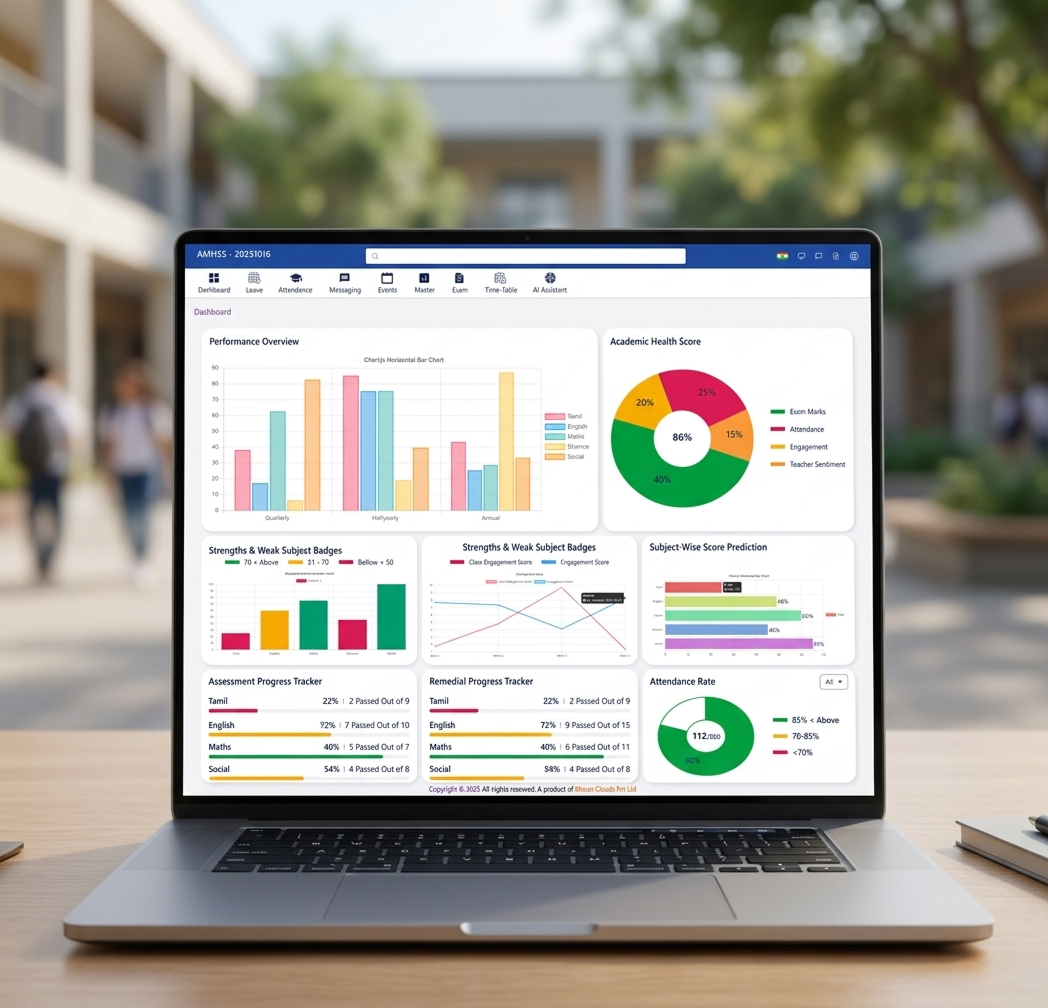
1. Map the Administrative Bottlenecks: The goal here is to find the "pain points." Is it fee collection? Attendance reconciliation? Parent communication? An AI-Powered School Management System excels at consolidation. By centralizing these fragmented systems into one unified platform, you can save administrative hours each week and significantly reduce paper usage . This consolidation is exactly what teachers' unions are fighting for—a single solution rather than 38 apps .
2. Prioritize Integration and Communication, Not Just Automation
The Feature You Need Most is Better Communication
In India, schools often have an app for attendance and another for fees. Parents get lost in the noise. When you look for an AI-Powered School Management System, for your educational institution prioritize those that provides the proper communication channel.
The reason schools like those using platforms such as School Chimes are successful is that they focus on bridging the parent-school communication gap . The platform combines administration tools with features like instant notifications, voice broadcasting, and automated fee reminders .
Reduce Parent-Administration Friction
Why is this important? Because real-time access to attendance records, fee status, and exam updates reduces the administrative load of answering repeated parent inquiries. When the system handles the manual follow-ups and sends automated alerts for homework updates or emergencies, administrators reclaim their time .
3. Leverage Artificial Intelligence
Move Beyond Basic ERP
Digital transformation in education is accelerating. According to the Ministry of Education, AI and Computational Thinking will be treated as "basic universal skills"
Harnessing Generative AI Tools
While adopting your system, look for AI-enabled key features that specifically simplifies your repetitive tasks. Manual timetable generation is a nightmare of conflicting schedules. AI can do this automatically .
Furthermore, consider assessment creation. AI-generated question papers and automated reporting systems are no longer futuristic concepts; they are available now. This directly addresses the "clerical burden" described by educators. If teachers aren't spending their evenings typing out OTPs and feeding portals, they can focus on what matters: teaching, mentoring, and lesson planning .
Share:
More in Technology
View categoryGot an App Idea? What to Do Before You Spend a Single Dollar on Development
Have an app idea in Scottsdale? Learn what to validate, plan, and define before hiring developers or spending money on app development.
READ ARTICLEHow a Dog Treadmill for Home Can Make Daily Exercise Easier in Any Weather
How a Dog Treadmill for Home Can Make Daily Exercise Easier in Any Weather
READ ARTICLEYour Guide to ServiceNow GRC Training in Noida with Techmyindia
ServiceNow GRC Training in Noida can help learners understand how organizations identify risks, manage compliance requirements, and strengthen governance through technology-driven workflows.
READ ARTICLE