
Globhy
BCBusiness Connect1 hour ago1 views

Share:

10 Ways AI Can Improve Code Quality, Security, and Performance

Business

Discover 10 practical ways AI improves code quality, application security, and software performance. Learn how CodeSureX by DATA helps teams build secure, high-quality software faster.
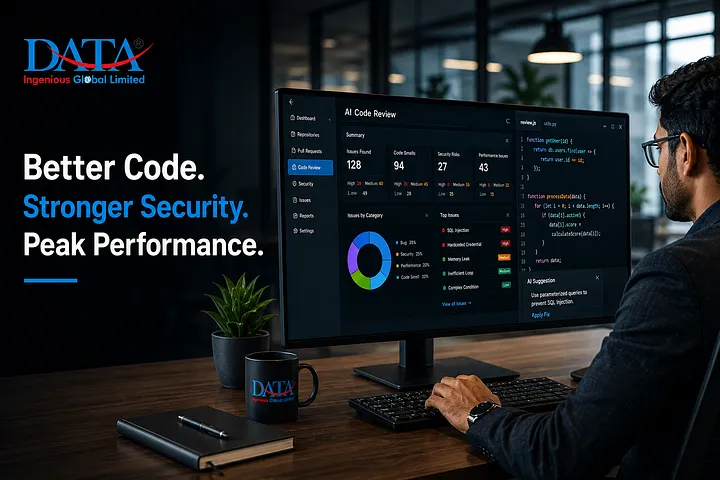
10 Ways AI Can Improve Code Quality, Security, and Performance

Software development has become increasingly complex. Organizations are expected to deliver secure, scalable, and high-performing applications faster than ever before. At the same time, developers must manage growing codebases, stricter compliance requirements, and evolving cybersecurity threats.

This is where Artificial Intelligence (AI) is changing the software development lifecycle.

Rather than replacing developers, AI acts as an intelligent engineering assistant analyzing millions of lines of code, identifying vulnerabilities, recommending improvements, optimizing performance, and automating repetitive tasks.

Platforms like CodeSureX by Data.in combine AI with secure software engineering practices to help organizations build reliable applications while improving productivity across development teams.

Whether you're a CIO, CTO, IT Manager, Government organization, Startup, SME, or Enterprise, AI-powered development tools can significantly improve software quality without increasing engineering overhead.

Why AI Matters in Modern Software Development

AI improves software development by automating code analysis, detecting security vulnerabilities, improving maintainability, optimizing application performance, and assisting developers throughout the Software Development Lifecycle (SDLC). The result is faster delivery, fewer defects, lower maintenance costs, and stronger software security.

The Growing Challenge

Today's applications often include:

Manual code reviews alone are no longer enough.

AI enables engineering teams to continuously monitor, analyze, and improve software quality throughout development.

1. AI Detects Bugs Before Production

AI identifies potential bugs during development by analyzing code patterns, detecting logical inconsistencies, and recognizing issues that traditional static analysis tools may overlook. Early bug detection reduces production failures, improves software reliability, and lowers debugging costs.

How It Works

AI models learn from:

Instead of simply checking syntax, AI understands code context.

Example

Rather than only identifying a null pointer exception, AI can predict where it is most likely to occur and recommend a safer implementation.

Practical Benefits

Key Takeaway: Finding bugs before deployment is significantly less expensive than fixing them after release.

2. AI Improves Code Quality Through Intelligent Reviews

AI automates code reviews by evaluating readability, maintainability, coding standards, and architectural consistency. It provides developers with contextual recommendations, helping teams write cleaner, more maintainable, and standardized code.

Beyond Traditional Linting

Unlike conventional code linters, AI evaluates:

Example

AI may suggest:

Platforms like CodeSureX provide actionable review recommendations that accelerate peer reviews while maintaining development standards.

Key Takeaway: AI helps engineering teams establish consistent coding practices across projects.

3. AI Strengthens Application Security

AI continuously scans source code for vulnerabilities, insecure coding patterns, dependency risks, and configuration issues. It enables organizations to identify security weaknesses earlier, reducing exposure to cyber threats and improving compliance.

Security Risks AI Can Detect

Why This Matters

Security flaws become increasingly expensive to fix later in the SDLC.

AI enables a Shift-Left Security approach by detecting vulnerabilities during development.

Best Practice

Integrate AI security analysis directly into:

Key Takeaway: AI helps developers build secure applications from the beginning rather than fixing vulnerabilities after deployment.

4. AI Optimizes Application Performance

AI identifies inefficient algorithms, resource bottlenecks, excessive memory consumption, and slow execution paths. Developers receive recommendations that improve speed, scalability, and infrastructure efficiency.

Performance Improvements

AI analyzes:

Example

AI may recommend:

Key Takeaway: Better-performing applications deliver improved user experiences while reducing infrastructure costs.

5. AI Reduces Technical Debt

AI identifies outdated code, unnecessary complexity, duplicated logic, and maintainability issues. It prioritizes technical debt based on business impact, helping organizations modernize applications more efficiently.

Technical Debt Indicators

AI identifies:

Practical Application

Instead of manually auditing thousands of files, AI prioritizes high-risk areas that require immediate attention.

Key Takeaway: Reducing technical debt improves long-term software maintainability and lowers operational costs.

6. AI Automates Software Testing

AI enhances software testing by generating test cases, identifying edge scenarios, recommending regression tests, and improving test coverage. This helps organizations deliver more reliable software while reducing manual testing effort.

AI-Powered Testing Includes

Example

AI can automatically generate missing test cases based on newly added business logic.

Key Takeaway: Better testing results in fewer production defects and higher customer satisfaction.

7. AI Improves Developer Productivity

AI accelerates software development by reducing repetitive tasks, assisting with code generation, explaining legacy code, and providing real-time coding recommendations. Developers spend more time solving business problems instead of routine coding tasks.

Productivity Improvements

Developers can:

This complements tools such as Prompt Optimizer, which helps teams create more effective prompts for AI-assisted coding and engineering workflows.

Key Takeaway: AI enables developers to focus on innovation rather than repetitive implementation.

8. AI Enhances DevSecOps Workflows

AI integrates with DevSecOps pipelines to automate security scanning, code quality checks, compliance validation, and deployment readiness. It enables continuous monitoring throughout the software delivery lifecycle.

AI in DevSecOps

AI supports:

Organizations developing Secure AI Systems benefit from integrating AI into CI/CD pipelines for continuous assurance.

Key Takeaway: AI makes software delivery faster without compromising security or quality.

9. AI Supports Smarter Decision-Making

AI provides engineering leaders with actionable insights into software quality, technical debt, release readiness, and development trends. These analytics enable better planning, resource allocation, and risk management.

Executive Insights

AI dashboards help leadership monitor:

This enables CIOs and CTOs to make data-driven technology decisions.

Key Takeaway: AI converts engineering metrics into strategic business intelligence.

10. AI Enables Continuous Software Improvement

AI continuously learns from code changes, production incidents, testing outcomes, and developer feedback to recommend ongoing improvements. This creates a cycle of continuous optimization across software quality, security, and performance.

Continuous Learning

Modern AI systems improve over time by analyzing:

Solutions across the Data.in AI ecosystem including AI Vision, AI/ML Development, Vaani AI, AI Sales Agent, and AI Phone Assistant demonstrate how AI can enhance different aspects of enterprise operations while promoting intelligent automation.

Key Takeaway: Continuous AI-driven improvement helps organizations maintain high-quality software over the long term.

AI vs Traditional Code Review

Feature

Traditional Code Review

AI-Powered Code Review

Speed

Manual

Near real-time

Scalability

Limited

Highly scalable

Bug Detection

Reviewer dependent

Pattern-based and contextual

Security Analysis

Manual

Automated

Performance Suggestions

Limited

Intelligent recommendations

Technical Debt Detection

Difficult

Automated

Consistency

Varies by reviewer

Standardized

Continuous Monitoring

No

Yes

Best Practices for Using AI in Software Development

Common Mistakes to Avoid

Expert Insight

Organizations achieving the best outcomes from AI-assisted development typically combine intelligent automation with experienced engineering oversight. AI excels at rapidly identifying patterns, inconsistencies, and optimization opportunities across large codebases, while human developers provide architectural judgment, business context, and final validation. This balanced approach improves quality without compromising accountability.

Key Takeaways

Frequently Asked Questions

1. How does AI improve code quality?

AI analyzes source code for bugs, code smells, complexity, duplication, and maintainability issues. It provides contextual recommendations that help developers write cleaner, more reliable software.

2. Can AI replace human code reviews?

No. AI is most effective as a complement to human expertise. It automates repetitive analysis and highlights potential issues, while developers make architectural decisions, validate recommendations, and apply business context.

3. Is AI-powered code analysis secure for enterprise use?

Yes, provided organizations use trusted, enterprise-grade platforms with strong security controls, data privacy measures, and compliance features. Self-hosted or private deployment options may be preferred for sensitive environments.

4. Which industries benefit most from AI-assisted software development?

AI-assisted development is valuable across industries, including finance, healthcare, government, manufacturing, retail, telecommunications, and technology, where software quality, security, and compliance are critical.

5. How does AI help reduce technical debt?

AI identifies outdated libraries, duplicated code, overly complex functions, and architectural issues. It also prioritizes remediation based on potential business impact, helping teams modernize codebases efficiently.

6. What is CodeSureX?

CodeSureX is an AI-powered code analysis solution from Data.in that helps organizations improve software quality, identify security risks, reduce technical debt, and optimize application performance through intelligent code reviews and automated insights.

7. Can AI improve application performance without changing functionality?

Yes. AI can recommend optimizations such as more efficient algorithms, database query improvements, caching strategies, and better resource utilization while preserving the application's intended behavior.

Conclusion

AI is redefining how modern software is built, tested, and maintained. By automating code reviews, strengthening application security, improving performance, reducing technical debt, and enhancing developer productivity, AI enables organizations to deliver reliable software faster and with greater confidence.

For enterprises, government agencies, startups, and SMEs, adopting AI-assisted development is no longer just a competitive advantage, it is becoming a strategic necessity. Solutions such as CodeSureX demonstrate how intelligent code analysis can support secure, scalable, and high-quality software engineering while aligning with modern DevSecOps practices.

Ready to Build Better Software with AI?

If you're looking to improve code quality, application security, and development efficiency, explore the AI solutions from Data.in. Whether you're interested in CodeSureX, Prompt Optimizer, AI Vision, AI/ML Development, Vaani AI, AI Sales Agent, AI Phone Assistant, or other intelligent enterprise solutions, Data.in can help your organization accelerate innovation while building secure, future-ready software.

Book a demo with Data.in today and discover how AI can transform your software development lifecycle.

Share:

More in Business

View category