Van Market 2030: Niche Segments to Watch
The global van market was valued at USD 160.90 billion in 2024 and is expected to reach USD 214.24 billion by 2030.
The global van market was valued at USD 160.90 billion in 2024 and is expected to reach USD 214.24 billion by 2030, expanding at a CAGR of 4.8% from 2025 to 2030. Market growth is supported by several key factors, including the rapid expansion of e-commerce and last-mile delivery services, as well as the growing shift toward electric vans.
Compact and multi-purpose vans are increasingly favored for urban freight transportation and shared mobility services due to their fuel efficiency, maneuverability, and operational flexibility. In addition, infrastructure development in emerging economies, including the expansion of road networks and accelerated industrialization in regions such as Asia Pacific and Latin America, is boosting demand for vans used in commercial applications. The rising adoption of electric vans is further strengthening market growth as governments and businesses prioritize sustainability and carbon emission reduction.
According to the European Automobile Manufacturers’ Association (ACEA), electric van sales in the European Union increased by 56.8% in 2023 compared to 2022. Supportive regulatory frameworks, government incentives, and subsidies for electric vehicles have encouraged logistics companies and fleet operators to transition toward electric vans. Moreover, advancements in battery technology and the expansion of charging infrastructure have enhanced the affordability and practicality of electric vans. These developments, combined with rising fuel prices and growing environmental awareness, are accelerating the global transition toward electric van adoption.
The increasing need for urban mobility solutions is also contributing significantly to the growth of the global van market. Cities are prioritizing compact and efficient transportation solutions for both goods and passengers, particularly in congested urban environments. Vans with smaller tonnage capacities are well suited for last-mile delivery, ride-sharing, and on-demand mobility services. The continued growth of e-commerce and the demand for flexible logistics solutions further reinforce this trend. In addition, urban policies promoting sustainable transportation are encouraging the use of eco-friendly vans, including electric and hybrid models.
Order a free sample PDF of the Van Market Intelligence Study, published by Grand View Research.
Key Market Trends & Insights
- North America led the global van market in 2024, accounting for a 32.6% revenue share. Market growth in the region is supported by strong infrastructure and high urbanization rates, which drive demand for efficient transportation solutions. The increasing popularity of recreational vans for road travel and outdoor activities, particularly in the U.S. and Canada, is also contributing to growth. Furthermore, government incentives for electric vehicles and the adoption of advanced fleet management technologies are supporting market expansion in the region.
- By tonnage capacity, the up to 2 tons segment dominated the market with a 44.5% share in 2024. Growth in this segment is driven by increasing demand for compact, fuel-efficient, and cost-effective vehicles used in urban logistics and last-mile delivery. The rapid rise of e-commerce and same-day delivery services has significantly increased demand for lightweight vans. Their low operating costs and versatility make them especially attractive to small and medium-sized enterprises (SMEs) and service-based businesses.
- By propulsion, the internal combustion engine (ICE) segment held the largest market share in 2024. ICE-powered vans continue to be preferred due to their reliability, affordability, and widespread fueling infrastructure. In regions with limited electric vehicle charging networks, ICE vans remain a practical choice for fleet operators. Additionally, their lower upfront cost compared to electric or hybrid vans makes them appealing to SMEs and budget-conscious businesses, despite the growing adoption of alternative powertrains.
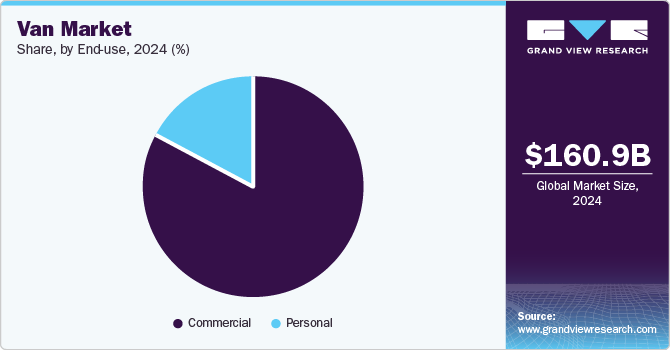
- By end use, the commercial segment dominated the market in 2024, driven by strong demand from logistics, e-commerce, and service industries. Vans play a critical role in transporting goods, equipment, and personnel, particularly in urban areas. The rapid expansion of online retail and increasing demand for last-mile delivery solutions have significantly boosted commercial van adoption. Moreover, the customization flexibility of vans makes them suitable for a wide range of applications, including delivery services, construction, and maintenance operations.
Market Size & Forecast
- 2024 Market Size: USD 160.90 Billion
- 2030 Projected Market Size: USD 214.24 Billion
- CAGR (2025-2030): 4.8%
- North America: Largest market in 2024
- Asia Pacific: Fastest growing market
Key Companies & Market Share Insights
The global van market features several prominent manufacturers, including Mercedes-Benz Group AG, Stellantis NV, and Nissan Motor Co., Ltd. Market participants are actively integrating advanced technologies, such as electrification and connected vehicle solutions, to maintain competitive advantage. Key strategic initiatives include new product launches, mergers and acquisitions, and partnerships aimed at expanding product portfolios and geographic reach.
- Mercedes-Benz Group AG is a leading player in the global van market, offering premium models such as the Sprinter and Vito. The company is heavily focused on innovation, particularly in electric vans, to address growing demand in logistics, transportation, and mobility applications worldwide.
- Volkswagen Group is another major manufacturer, with a broad van portfolio that includes the Transporter and Crafter models. The company is advancing electric mobility through products such as the ID. Buzz electric van, targeting increasing demand for sustainable and efficient commercial and personal transportation solutions.
Key Players
- Ford Motor Company
- Mercedes-Benz Group AG
- Volkswagen Group
- Renault Group
- TOYOTA MOTOR CORPORATION
- Nissan Motor Co., Ltd.
- Hyundai Motor Company
- MITSUBISHI MOTORS CORPORATION
- ISUZU MOTORS LIMITED
- Stellantis NV
Explore Horizon Databook – The world's most expansive market intelligence platform developed by Grand View Research.
Conclusion
The global van market is experiencing steady growth, driven by expanding e-commerce activities, rising demand for last-mile delivery solutions, and the increasing shift toward electric mobility. Urbanization, infrastructure development in emerging markets, and supportive government policies are further strengthening market expansion. While internal combustion engine vans continue to dominate due to affordability and infrastructure availability, electric vans are gaining momentum as battery technology improves and sustainability becomes a priority. With North America leading the market and Asia Pacific emerging as the fastest-growing region, the global van market is expected to reach USD 214.24 billion by 2030, growing at a CAGR of 4.8% over the forecast period.