Sustainable Manufacturing Market Growth: Capitalizing on Eco-Conscious Consumers
The global sustainable manufacturing market was valued at USD 203.65 billion in 2023 and is expected to reach USD 422.12 billion by 2030.
The global sustainable manufacturing market was valued at USD 203.65 billion in 2023 and is expected to reach USD 422.12 billion by 2030, expanding at a CAGR of 11% from 2024 to 2030. Market growth is largely driven by increasingly stringent environmental regulations and government policies focused on reducing carbon emissions, waste generation, and overall environmental impact, prompting manufacturers to transition toward more sustainable operating models.
Rising consumer awareness and growing demand for environmentally responsible products are further encouraging companies to adopt sustainable manufacturing practices in order to align with market expectations. In addition to environmental benefits, sustainable manufacturing often delivers long-term cost advantages through improved resource efficiency, lower energy consumption, and reduced material waste. Technological advancements—including renewable energy integration, energy-efficient machinery, and advanced recycling solutions—are making sustainable production methods more accessible and economically viable.
Sustainability is also being increasingly embedded into Corporate Social Responsibility (CSR) strategies, enabling organizations to strengthen brand reputation and meet evolving investor and stakeholder expectations. As global supply chains grow more complex, manufacturers are placing greater emphasis on ensuring sustainability and ethical compliance across all stages of production and sourcing. Substantial investments in sustainable technologies by governments, private equity firms, and venture capitalists are further accelerating market expansion.
The urgent need to address climate change and reduce greenhouse gas emissions is compelling manufacturers to minimize their environmental footprint through sustainable practices. Additionally, the limited availability of natural resources such as raw materials and water is driving companies to adopt conservation-focused manufacturing models that ensure long-term resource security. Continuous research and development in sustainable materials, processes, and manufacturing technologies is unlocking new opportunities for efficiency improvements and market growth.
Order a free sample PDF of the Sustainable Manufacturing Market Intelligence Study, published by Grand View Research.
Key Market Trends & Insights
- North America dominated the sustainable manufacturing market in 2023, accounting for over 30.0% of total revenue. Companies across the region are setting clear sustainability goals, including carbon footprint reduction and increased use of sustainable materials. Advances in energy-efficient equipment, renewable energy adoption, and sophisticated recycling technologies are making sustainable manufacturing more cost-effective and widely adopted.
- By offering, the recycled plastics segment led the market with a revenue share of over 21.0% in 2023. Stricter regulations related to plastic waste and recycling, combined with rising consumer demand for sustainable packaging and eco-friendly products, are driving the adoption of recycled plastics. The growing emphasis on a circular economy, which prioritizes reuse and recycling, is further supporting segment growth.
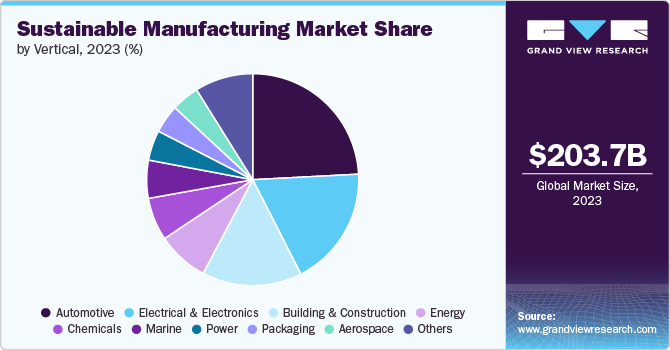
- By vertical, the automotive sector held the largest revenue share in 2023. Increasing consumer preference for environmentally friendly vehicles is encouraging automakers to adopt sustainable materials and production processes. Innovations in battery technology, lightweight components, and energy-efficient manufacturing methods are improving sustainability in automotive production. Additionally, the implementation of circular economy principles and government incentives for electric and hybrid vehicles are reinforcing sustainable manufacturing practices in this sector.
Market Size & Forecast
- 2023 Market Size: USD 203.65 Billion
- 2030 Projected Market Size: USD 422.12 Billion
- CAGR (2024-2030): 11%
- North America: Largest market in 2023
- Asia Pacific: Fastest growing market
Key Companies & Market Share Insights
Key players in the sustainable manufacturing market include 3M, Braskem, and Cirba Solutions. Companies are actively pursuing strategies such as partnerships, mergers and acquisitions, collaborations, and new product and technology development to expand their customer base and strengthen their competitive position. For example, in November 2023, EDF partnered with REEL and selected Veolia’s technological solution to design, manufacture, and deploy mobile units for treating contaminated water in the event of a nuclear accident. This solution aims to minimize environmental impact by treating primary circuit water stored on-site within reactor building tanks following a pipe rupture.
Key Players
- 3M
- Braskem
- Cirba Solutions
- NatureWorks LLC
- Schneider Electric
- Siemens
- Tesla
- Umicore
- Unilever
- Veolia
Explore Horizon Databook – The world's most expansive market intelligence platform developed by Grand View Research.
Conclusion
The sustainable manufacturing market is poised for strong growth through 2030, driven by regulatory pressure, rising consumer demand for eco-friendly products, and continuous technological advancements. Increasing investments, integration of sustainability into corporate strategies, and growing adoption across key industries such as automotive are reshaping manufacturing practices globally. As companies focus on resource efficiency, emission reduction, and circular economy principles, sustainable manufacturing will play a critical role in enabling long-term industrial resilience and environmental stewardship.