ServiceNow CSDM and CMDB: A Comprehensive Comparison for IT Leaders
Discover the key differences between ServiceNow CSDM and CMDB, how they work together, and why a unified model is essential for service-centric IT operations.
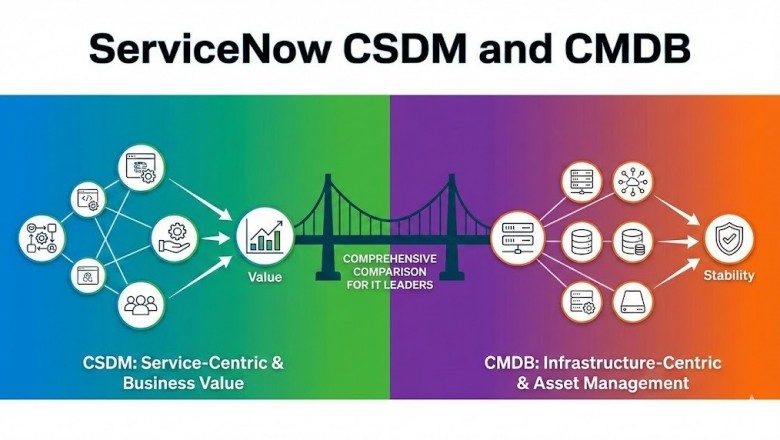
Modern enterprises operate in increasingly dynamic environments where services span hybrid architectures, multi-cloud platforms, distributed applications, and evolving business models. For IT leaders, maintaining clarity across this complexity requires more than inventory tracking. It demands a unified view of technology, services, and business outcomes.
Two foundational pillars provide this clarity: the Configuration Management Database (CMDB) and the ServiceNow Common Service Data Model (CSDM). While closely related, they serve distinct roles. Understanding how they differ — and how they work together — is essential for building service-aware operations and driving organisational maturity.
Understanding CMDB
A CMDB is the system of record for all configuration items (CIs). It provides a complete view of technology components including servers, applications, network devices, cloud resources, databases, containers, and their relationships.
More than just a repository, a well-maintained CMDB supports:
-
Impact analysis for change and incident management
-
Root cause identification
-
Risk evaluation
-
Asset governance and lifecycle tracking
-
Audit readiness and compliance
-
Infrastructure planning and optimisation
The CMDB captures what you have and how it connects. It is the technical backbone for IT operations.
Understanding ServiceNow CSDM
ServiceNow CSDM is a standardised, prescriptive data model that defines how services, applications, infrastructure components, and business capabilities should be represented within the ServiceNow platform.
It is not another database — it is a framework that guides how data should be structured inside the CMDB and across ServiceNow applications. CSDM provides:
-
A consistent naming and modeling convention
-
Defined layers (Business Domain, Application Domain, Service Domain, Technical Domain)
-
Standard relationships between configuration items
-
A common language for IT and business stakeholders
-
A blueprint for service-centric visibility
Where the CMDB represents raw data, ServiceNow CSDM shapes that data into meaningful service views, ensuring accuracy, consistency, and scalability.
CMDB vs ServiceNow CSDM: What Sets Them Apart
Although related, the CMDB and CSDM are fundamentally different in purpose and scope.
1. Function and Intent
-
CMDB: Stores CIs, attributes, and relationships.
-
CSDM: Defines how those CIs and relationships should be structured to support service-aware operations.
2. Output and Value
-
CMDB gives infrastructure visibility.
-
CSDM gives service visibility, allowing leaders to understand how technology supports business outcomes.
3. Flexibility vs Standardisation
-
CMDB can be populated in many ways — which often leads to inconsistency.
-
CSDM enforces a stable, upgrade-friendly model that prevents data fragmentation.
4. Team Impact
-
CMDB primarily benefits operations teams.
-
CSDM benefits the entire organisation by aligning IT with business services, portfolios, and performance metrics.
5. Platform Integration
Many ServiceNow applications require or perform best with CSDM-aligned data. Without adherence to the model, modules such as ITOM, APM, Service Portal, Service Mapping, and SPM cannot operate at full capability.
Why CMDB Alone Is Not Enough
A CMDB that captures infrastructure components is helpful — but without structure, consistency, and service alignment, it becomes difficult to:
-
Identify business impact when a CI fails
-
Support service-level reporting
-
Onboard new services efficiently
-
Scale platform capabilities
-
Maintain clean, reliable data across teams
Organisations with CMDB only often face:
-
Duplicate CI classes and naming conventions
-
Inconsistent service definitions
-
Conflicting interpretations between departments
-
Lack of alignment between applications, services, and business units
-
Technical debt due to excessive customisation
This is where ServiceNow CSDM becomes essential.
Why ServiceNow CSDM Matters
1. Enables Service-Aware Operations
CSDM connects infrastructure to application services and business services, allowing IT teams to understand impact at a service level, not only a technical level.
2. Provides a Unified Data Architecture
CSDM enforces clarity around what constitutes a service, what qualifies as an application, and how components relate. This eliminates ambiguity and improves cross-functional alignment.
3. Supports Every ServiceNow Workflow
Incident, change, problem, portfolio management, operations management, request fulfilment, and service mapping all rely on structured CI data. CSDM ensures that data is consistently modelled and future-ready.
4. Reduces Technical Debt
Standardised modeling minimises unnecessary customisation and ensures smooth platform upgrades.
5. Strengthens Governance and Reporting
CSDM creates a reliable foundation for accurate dashboards, service availability metrics, cost transparency, and risk management.
Using CMDB + ServiceNow CSDM Together: Best Practice for IT Leaders
Organisations achieve the highest value when CMDB and CSDM work in harmony. The recommended approach is:
Step 1 — Build a Complete and Accurate CMDB
Populate the CMDB with configuration items that reflect your real environment. Ensure relationships, lifecycle states, and CI attributes are consistent. This forms the technical baseline.
Step 2 — Adopt the CSDM Framework as the Standard
Apply the CSDM model to structure CIs, map services, define service offerings, and organise the application portfolio. Establish governance policies to maintain alignment.
Step 3 — Connect Technical CIs to Business Services
Use Service Mapping, Discovery, and manual modeling where required. Link infrastructure components to application services and application services to business services. This delivers end-to-end service visibility.
Step 4 — Implement Data Governance and Compliance
Monitor CI health, completeness scores, and model adherence. Establish review cycles, ownership roles, and automated validation dashboards to maintain model integrity.
Step 5 — Expand Service-Aware Capabilities
Once aligned, you can extend the model across ITSM, ITOM, ITAM, APM, SPM, cloud governance, and operations intelligence — maximising the value of your ServiceNow investment.
Impact for IT Leaders and Enterprise Governance
With CMDB and ServiceNow CSDM working together, IT leaders gain:
Service-Level Impact Analysis
Incidents, outages, and changes can be assessed based on business services rather than isolated components — improving communication, prioritisation, and speed of resolution.
Accurate Service Reporting and Financial Transparency
CSDM-aligned CMDB supports service costing, availability reporting, performance KPIs, and portfolio insights.
Improved Risk and Compliance Posture
Standardised data structures simplify audit processes, risk assessments, and lifecycle tracking.
Reduced Operational Overhead
Consistent modeling eliminates redundant configuration items, simplifies upgrades, and reduces time spent on data correction.
Clear Business–IT Alignment
IT can finally speak the language of the business — services, outcomes, capabilities — instead of isolated infrastructure components.
When Should Organisations Implement CSDM?
CSDM is no longer optional for enterprises using the ServiceNow platform. It becomes essential when:
-
Services need clear definitions and ownership
-
Multiple teams interact with shared service data
-
Organisations plan to expand ServiceNow modules
-
Cloud and hybrid environments are growing
-
Accurate service reporting is required
-
Leadership wants improved transparency and governance
A CMDB without CSDM quickly becomes difficult to maintain and scale.
Conclusion
The CMDB and ServiceNow CSDM are not competing concepts — they are complementary.
-
The CMDB captures what exists in your environment.
-
ServiceNow CSDM defines how that information should be structured to support service-aware operations.
Together, they unlock reliable service visibility, operational resilience, and strategic alignment between technology and business priorities. For IT leaders, adopting both is a foundational step toward a modern, service-centric enterprise.