Next-generation Sequencing Services Market: Gene Regulation Service Dynamics
The next-generation sequencing services market is poised for substantial expansion as technological advancements, precision medicine, and the rising burden of chronic and genetic diseases continue to drive demand.
The global next-generation sequencing services market was valued at USD 6.66 billion in 2024 and is projected to reach USD 40.43 billion by 2033, expanding at a CAGR of 22.54% from 2025 to 2033. Market growth is primarily driven by increasing demand for advanced genomic research, a rising prevalence of genetic disorders, and accelerating adoption of precision medicine worldwide.
A key factor fueling expansion is the growing global burden of genetic and chronic diseases. Conditions such as cancer, cardiovascular diseases, neurological disorders, and rare inherited syndromes continue to rise, increasing the need for advanced diagnostic solutions. Traditional diagnostic methods often fail to detect underlying genetic mechanisms, whereas NGS provides comprehensive genomic insights that support early detection and precise diagnosis. According to the Centers for Disease Control and Prevention (CDC), six in ten Americans live with at least one chronic disease, while four in ten manage two or more, underscoring the urgency for more accurate and scalable sequencing technologies. As healthcare systems shift toward preventive and personalized care, the demand for robust NGS services continues to accelerate.
Key Market Trends & Insights
- North America accounted for the largest revenue share in 2024, at 45.56%.
- The U.S. market is expected to experience substantial growth from 2025 to 2033.
- By service type, human genome sequencing held the largest share at 31.28% in 2024.
- By workflow, the sequencing segment dominated the market in 2024.
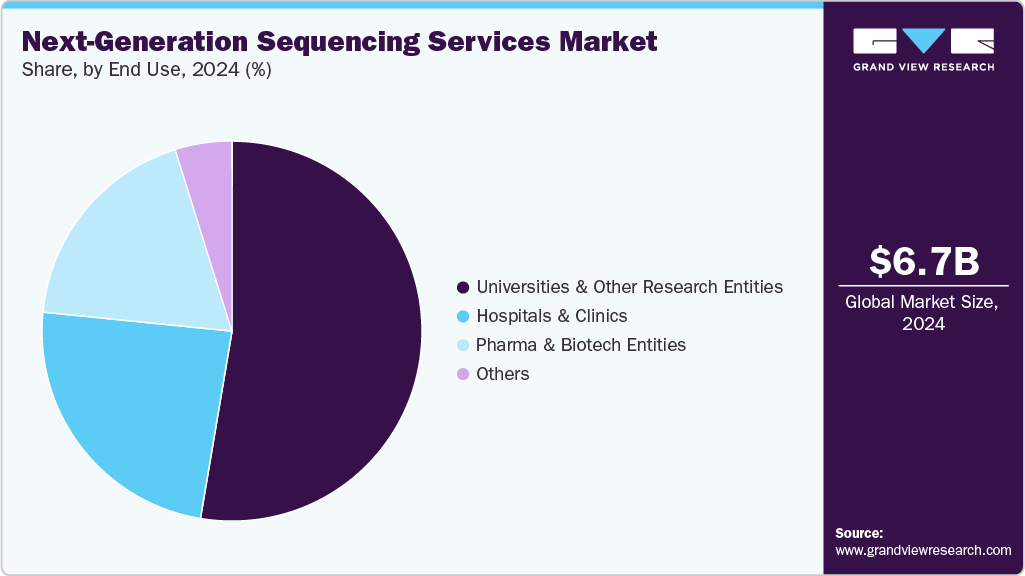
- Among end users, universities and research institutions represented the largest share in 2024.
Download a free sample PDF of the Next-generation Sequencing Services Market Intelligence Study by Grand View Research.
Market Size & Forecast
- 2024 Market Size: USD 6.66 Billion
- 2033 Market Size Projection: USD 40.43 Billion
- CAGR (2025–2033): 22.54%
- Largest Market (2024): North America
- Fastest-Growing Region: Asia Pacific
Competitive Landscape
The NGS services market is rapidly evolving, driven by the need for high-throughput, accurate, and cost-efficient sequencing solutions across clinical diagnostics, research, and pharmaceutical development. Industry leaders—including Illumina, Thermo Fisher Scientific, Quest Diagnostics, ARUP Laboratories, Novogene, Azenta Life Sciences (GENEWIZ), PacBio, BGI, Gene by Gene, Lucigen, abm, NanoString Technologies, and Veritas—continue to expand their footprints through advanced technologies, global service networks, and deep genomics expertise.
These companies offer a wide array of sequencing services, including whole-genome sequencing, whole-exome sequencing, transcriptomics, targeted panels, and metagenomics, all supported by sophisticated bioinformatics and data analysis platforms. Continued investment in R&D, regulatory compliance, and strategic collaborations with hospitals, academic institutions, and biopharmaceutical organizations is positioning these players at the forefront of precision medicine. As personalized healthcare and data-driven drug development accelerate, the NGS market is expected to prioritize innovation, scalability, and global accessibility.
Prominent Companies
- Illumina, Inc.
- Thermo Fisher Scientific Inc.
- BGI Genomics
- Eurofins Genomics
- GENEWIZ
- Macrogen Inc.
- QIAGEN N.V.
- Agilent Technologies Inc.
- Revvity, Inc.
- Twist Bioscience
Explore Horizon Databook – the world’s most comprehensive market intelligence platform by Grand View Research.
Conclusion
The next-generation sequencing services market is poised for substantial expansion as technological advancements, precision medicine, and the rising burden of chronic and genetic diseases continue to drive demand. With strong regional growth dynamics and increasing investment from key industry players, the NGS services sector will remain a critical component of the global healthcare and biotechnology landscape.