Millimeter Wave Technology Market Forecast by Product, Component & Region
The mmWave technology market is on a steep growth trajectory, fueled by the global rollout of 5G and the rising demand for high-speed, high-capacity wireless communication.
The global millimeter wave technology market was valued at USD 3.75 billion in 2023 and is projected to reach USD 38.55 billion by 2030, expanding at a CAGR of 39.7% from 2024 to 2030. mmWave encompasses the high-frequency band ranging from 30 GHz to 300 GHz.
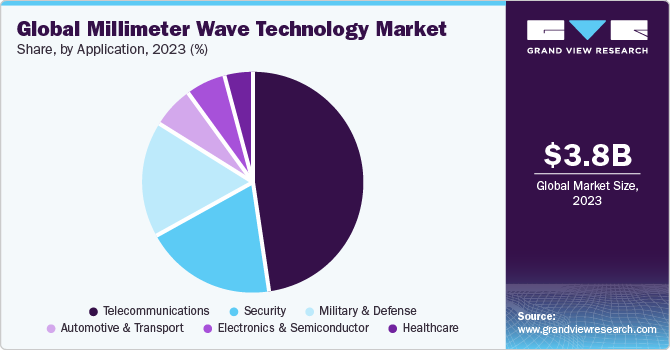
The rapid emergence of 5G technology is a primary catalyst accelerating the adoption of mmWave solutions. 5G mmWave enables ultra-fast and highly responsive connectivity, supporting the surge in connected devices and the growing dependence on wireless infrastructure. As applications such as smart cities, connected vehicles, industrial automation, and high-speed data services continue to expand, mmWave technology is becoming increasingly essential for delivering the performance required in a hyper-connected environment.
However, challenges such as limited transmission range, the need for direct line-of-sight, and sensitivity to environmental obstructions continue to restrict widespread deployment. These constraints affect signal propagation, reliability, and coverage. In response, leading market players are investing heavily in R&D to develop improved mmWave hardware and network solutions designed to overcome these limitations and enhance system robustness.
Key Market Trends & Insights
- North America led the market in 2023 with a 41.8% share.
- Asia Pacific is expected to experience substantial growth, driven by rapid advancements in AI, 5G deployment, and industrial automation.
- By product, telecommunication equipment accounted for 57.8% of global revenue in 2023.
- By component, antennas and transceivers held the largest share at 42.08% in 2023.
- By frequency band, the E-band segment dominated with 62.64% of revenue in 2023.
Download a free sample PDF of the Millimeter Wave Technology Market Intelligence Study by Grand View Research.
Market Size & Forecast
- 2023 Market Size: USD 3.75 Billion
- 2030 Forecast: USD 38.55 Billion
- CAGR (2024–2030): 39.7%
- Largest Market (2023): North America
- Fastest-Growing Market: Asia Pacific
Competitive Landscape
Leading companies operating in the mmWave technology space include NEC Corporation, Keysight Technologies, Bridgewave Communications, and Aviat Networks, Inc.
- NEC Corporation offers advanced mmWave solutions for 5G networks, IoT applications, and radar systems, backed by strong expertise in telecommunications.
- Keysight Technologies specializes in high-frequency test and measurement solutions, supporting the development, validation, and optimization of mmWave devices for 5G and IoT.
- Emerging participants such as Millitech, Inc., E-Band Communications, LLC, Trex Enterprises Corporation, and Siklu Communication Ltd. are contributing innovative components and systems for satellite communications, defense, and radar applications.
- Millitech, Inc. is recognized for its high-performance mmWave components and systems, with applications spanning radar, defense, and satellite communication.
Prominent Companies
- Aviat Networks, Inc.
- BridgeWave Communications
- E-Band Communications, LLC
- Farran Technology
- Keysight Technologies
- LightPointe Communications, Inc.
- Millitech, Inc.
- NEC Corporation
Explore Horizon Databook – the world’s most comprehensive market intelligence platform by Grand View Research.
Conclusion
The mmWave technology market is on a steep growth trajectory, fueled by the global rollout of 5G and the rising demand for high-speed, high-capacity wireless communication. While technical limitations persist, ongoing innovation and industry collaboration are paving the way for broader adoption across telecommunications, industrial automation, defense, and emerging digital ecosystems.