Marine Vessel Market: Scaling Up with Ultra-Large DWT
The global marine vessel market is expected to grow steadily through 2033, supported by rising defense spending, expanding maritime trade, and rapid technological advancements in vessel design and propulsion systems.
The global marine vessel market was valued at USD 112.02 billion in 2024 and is projected to reach USD 150.45 billion by 2033, expanding at a CAGR of 3.6% from 2025 to 2033. Market growth is driven by rising geopolitical tensions, increasing maritime security concerns, and extensive fleet modernization programs across both developed and developing economies.
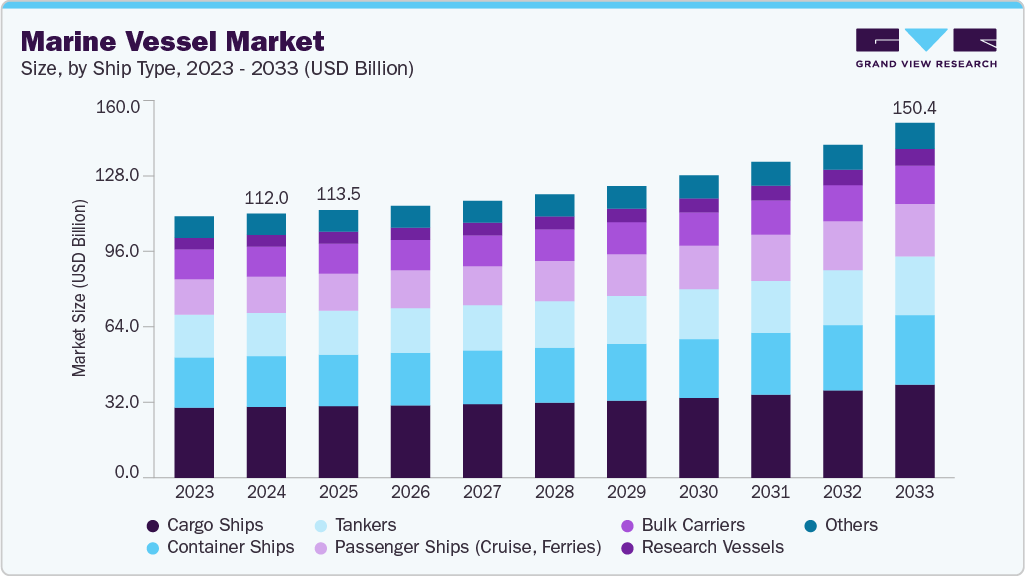
Growing emphasis on naval deterrence, blue-water capabilities, and maritime domain awareness has resulted in increased procurement of advanced surface and sub-surface vessels. Governments worldwide are investing heavily in next-generation naval platforms to strengthen defense readiness, secure sea lanes, and safeguard strategic maritime assets.
Technological advancements are significantly reshaping the marine and naval vessel market. There is a strong shift toward automation, stealth technologies, and integrated combat systems, with vessels increasingly designed using modular architectures that enable rapid upgrades and multi-role functionality. Emerging technologies such as artificial intelligence (AI), unmanned systems, sensor fusion, electric and hybrid propulsion systems, and advanced radar-absorbing materials are being incorporated to enhance operational efficiency, sustainability, survivability, and mission effectiveness.
Key Market Trends & Insights
- The Asia Pacific marine vessel market accounted for 47.2% of the global market share in 2024, driven by strong shipbuilding activity and expanding naval fleets.
- The China marine vessel industry held a dominant position in 2024, supported by large-scale commercial and defense shipbuilding capabilities.
- By ship type, the cargo ships segment accounted for the largest share of 26.8% in 2024, reflecting growth in global trade and logistics.
- By deadweight tonnage, vessels with more than 15,000 DWT held the largest market share in 2024.
- By operation, the seafaring segment dominated the market in 2024, driven by rising commercial and defense maritime operations.
Download a free sample PDF of the Marine Vessel Market Intelligence Study by Grand View Research
Market Size & Forecast
- 2024 Market Size: USD 112.02 Billion
- 2033 Projected Market Size: USD 150.45 Billion
- CAGR (2025–2033): 3.6%
- Largest Market (2024): Asia Pacific
Competitive Landscape
The marine vessel market is characterized by the presence of large, well-established shipbuilders and maritime technology providers focusing on innovation, strategic partnerships, and capacity expansion. Leading companies shaping industry trends include:
- HD Hyundai Heavy Industries Co., Ltd.
- Hanwha Ocean Co., Ltd.
- Samsung Heavy Industries Co., Ltd.
- Fincantieri S.p.A.
- Mitsubishi Heavy Industries, Ltd.
- Oshima Shipbuilding Co., Ltd.
- General Dynamics NASSCO
- Rolls-Royce plc
- Kongsberg Maritime
- Damen Shipyards Group
Recent Developments
- July 2025 – Cochin Shipyard Limited (CSL) entered into a strategic Memorandum of Understanding (MoU) with HD Hyundai, through its shipbuilding arm HD Korea Shipbuilding & Offshore Engineering Co. Ltd. (HD KSOE). The partnership aims to strengthen India’s shipbuilding capabilities through technology transfer, productivity enhancement, workforce development, and joint pursuit of domestic and international shipbuilding opportunities, in alignment with initiatives such as Maritime Amrit Kaal Vision 2047 and Maritime India Vision 2030.
- June 2025 – Eureka Naval Craft collaborated with Greenroom Robotics to develop next-generation autonomous naval vessels, resulting in the launch of the AIRCAT Bengal, a 36-meter multi-mission Surface Effect Ship (SES) designed for fully autonomous operations. The partnership focuses on delivering faster, more cost-efficient, and simpler-to-construct naval platforms.
Explore Horizon Databook – the world’s most comprehensive market intelligence platform by Grand View Research.
Conclusion
The global marine vessel market is expected to grow steadily through 2033, supported by rising defense spending, expanding maritime trade, and rapid technological advancements in vessel design and propulsion systems. Asia Pacific is anticipated to remain the dominant regional market, while innovations in automation, autonomous vessels, and sustainable propulsion technologies will continue to shape the future of the industry. Strategic collaborations, modernization initiatives, and adoption of advanced digital and naval technologies will be critical in defining competitive success across the marine vessel ecosystem.