Low Rolling Resistance Tire Market: Uncovering the Benefits for Eco-Conscious Drivers
The global low rolling resistance (LRR) tire market was valued at USD 21.25 billion in 2024 and is expected to expand to USD 43.57 billion by 2030.
The global low rolling resistance (LRR) tire market was valued at USD 21.25 billion in 2024 and is expected to expand to USD 43.57 billion by 2030, registering a CAGR of 12.7% from 2025 to 2030. This strong growth trajectory is primarily driven by advancements in tire technology, increasing environmental awareness, and rising consumer preference for fuel-efficient mobility solutions.
A key benefit of low rolling resistance tires lies in their ability to improve vehicle fuel efficiency. These tires are engineered to minimize energy losses caused by tire deformation during motion, which directly enhances fuel economy. Research suggests that vehicles equipped with LRR tires can experience fuel efficiency improvements ranging from 5% to 10%. This advantage makes them highly attractive to both individual consumers and commercial operators seeking to reduce fuel expenses amid escalating energy costs.
Environmental considerations also play a significant role in accelerating the adoption of low rolling resistance tires. Governments across the globe are enforcing stricter vehicle emission regulations, and LRR tires provide an effective means to comply with these standards. By lowering fuel consumption, these tires help reduce greenhouse gas emissions, supporting global initiatives focused on sustainability and climate change mitigation.
Technological progress has further strengthened the market outlook. Innovations in materials, including the use of silica and graphene, have allowed manufacturers to reduce hysteresis losses while maintaining safety, durability, and traction. As a result, modern LRR tires deliver reliable performance across various road and weather conditions. Additionally, lightweight construction and optimized tread patterns contribute to improved efficiency and extended tire life.
Order a free sample PDF of the Low Rolling Resistance Tire Market Intelligence Study, published by Grand View Research.
Key Market Trends & Insights
- Regional Outlook: The Asia Pacific region held the largest market share of 26.9% in 2024 and is projected to grow at a CAGR of 13.8% from 2025 to 2030. This dominance is supported by rapid growth in automotive production and increasing electric vehicle adoption. China and India are major contributors, with China leading in vehicle manufacturing and sales. Strong public and private investments in advanced tire technologies, along with a growing emphasis on fuel efficiency and sustainability, continue to drive regional demand.
- By Vehicle Type: Passenger cars accounted for approximately 41.1% of the total revenue share in 2024. Growth in this segment is fueled by rising demand for fuel-efficient vehicles among environmentally conscious consumers. LRR tires help reduce rolling energy loss, resulting in cost savings and lower emissions. Stringent emission regulations have further encouraged automakers to integrate LRR tires into passenger vehicle models.
- By Width: Wide-band low rolling resistance tires are gaining traction due to their ability to distribute vehicle weight more evenly, thereby reducing frictional heat and tire wear. These characteristics make them ideal for heavy commercial vehicles and long-haul operations, where durability and fuel efficiency are essential. Their suitability for electric vehicles further supports their increasing adoption.
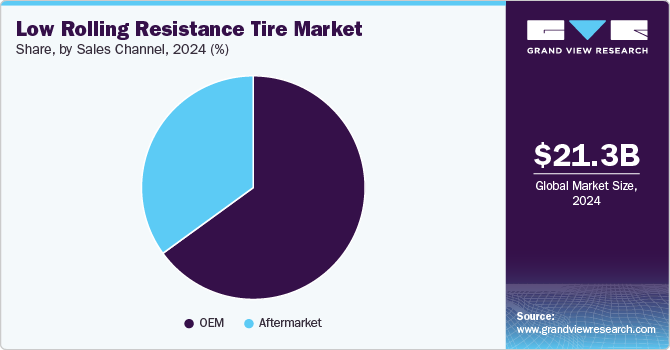
- By Sales Channel: The OEM segment accounted for a significant share of the market in 2024, driven by the installation of LRR tires during vehicle manufacturing. Automakers are adopting these tires to meet regulatory requirements related to fuel efficiency and carbon emissions. LRR tires are commonly offered as standard equipment in hybrid and electric vehicles, where energy efficiency is a major selling point.
Market Size & Forecast
- 2024 Market Size: USD 21.25 Billion
- 2030 Projected Market Size: USD 43.57 Billion
- CAGR (2025-2030): 12.7%
- Asia Pacific: Largest market in 2024
Key Companies & Market Share Insights
Leading companies such as Bridgestone, Michelin, Goodyear, Continental, and Pirelli hold a dominant position in the market due to their strong brand recognition, extensive product portfolios, and robust research and development capabilities. These manufacturers utilize advanced technologies to develop LRR tires suitable for both internal combustion engine vehicles and electric vehicles.
For instance, Bridgestone’s Ecopia range and Michelin’s Primacy low rolling resistance HP tires are designed to enhance fuel efficiency without compromising safety or performance. Their global reach and ability to serve diverse vehicle segments provide a strong competitive advantage. As electric vehicle adoption rises and emission regulations become more stringent, competition is expected to intensify. Companies focusing on sustainability, innovation, product diversification, and strategic partnerships are likely to maintain market leadership.
Key Players
- Bridgestone Corporation
- Michelin
- Goodyear Tire & Rubber Company
- Continental AG
- Pirelli & C. S.p.A.
- Hankook Tire
- Yokohama Rubber Co. Ltd.
- Apollo Tyres Ltd.
- Cheng Shin Rubber Industry Co. (Maxxis)
- Kumho Tire
- Zhongce Rubber Group Co., Ltd. (ZC-Rubber)
- Nokian Tyres plc
- MRF Tyres
- Sumitomo Rubber Industries, Ltd.
- Firestone Tire and Rubber Company
- Cooper Tire & Rubber Company
- Toyo Tire & Rubber Company
Explore Horizon Databook – The world's most expansive market intelligence platform developed by Grand View Research.
Conclusion
The global low rolling resistance tire market is poised for substantial growth, driven by the convergence of regulatory pressure, technological innovation, and increasing demand for fuel-efficient and sustainable transportation solutions. With significant gains in fuel economy, reduced environmental impact, and compatibility with electric vehicles, LRR tires have become a critical component of the evolving automotive ecosystem. As automakers and consumers continue to prioritize efficiency and sustainability, and as emerging markets—particularly in Asia Pacific—expand rapidly, the demand for low rolling resistance tires is expected to grow steadily through 2030. Companies that invest in advanced materials, eco-friendly designs, and strategic collaborations will be well-positioned to capitalize on this expanding market opportunity.