Live Streaming Market 2030: Key Players to Watch
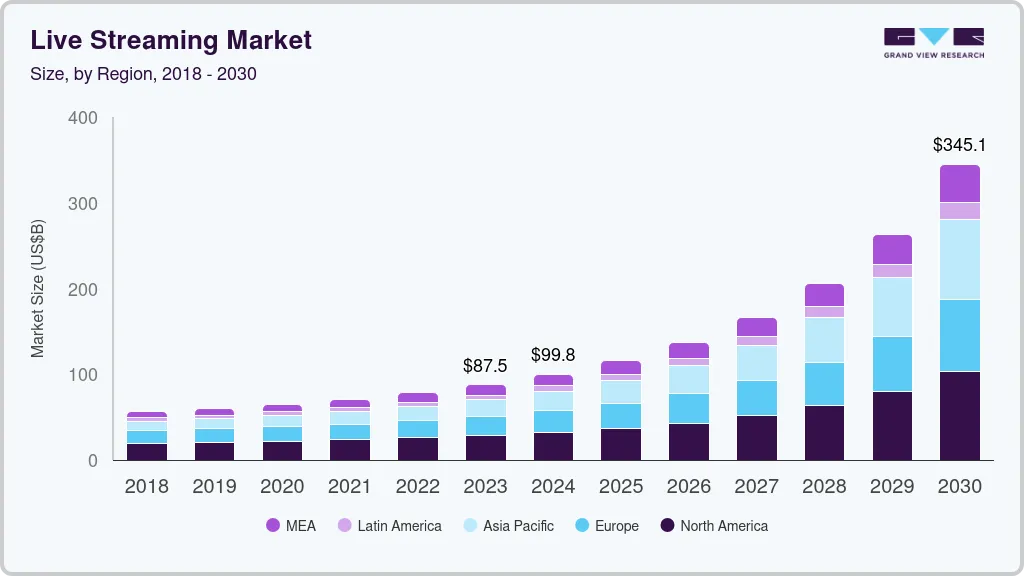
The global live streaming market was valued at USD 87.55 billion in 2023 and is expected to reach USD 345.13 billion by 2030, expanding at a CAGR of 23.0% from 2024 to 2030.
The global live streaming market was valued at USD 87.55 billion in 2023 and is expected to reach USD 345.13 billion by 2030, expanding at a CAGR of 23.0% from 2024 to 2030. The market’s rapid growth reflects a fundamental shift in how audiences consume digital content. Viewers are increasingly moving away from passive consumption of pre-recorded media and are instead seeking interactive, real-time experiences that allow direct engagement with content creators.
Live streaming has emerged as a powerful medium to meet this demand for interactivity. Features such as live Q&A sessions with influencers, experts, and brands on platforms like Instagram Live and YouTube Live enable audiences to participate actively by asking questions and receiving immediate responses. This real-time engagement transforms content consumption into a more immersive and participatory experience, strengthening audience involvement and fostering deeper connections between brands, creators, and viewers.
Another major driver of market growth is the widespread adoption of multi-platform and multi-device content consumption. Audiences increasingly access live streams through smartphones, tablets, smart TVs, gaming consoles, and other connected devices. This flexibility allows users to watch content anytime and anywhere, supporting mobile and on-the-go lifestyles. Seamless transitions across devices enhance viewing continuity and increase overall engagement. For content creators, this trend expands audience reach and enables the delivery of tailored experiences across diverse viewing environments. Companies such as Netflix have successfully embraced this approach by offering content across multiple devices, highlighting the growing importance of platform versatility.
Emerging technologies such as virtual reality (VR), augmented reality (AR), and mixed reality (MR) are further accelerating the evolution of live streaming. These technologies enhance immersion by allowing creators to integrate virtual environments, interactive overlays, and real-time visual enhancements into their broadcasts. VR live streaming can place viewers within the event itself, while AR elements provide additional information and interactive features during live sessions. As these technologies become more accessible, they are creating new opportunities for differentiation and innovation in an increasingly competitive live streaming landscape.
Order a free sample PDF of the Live Streaming Market Intelligence Study, published by Grand View Research.
Key Market Trends & Insights
- Regional Insights: North America dominated the global live streaming market in 2023, accounting for 32.60% of total revenue. Strong audience interest in live entertainment, gaming, sports, and e-learning continues to fuel regional growth. As demand for real-time and interactive experiences rises, content creators and platforms are expanding offerings tailored to North American preferences, making the region a key revenue generator.
- Component Insights: The platforms segment led the market with a revenue share of 64.03% in 2023. Growth in this segment is driven by changing user preferences, technological innovation, and expanding content diversity. Established platforms such as Twitch, YouTube Live, and Facebook Gaming continue to dominate, while niche platforms targeting specific interests—such as gaming, education, and professional networking—are gaining traction. Social media platforms including Instagram, Twitter, and TikTok are also integrating live streaming features, broadening market reach.
- Type Insights: The video streaming segment accounted for the largest share of market revenue in 2023. Widespread access to high-speed internet and affordable data plans has significantly expanded the global audience for live video content. Over-the-top (OTT) platforms such as Twitch, YouTube Live, and Facebook Live provide live streams across gaming, sports, and events, attracting viewers worldwide.
- Revenue Model Insights: The ad-supported segment generated the highest revenue share in 2023. Free access to content under this model attracts large audiences, creating valuable advertising opportunities. Advanced targeting and analytics allow advertisers to reach specific demographics, driving strong monetization for platforms and creators while encouraging continuous content production.
- End-Use Insights: The gaming segment held the largest market revenue share in 2023. The rise of esports has transformed gaming into a mainstream spectator activity, with professional players and streamers attracting large audiences and sponsorships. Interactive features such as live chat and viewer donations further enhance engagement, loyalty, and monetization within the gaming ecosystem.
Market Size & Forecast
- 2023 Market Size: USD 87.55 Billion
- 2030 Projected Market Size: USD 345.13 Billion
- CAGR (2024-2030): 23.0%
- North America: Largest market in 2023
- Asia Pacific: Fastest growing market
Key Companies & Market Share Insights
Leading companies in the live streaming market are actively pursuing strategies such as product launches, technological enhancements, partnerships, collaborations, and mergers to strengthen their market positions. These initiatives aim to expand platform capabilities, improve user experience, and increase market penetration.
For example, in April 2024, Google Meet, developed by Google LLC, partnered with BRANDLIVE, INC. to provide Workspace users with seamless access to customizable online events and webinars for up to 1,000 participants. This collaboration integrated Google Meet’s familiar interface with Brandlive’s advanced event management tools, enhancing live event hosting capabilities.
Key Players
- Dacast, Inc.
- Empire Video Productions LLC
- Flux Broadcast Ltd.
- Huya Inc.
- International Business Machines Corporation
- Meta
- Pluto Inc.
- TikTok Inc.
- Twitch Interactive, Inc.
- Vimeo, Inc.
Explore Horizon Databook – The world's most expansive market intelligence platform developed by Grand View Research.
Conclusion
The live streaming market is undergoing rapid expansion, driven by growing demand for real-time, interactive content, widespread multi-device accessibility, and advancements in immersive technologies such as VR and AR. With the market projected to grow from USD 87.55 billion in 2023 to USD 345.13 billion by 2030 at a CAGR of 23.0%, live streaming is becoming a central component of digital media consumption. Continued innovation in platform capabilities, monetization models, and immersive experiences will further strengthen audience engagement and position live streaming as a dominant force in the global digital entertainment and communication ecosystem.