Digital Textile Printing Market: Full Segment Trends and Forecast to 2030
The digital textile printing market is on a strong upward trajectory, fueled by e-commerce expansion, fast fashion dynamics, and the widespread adoption of on-demand manufacturing.
The global digital textile printing market was valued at USD 5,800.3 million in 2024 and is projected to reach USD 11,596.4 million by 2030, growing at a CAGR of 12.7% from 2025 to 2030. Market expansion is driven primarily by the rapid rise of e-commerce and fast fashion, both of which rely on speed, customization, and flexible production.
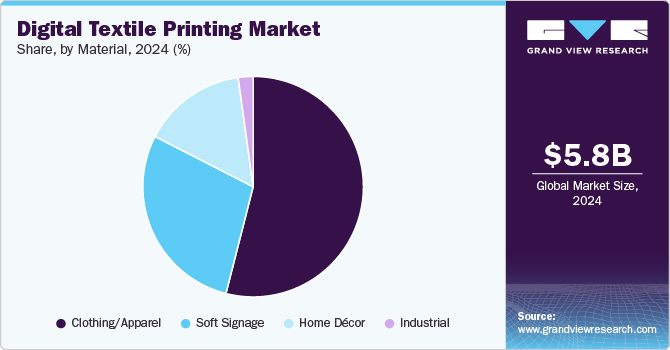
E-commerce platforms, in particular, thrive on fast turnaround times and diverse design offerings, making digital textile printing ideal for producing trendy, on-demand prints. The fast fashion industry also depends on quick design cycles and frequent product launches—capabilities that digital printing supports by significantly reducing lead times and streamlining production. According to the U.S. Census Bureau, the number of global e-commerce websites surged from 9.2 million in 2019 to over 26.2 million in 2023, with e-commerce accounting for 15.6% of total retail sales in the U.S. in 2023.
Another major growth driver is the expanding adoption of on-demand manufacturing, particularly in fashion and home décor. By enabling brands to produce only what is needed, this model minimizes waste, reduces inventory risk, and increases profitability. Digital textile printing aligns seamlessly with this approach, offering the flexibility and speed required for short runs, customization, and rapid response to shifting consumer preferences.
Key Market Trends & Insights
- Asia Pacific held the largest market share in 2024, accounting for 32.6%.
- Demand for digital textile printing in the U.S. is growing rapidly.
- By printing process, direct-to-fabric (roll-to-roll) dominated with a 66.9% revenue share in 2024.
- By operation, the single-pass segment led the market with a 37.7% revenue share in 2024.
- By material, cotton remained the leading segment, capturing 52.4% of global revenue in 2024.
Download a free sample PDF of the Digital Textile Printing Market Intelligence Study by Grand View Research.
Market Size & Forecast
- 2024 Market Size: USD 5,800.3 Million
- 2030 Projected Market Size: USD 11,596.4 Million
- CAGR (2025–2030): 12.7%
- Largest Market (2024): Asia Pacific
Competitive Landscape
Key market players continue to expand their product portfolios and adopt strategic collaborations to strengthen their presence:
- September 2024: Roland DG Corporation launched the TY-300 direct-to-film production transfer printer, offering superior image quality, high productivity, and cost efficiency. The printer’s inks and powders are OEKO-TEX ECO PASSPORT certified, ensuring compliance with global safety and environmental standards.
- April 2024: Epson America, part of Seiko Epson Corporation, introduced the SureColor F11070 and F11070H dye-sublimation printers. Engineered for industrial reliability and high throughput, these models feature a large roll media unwinder and an expanded ink set to support high-volume print environments. Their user-friendly interface and low-maintenance design enhance productivity for industrial and web-to-print operations.
- January 2024: Agfa partnered with EFI, combining their advanced printing technologies. Agfa integrated EFI’s roll-to-roll system into its portfolio, while EFI incorporated Agfa’s hybrid inkjet printers. This strategic alliance strengthens both companies’ offerings, providing customers with an expanded, innovative product range backed by reliable service infrastructure.
Prominent Companies
- Seiko Epson Corporation
- Mimaki Engineering
- Kornit Digital
- Electronics for Imaging
- Roland DG Corporation
- Durst Phototechnik
- Konica Minolta
- Ricoh
- Colorjet
- Sawgrass Technologies Inc
- Spgprints B.V.
Explore Horizon Databook – the world’s most comprehensive market intelligence platform by Grand View Research.
Conclusion
The digital textile printing market is on a strong upward trajectory, fueled by e-commerce expansion, fast fashion dynamics, and the widespread adoption of on-demand manufacturing. As brands increasingly prioritize sustainable, flexible, and efficient production models, digital printing technologies will play an essential role in shaping the future of the global textile industry.