Development of Interactive and Dynamic Web Applications: Technologies, Benefits & Best Practices
Interactive and dynamic web applications represent a modern approach to web development, where user experience is no longer static or one-directional
Users no longer interact with the web in a passive way. They expect websites and applications to respond instantly, adapt to their behavior, and deliver seamless experiences across every device. This shift has made the development of interactive and dynamic web applications a critical focus for businesses aiming to engage users, improve performance, and drive measurable growth. By combining modern technologies, data-driven architecture, and user-centered design, interactive and dynamic web solutions are redefining how digital products create value and stay competitive.
What Are Interactive and Dynamic Web Applications?
Interactive and dynamic web applications represent a modern approach to web development, where user experience is no longer static or one-directional. Instead of simply displaying fixed content, these applications are designed to respond intelligently to user actions and data in real time, creating a more engaging and personalized digital experience.
To understand their full value, it is important to look separately at what makes a web application interactive and what defines it as dynamic and how these two concepts work together.
Interactive web applications focus on real-time user interaction. Every click, scroll, input, or gesture triggers an immediate response from the interface, making the user feel actively involved rather than passively consuming content.

What Are Interactive and Dynamic Web Applications?
Common characteristics of interactive web applications include:
- Responsive user interfaces that react instantly to user input
- Features such as live forms, real-time validation, chat widgets, and interactive dashboards
- Smooth animations and micro-interactions that guide user behavior
From a technical perspective, interactivity is largely powered by client-side technologies, particularly JavaScript and modern front-end frameworks like React, Vue, or Angular. These technologies allow parts of a web page to update without requiring a full page reload, resulting in a faster and more fluid user experience.
Ultimately, interactive web applications aim to increase engagement, usability, and user satisfaction, which directly impacts metrics such as time on site and conversion rates.
Dynamic web applications are built around data-driven content. Instead of showing the same information to every visitor, dynamic websites generate content based on user data, preferences, behavior, or real-time system inputs.
Key features of dynamic web applications include:
- Content that changes automatically based on user actions or profiles
- Integration with databases and back-end systems
- Personalized dashboards, recommendations, and user-specific workflows
Dynamic behavior is typically handled on the server side, using back-end technologies such as Node.js, Python, PHP, or Java, along with databases like MySQL, PostgreSQL, or NoSQL solutions. APIs play a critical role in delivering up-to-date information between the server and the front end.
This dynamic capability allows businesses to deliver personalized experiences at scale, adapt quickly to changing data, and support complex business logic within their web applications.
Interactive vs. Dynamic Web Applications: Key Differences
Although the terms are often used together, interactive and dynamic web applications serve different but complementary purposes.
- Interactivity focuses on how users engage with the interface
- Dynamism focuses on how content and data are generated and managed
An interactive web application may respond smoothly to user input, but without dynamic data, the experience remains limited. Conversely, a dynamic web application can deliver personalized content, but without interactivity, it may feel slow or disconnected.
The most effective modern web applications combine both interactivity and dynamic behavior, ensuring that users not only receive relevant content but also enjoy a fast, responsive, and intuitive experience.
Core Technologies Used in the Development of Interactive and Dynamic Web Applications
Building interactive and dynamic web applications requires a carefully selected technology stack that balances performance, scalability, security, and user experience. Rather than relying on a single tool or framework, modern web development combines multiple technologies working together across the front end, back end, and infrastructure layers.
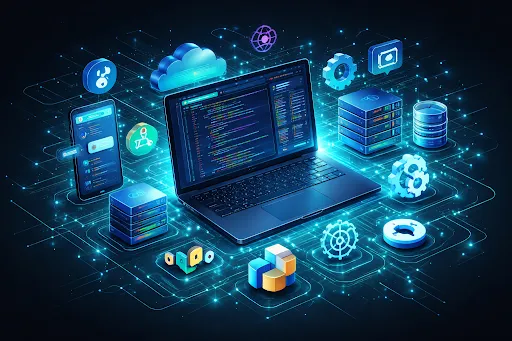
Core Technologies Used in the Development of Interactive and Dynamic Web Applications
Understanding these core technologies helps businesses make informed decisions and ensures that web applications are built on a solid, future-ready foundation.
1. Front-End Technologies for Interactive User Experiences
The front end is where interactivity truly comes to life. It is responsible for how users see, feel, and interact with a web application in real time.
Key front-end technologies include:
-
HTML5 and CSS3 for semantic structure and responsive layouts
-
JavaScript (ES6+) as the core language enabling interactivity
-
Modern front-end frameworks and libraries, such as:
- React.js for component-based UI development
- Vue.js for flexible and lightweight applications
- Angular for large-scale, enterprise-grade solutions
These frameworks support Single Page Application (SPA) architectures, allowing content to update dynamically without full page reloads. This results in faster interactions, smoother transitions, and a more app-like experience for users.
To enhance performance and usability, additional techniques such as state management, lazy loading, and UI component libraries are commonly applied.
2. Back-End Technologies Powering Dynamic Content and Logic
While the front end handles interaction, the back end is responsible for business logic, data processing, and content generation, the core elements of dynamic web applications.
Common back-end technologies include:
-
Node.js for scalable, event-driven applications
-
Python frameworks such as Django or Flask for rapid development and clean architecture
-
PHP frameworks like Laravel for robust content-driven platforms
-
Java frameworks such as Spring Boot for complex enterprise systems
These back-end technologies interact with databases to store and retrieve data efficiently:
- SQL databases (MySQL, PostgreSQL) for structured data
- NoSQL databases (MongoDB, Redis) for flexibility and high performance
A well-designed back-end architecture ensures that dynamic content is delivered quickly, securely, and reliably to the front end.
3. APIs and Real-Time Communication Technologies
APIs serve as the bridge between the front end and back end, enabling seamless data exchange and system integration.
Key technologies include:
- RESTful APIs for standardized communication
- GraphQL for flexible and efficient data queries
- WebSockets for real-time features such as live chat, notifications, and collaborative tools
In addition, third-party APIs allow web applications to integrate essential services such as payment gateways, CRM systems, analytics tools, and cloud-based services. These integrations significantly extend functionality without increasing development complexity.
4. Cloud Infrastructure and Deployment Technologies
Modern interactive and dynamic web applications are rarely hosted on traditional servers alone. Cloud infrastructure provides the scalability and reliability needed to support growing user bases and fluctuating traffic.
Core infrastructure technologies include:
- Cloud platforms such as AWS, Google Cloud, and Microsoft Azure
- Containerization using Docker for consistent deployment environments
- Orchestration tools like Kubernetes for scalability and availability
- CI/CD pipelines to automate testing, deployment, and updates
By leveraging cloud-native technologies, businesses can ensure their web applications remain highly available, secure, and easy to maintain over time.
Beyond the core stack, several supporting technologies play a crucial role in delivering high-quality interactive and dynamic web applications:
- Caching mechanisms to improve speed and reduce server load
- Authentication and authorization tools to protect user data
- Monitoring and analytics tools to track performance and user behavior
- Content Delivery Networks (CDNs) to deliver content faster across regions
These technologies help maintain optimal performance while ensuring compliance with security and data protection standards.
Services Serdao:
Support Helpdesk
Gestion de la Sécurité
Diagnostic et Résolution des Problèmes
Management de la Data
Installation et Configuration
Formation et Support Utilisateur
Maintenance et Mises à Jour des Systèmes
Service de surveillance et de support proactif
Migration de Système à Distance
Key Benefits of Interactive and Dynamic Web Applications for Businesses
Investing in interactive and dynamic web applications is no longer just a technical decision, it is a strategic move that directly impacts user engagement, operational efficiency, and long-term business growth. By combining real-time interaction with data-driven functionality, these applications deliver measurable benefits across multiple business objectives.

Key Benefits of Interactive and Dynamic Web Applications for Businesses
Enhanced User Engagement and Experience
Interactive and dynamic web applications create experiences that feel intuitive, responsive, and personalized. Instead of static content, users interact with interfaces that respond instantly to their actions and adapt to their needs.
Key advantages include:
- Higher user engagement through real-time feedback and interaction
- Reduced bounce rates due to faster and more relevant experiences
- Increased time spent on the platform
When users feel involved and understood, they are more likely to return, explore further, and build trust with the brand.
Improved Conversion Rates and Customer Retention
A seamless, interactive experience plays a critical role in guiding users toward desired actions. Dynamic content allows businesses to tailor messages, offers, and calls-to-action based on user behavior and preferences.
This leads to:
- More effective user journeys with fewer friction points
- Personalized experiences that increase conversion probability
- Stronger customer retention through relevant, timely interactions
By aligning technology with user intent, businesses can turn engagement into measurable results.
Data-Driven Decision Making and Personalization
Dynamic web applications continuously collect and process user data, enabling businesses to make informed decisions based on real-world behavior rather than assumptions.
Business benefits include:
- Deeper insights into user preferences and patterns
- Personalized content, recommendations, and workflows
- Smarter marketing and product optimization strategies
This data-driven approach allows companies to refine their offerings and deliver experiences that resonate more effectively with their target audiences.
Operational Efficiency and Automation
Interactive and dynamic web applications streamline internal processes by automating repetitive tasks and reducing manual intervention.
Examples include:
- Automated form handling and data validation
- Real-time dashboards for monitoring operations
- Seamless integration with internal systems and third-party services
These efficiencies not only reduce operational costs but also allow teams to focus on higher-value strategic activities.
Scalability and Long-Term Business Growth
Modern interactive and dynamic web applications are built with scalability in mind. As user demand grows, features can be expanded and performance optimized without rebuilding the entire system.
Long-term advantages include:
- Flexible architecture that supports business expansion
- Easier integration of new features and technologies
- Improved ability to adapt to changing market demands
This scalability ensures that digital products remain relevant and competitive as businesses evolve.
Stronger Brand Perception and Competitive Advantage
A high-quality interactive and dynamic web application reflects a brand’s commitment to innovation, usability, and customer experience.
From a business perspective, this results in:
- Stronger brand credibility and professionalism
- Differentiation in competitive markets
- Increased customer trust and loyalty
By delivering modern, engaging digital experiences, businesses position themselves as forward-thinking and customer-focused.
Best Practices in the Development of Interactive and Dynamic Web Applications
Developing interactive and dynamic web applications is not just about choosing the right technologies, it is about applying the right practices throughout the entire development lifecycle. When executed correctly, these best practices ensure that applications remain performant, secure, scalable, and truly valuable to end users.
- Adopt a user-centered design approach from the beginning: Start by understanding user behavior, goals, and pain points. Designing around real user needs ensures that interactivity enhances usability rather than becoming a distraction.
- Balance interactivity with performance: Interactive features should feel fast and seamless. Optimize assets, minimize unnecessary animations, and use techniques such as lazy loading and code splitting to maintain high performance.
- Design for scalability and future growth: Build modular architectures that allow new features to be added without disrupting existing functionality. Scalable systems reduce technical debt and support long-term business expansion.
- Ensure robust security and data protection: Implement secure authentication, authorization, and encrypted data transmission. Protecting user data is essential for building trust and meeting regulatory requirements.
- Leverage APIs and integrations strategically: Use APIs to connect systems efficiently and avoid tightly coupled architectures. Well-designed integrations improve flexibility and simplify future updates.
- Optimize for cross-device and cross-browser experiences: Apply responsive and mobile-first design principles to ensure consistent performance across different devices, screen sizes, and browsers.
- Continuously test, monitor, and improve: Use automated testing, performance monitoring, and analytics to identify issues early. Iterative improvements help maintain a high-quality user experience over time.
- Avoid overengineering and unnecessary complexity: Focus on features that deliver real value. Simpler, well-executed solutions often outperform complex systems that are difficult to maintain.
When these best practices are applied consistently, interactive and dynamic web applications become reliable digital assets rather than short-term solutions. They are easier to maintain, faster to evolve, and better aligned with both user expectations and business objectives.
Readmore Blog Serdao:
it support services
helpdesk définition
support informatique
niveau de support
Conclusion
The development of interactive and dynamic web applications has become a defining factor in how businesses deliver value, engage users, and remain competitive in a rapidly evolving digital landscape. More than a technical trend, it represents a strategic approach to building web solutions that are responsive, data-driven, and designed around real user needs.
By combining the right technologies with proven best practices, businesses can create web applications that not only perform efficiently but also scale seamlessly and adapt to future demands. When interactivity and dynamic functionality are implemented thoughtfully, they transform digital platforms into powerful tools for growth, personalization, and long-term success.