Data Center Automation Market: On-Premise vs Cloud Deployment Forecasts
The data center automation market is poised for rapid expansion through 2030, driven by cloud adoption, AI workload growth, and the need for efficient and resilient IT infrastructure management.
The global data center automation market was valued at USD 10,091.9 million in 2024 and is projected to reach USD 25,392.5 million by 2030, expanding at a robust CAGR of 16.9% from 2025 to 2030. Market growth is primarily driven by the rising need for operational efficiency, scalability, and cost reduction in the management of modern data centers. As organizations increasingly transition toward hybrid and multi-cloud environments, the complexity of IT infrastructures has intensified, accelerating the adoption of automated data center solutions.
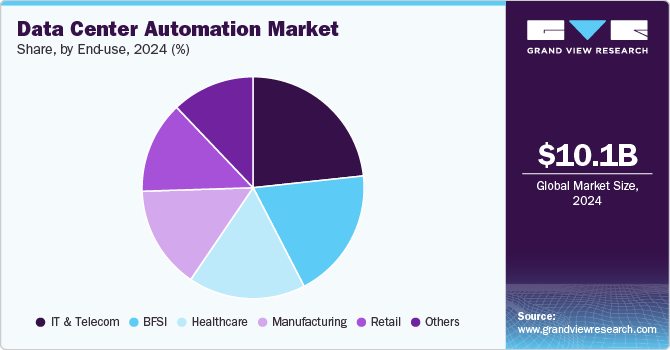
Growing awareness of advanced digital technologies and the expanding deployment of automation-driven solutions across industries are expected to further fuel market growth over the forecast period. Sectors such as manufacturing and healthcare are witnessing increased automation adoption, as organizations seek to streamline operations, enhance reliability, and reduce operational expenditure (OPEX). In particular, manufacturing enterprises are leveraging data center automation to improve process efficiency, minimize downtime, and optimize resource utilization.
Key Market Trends & Insights
- North America held the largest market share of over 43% in 2024.
- The United States is expected to witness significant growth from 2025 to 2030.
- By component, the solution segment dominated the market, accounting for over 66% of the share in 2024.
- By end-use, the IT & telecom segment led the market with a share of approximately 23% in 2024.
Download a free sample PDF of the Data Center Automation Market Intelligence Study by Grand View Research
Market Size & Forecast
- 2024 Market Size: USD 10,091.9 Million
- 2030 Projected Market Size: USD 25,392.5 Million
- CAGR (2025–2030): 16.9%
- Largest Market (2024): North America
Competitive Landscape
The data center automation market is highly competitive, with leading players focusing on product innovation, strategic partnerships, collaborations, and technology integrations to strengthen their market position. Key companies operating in this space include ABB, BMC Software, Inc., Cisco Systems, Inc., Citrix Systems, Inc., FUJITSU, Hewlett Packard Enterprise Development LP, Microsoft, Oracle, ServiceNow, and VMWare.
Notable recent developments include:
- September 2024: ATS Global partnered with ABB to enhance its data center automation capabilities. The collaboration enables the deployment of solutions built on ABB Ability, ABB’s integrated platform for control, monitoring, and optimization of mission-critical data center infrastructure. The platform integrates BMS, EPMS, DCIM, and SCADA functionalities, enabling real-time infrastructure visibility, automated cooling and electrical optimization, elimination of manual KPI tracking, and improved uptime. Supported by ATS Global’s experience in over 100 mission-critical projects, the partnership is expected to improve system availability and customer reliability through responsive local support.
- June 2024: Cisco Systems, Inc. announced a series of innovations aimed at transforming data center infrastructure and IT operations. In collaboration with NVIDIA, Cisco introduced the Cisco Nexus HyperFabric AI cluster solution, an end-to-end platform designed to efficiently scale generative AI workloads. The solution combines Cisco’s AI-native networking capabilities with NVIDIA’s accelerated computing and AI software, further strengthened by VAST Data’s high-performance storage platform.
Prominent Companies
- ABB
- BMC Software, Inc.
- Cisco Systems, Inc.
- Citrix Systems, Inc.
- FUJITSU
- Hewlett Packard Enterprise Development LP
- Microsoft
- Oracle
- ServiceNow
- VMWare
Explore Horizon Databook – the world’s most comprehensive market intelligence platform by Grand View Research.
Conclusion
The data center automation market is poised for rapid expansion through 2030, driven by cloud adoption, AI workload growth, and the need for efficient and resilient IT infrastructure management. Continued technological innovation, strategic collaborations, and increasing automation across industries will remain central to shaping the future of the market.