Chatbots vs AI Agents: Key Development Differences
Discover the key differences between chatbots and AI agents, how they work, and why AI agents offer more advanced capabilities for automation and decision-making. Learn which technology is right for your business.
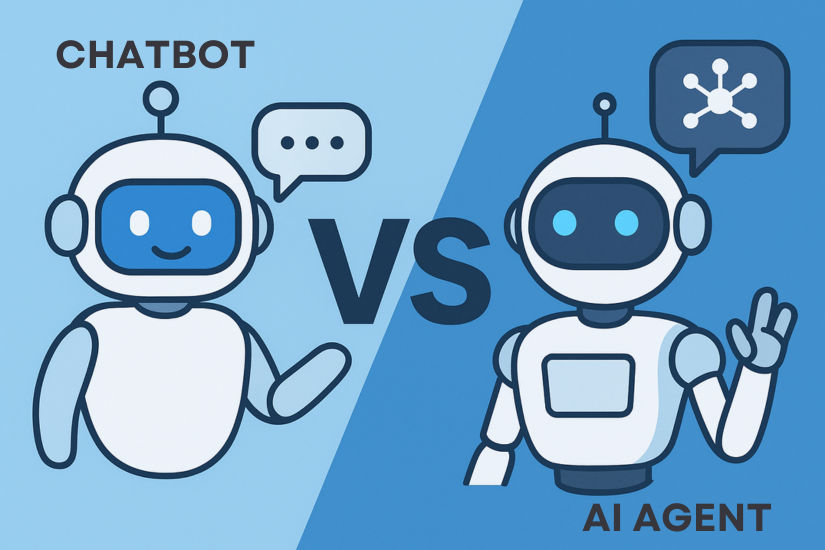
Remember when chatbots were the hottest thing in tech? Every company wanted one. Fast forward to today, and we're talking about AI agents—and honestly, they're in a completely different league.
Here's the thing though: most people use these terms interchangeably. "We need an AI chatbot" often means they actually want an AI agent. Or sometimes the opposite. Understanding the difference isn't just semantics—it fundamentally changes how you approach development, what you should expect, and how much you'll invest.
Let's break down what really separates chatbots from AI agents, and why it matters for your project.
What Chatbots Actually Are
Think of traditional chatbots as really sophisticated decision trees. You ask a question, the bot matches it to something in its database, and spits back a pre-written response. They're basically fancy FAQ systems with conversational interfaces.
Even the more advanced chatbots that use natural language processing are still fundamentally reactive. They respond to what you say but don't really "think" beyond that immediate interaction. Ask them to book a flight, and they'll guide you through the steps—but they're following a script, not actually problem-solving.
That's not a criticism. Chatbots work great for their intended purpose: handling common questions, routing inquiries, and providing basic information. They're predictable, reliable, and relatively simple to build and maintain.
What AI Agents Actually Do
AI agents? Completely different beast. These systems can actually reason, plan, and take actions to achieve goals. Give an AI agent a task like "I need to organize a team meeting next week," and it doesn't just respond—it actually does things.
It might check everyone's calendars, find a time that works, book a conference room, send invitations, and maybe even order lunch. It's breaking down a complex goal into steps, using tools to complete those steps, and adapting when things don't go as planned.
The key difference is autonomy. While chatbots wait for your next instruction, AI agents work toward objectives. They're proactive, not just reactive.
The Development Complexity Gap
Building a chatbot and building an AI agent require completely different skill sets and approaches. Let me explain why.
Chatbot development is relatively straightforward. You map out conversation flows, write responses, maybe train some intent recognition models, and connect it to your FAQ database. A competent development team can build a decent chatbot in weeks.
AI agent development is exponentially more complex. You're building systems that need to understand context across multiple interactions, break complex goals into actionable steps, decide which tools or APIs to use, handle failures and adapt strategies, learn from past interactions, and maintain coherent long-term objectives.
This is why working with an ai agents development company requires finding specialists, not just any AI developer. The architecture, algorithms, and problem-solving approaches are fundamentally different.
The Technology Stack Differences
Chatbots typically use intent recognition, entity extraction, dialogue management systems, and response generation templates. Pretty standard stuff. Many platforms offer no-code or low-code chatbot builders.
AI agents need way more sophisticated technology: large language models for reasoning and planning, tool-use frameworks that let them interact with APIs and databases, memory systems to maintain context across sessions, decision-making algorithms, error handling and retry logic, and often reinforcement learning to improve over time.
When you hire artificial intelligence developers for AI agent projects, you're looking for people who understand these complex systems. It's not just about making something that talks—it's about building something that thinks and acts.
Real-World Capability Differences
Let me give you a concrete example. Say a customer contacts support about a delayed shipment.
A chatbot interaction might go:
- Customer: "Where's my order?"
- Bot: "I can help you track your order. Please provide your order number."
- Customer: "12345"
- Bot: "Your order is delayed. Expected delivery is now March 15."
- Customer: "Can you expedite it?"
- Bot: "For expedited shipping questions, please contact our support team at..."
An AI agent handling the same situation:
- Customer: "Where's my order?"
- Agent: Checks order system automatically "I see your order #12345 is delayed due to weather. Current estimated delivery is March 15, three days later than originally promised."
- Customer: "Can you expedite it?"
- Agent: Evaluates options, checks customer account, reviews shipping alternatives "I can upgrade you to priority shipping at no charge as an apology for the delay. This would get your order to you by March 13. I can also apply a 10% discount to your next purchase. Would you like me to make these changes?"
- Customer: "Yes, please."
- Agent: Updates shipping, applies discount, sends confirmation email "Done. You'll receive a confirmation email shortly, and I've added tracking updates to your account. Is there anything else I can help with?"
See the difference? The agent is actually solving problems, not just providing information.
Cost and Development Time Realities
Let's talk about money, because that's usually the first question.
Basic chatbots might cost anywhere from $5,000 to $50,000 depending on complexity and customization. Development time is typically 4-12 weeks. Maintenance is relatively straightforward—updating responses, adding new intents.
AI agents? You're looking at $50,000 to $500,000+ for sophisticated implementations. Development time ranges from 3-12 months depending on complexity. And they need ongoing attention—monitoring performance, retraining models, updating capabilities.
Working with a generative ai consulting company helps navigate these costs. They can advise on what level of capability you actually need versus what would be nice to have. Sometimes a chatbot really is sufficient. Other times, only an agent will do.
When You Actually Need an AI Agent
Not every problem needs an AI agent. Honestly, they're overkill for many use cases.
You probably need an agent when tasks require multiple steps across different systems, decisions need to be made based on complex criteria, the system should proactively solve problems, interactions need to remember context over days or weeks, or you want the system to improve from experience.
You can probably stick with a chatbot when you're just answering common questions, following simple workflows, providing information retrieval, or routing inquiries to humans.
An ai app development company can help you figure out which approach fits your actual needs versus what sounds cool.
Integration Challenges
Here's something people underestimate: integration difficulty.
Chatbots typically need to connect to a knowledge base and maybe a ticketing system. Pretty straightforward stuff that artificial intelligence integration services handle routinely.
AI agents need to interact with potentially dozens of systems—CRM, inventory management, payment processing, calendar systems, email platforms, and more. Each integration point needs robust error handling because the agent is actually taking actions, not just retrieving information.
Mess up a chatbot integration and someone gets the wrong information. Mess up an agent integration and it might book the wrong flight, charge the wrong amount, or delete important data. The stakes are higher.
The Human Oversight Question
Chatbots need minimal supervision once deployed. They're scripted, predictable, and low-risk. You monitor performance and update content, but they're not making consequential decisions.
AI agents need more careful oversight, at least initially. You're giving them autonomy to take actions, which means you need guardrails, monitoring systems, and often human-in-the-loop verification for high-stakes decisions.
Mature agents from an experienced ai agents development company include robust logging, decision explanation capabilities, and rollback mechanisms. But you still need to watch them more carefully than chatbots.
Making the Right Choice
So which do you need? Here's my honest take.
Start by defining what success looks like. If "answering customer questions faster" is your goal, a chatbot might be perfect. If "reducing support tickets by actually solving problems" is the goal, you probably need an agent.
Consider your technical infrastructure. Agents need to connect to multiple systems and actually make changes. If your systems aren't API-enabled or you have strict controls on automated actions, an agent might be premature.
Think about your budget and timeline. If you need something deployed in six weeks for under $30,000, an agent probably isn't realistic. But if you're planning a 6-month project with serious budget, agents become feasible.
Also Read: Top 10 AI Agent Development Companies in 2026
The Evolution Path
Here's what I see companies doing successfully: start with a chatbot, learn what users actually need, then evolve to an agent when you understand the use cases.
A chatbot gives you data. You see where conversations break down, what tasks users want help with, where human handoffs happen most. Use that intelligence to inform agent development.
When you hire artificial intelligence developers for the agent phase, they're working with real usage data instead of assumptions. That dramatically increases success rates.
Looking Forward
The gap between chatbots and agents will probably blur over time. Today's agents will be tomorrow's basic functionality. But right now, they're genuinely different things requiring different approaches.
If you're exploring either option, find partners who understand both. An ai agents development company worth working with won't push you toward the most expensive option—they'll help you figure out what actually solves your problem.
Sometimes that's a simple chatbot. Sometimes it's a sophisticated agent. Most often, it's something in between that evolves over time. Understanding these differences helps you make that call intelligently.