Capillary Blood Collection Devices Market: Plastic Material Demand Shifts
The capillary blood collection devices market is poised for steady growth, driven by rising PoC diagnostic adoption, growing chronic disease prevalence, and a shift toward home-based and remote healthcare.
The global capillary blood collection devices market was valued at USD 2.13 billion in 2024 and is projected to reach USD 3.52 billion by 2030, expanding at a CAGR of 8.8% from 2025 to 2030. Market growth is fueled by the rising availability of point-of-care (PoC) diagnostics, increasing prevalence of chronic diseases such as diabetes, cardiovascular conditions, and infectious diseases, and the advantages offered by capillary sampling—including ease of use, minimal invasiveness, and suitability for frequent blood testing.
The adoption of rapid PoC diagnostic methods is accelerating, further boosting the need for capillary blood collection devices. Their integration with PoC technologies makes them well-suited for remote, home-based, and ambulatory care environments. Capillary sampling is widely used for glucose and hemoglobin monitoring due to its simplicity and reduced patient discomfort. As home-based healthcare becomes more prevalent, demand for user-friendly, reliable capillary blood collection devices is expected to rise significantly.
Key Market Trends & Insights
- North America dominated the market with a 33.6% share in 2024.
- By material, plastic accounted for the largest market share at 40.6% in 2024.
- By product, lancets held the largest revenue share at 33.5% in 2024.
- By end use, hospitals and clinics captured the highest market share at 29.6% in 2024.
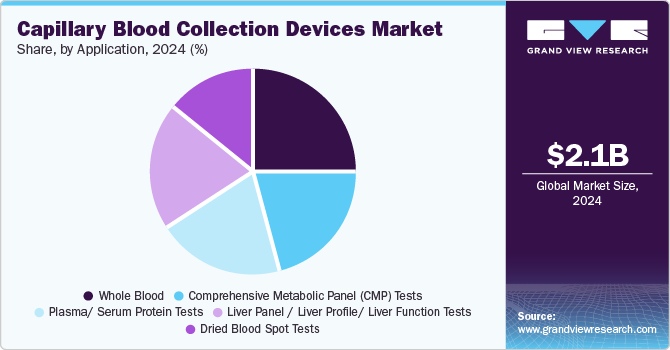
- By application, whole blood tests held the largest revenue share at 24.6% in 2024.
Download a free sample PDF of the Capillary Blood Collection Devices Market Intelligence Study by Grand View Research.
Market Size & Forecast
- 2024 Market Size: USD 2.13 Billion
- 2030 Projected Market Size: USD 3.52 Billion
- CAGR (2025–2030): 8.8%
- Largest Market (2024): North America
- Fastest-Growing Region: Asia Pacific
Competitive Landscape
The market is highly competitive, with numerous manufacturers strengthening their presence through product innovations, regulatory approvals, strategic acquisitions, and global expansions. Collaboration remains a key strategy. For instance, in May 2022, Babson Diagnostics and BD expanded their strategic partnership to broaden their blood testing portfolio and enhance global reach.
Prominent Companies
- Becton, Dickinson and Company (BD)
- Greiner Bio-One International GmbH
- SARSTEDT AG & Co. KG
- Terumo Medical Corp.
- B. Braun Melsungen AG
- Improve Medical
- Abbott Laboratories
- Cardinal Health
- Retractable Technologies Inc.
- Haemonetics Corporation
Recent Developments
- July 2024: O’Ryan.Health announced two pivotal studies—The JDM Study and The Healthy Kids Study—focused on at-home pediatric blood collection using YourBio Health’s capillary devices.
- December 2023: BD received U.S. FDA approval for its MiniDraw Capillary Blood Collection System, enabling fingertip-based blood collection suitable for laboratory-grade results.
- July 2022: Rhinostics launched the VERIstic Collection Device, designed for faster capillary blood collection with an integrated cap for improved workflow efficiency.
Explore Horizon Databook – the world’s most comprehensive market intelligence platform by Grand View Research.
Conclusion
The capillary blood collection devices market is poised for steady growth, driven by rising PoC diagnostic adoption, growing chronic disease prevalence, and a shift toward home-based and remote healthcare. Continuous product innovation, improved device usability, and strategic industry partnerships will further support market expansion through 2030.