Bovine Artificial Insemination Market: Private Sector Expansion Insights
The bovine artificial insemination market is poised for steady expansion as global demand for dairy and meat products accelerates and genetic improvement becomes a central focus for livestock productivity.
The global bovine artificial insemination market was valued at USD 3.21 billion in 2024 and is projected to reach USD 5.80 billion by 2033, expanding at a CAGR of 6.9% from 2025 to 2033. Growth in the market is driven by rising global demand for meat and dairy products, advancements in veterinary reproductive technologies, increasing focus on sustainable food production, and supportive initiatives undertaken by governments and industry stakeholders.
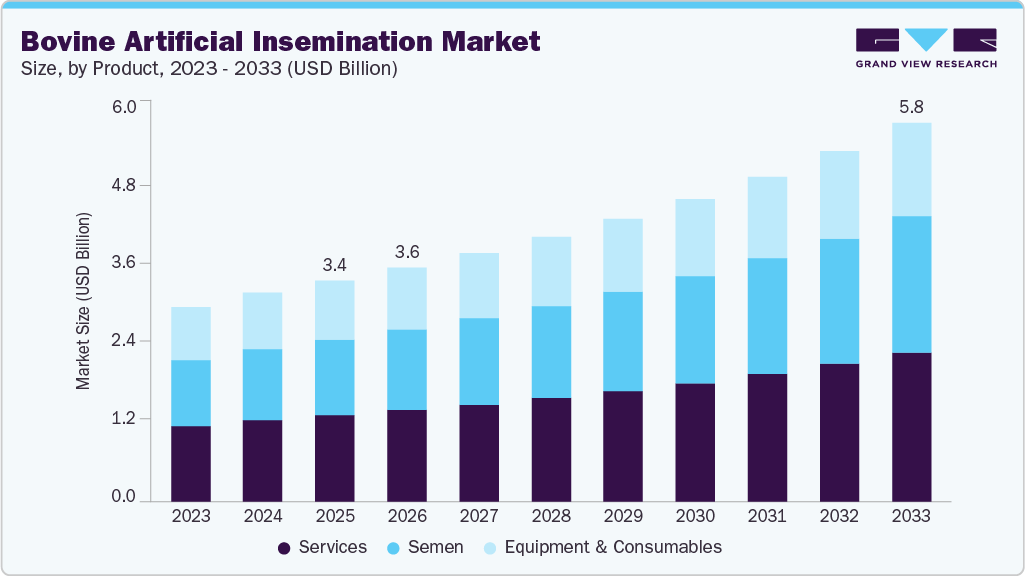
A major growth driver is the expanding demand for dairy products. As global population levels rise and consumer diets shift toward higher protein intake, the need for improved livestock productivity has intensified. Bovine AI plays a crucial role in meeting this demand by enhancing genetic traits, increasing milk yield, and improving product quality. For example, according to The Hindu (November 2024), India’s milk output increased by 3.78% in 2023–2024, with Uttar Pradesh contributing 16.21% of the nation’s total milk production. This growing emphasis on efficiency and output highlights the value of AI in modern dairy farming.
Key Market Trends & Insights
- North America held the largest revenue share of 30.94% in 2024.
- The U.S. dominated the North America market in 2024.
- By solutions, services accounted for the largest share at 39.02% in 2024.
- By distribution channel, the private segment led with 56.19% market share in 2024.
- By sector, the dairy segment held the largest share in 2024.
Download a free sample PDF of the Bovine Artificial Insemination Market Intelligence Study by Grand View Research.
Market Size & Forecast
- 2024 Market Size: USD 3.21 Billion
- 2033 Projected Market Size: USD 5.80 Billion
- CAGR (2025–2033): 6.9%
- Largest Region (2024): North America
- Fastest-Growing Region: Asia Pacific
Competitive Landscape
Key players in the bovine AI market are prioritizing genetic improvement, partnerships, and global expansion to maintain competitive advantage.
- Genus plc (ABS Global) leads in precision breeding and advanced genetic improvement programs.
- STgenetics specializes in sex-sorted semen and genomic selection technologies.
- CRV Holding focuses on sustainable breeding and high-performance dairy genetics.
- Semex Alliance emphasizes genomic advancements and fertility-enhancing solutions.
- IMV Technologies supplies essential AI equipment and cryopreservation tools across global markets.
- URUS Group integrates brands such as Alta Genetics and GENEX to offer data-driven reproductive management and herd optimization.
These organizations collectively advance the industry through innovations in genomic testing, AI optimization, reproductive technologies, and digital herd management platforms that boost productivity and improve genetic outcomes.
Prominent Companies
- Genus Plc
- IMV Technologies
- SEMEX
- Jorgensen Laboratories
- URUS Group
- STgenetics
- National Dairy Development Board
- Munster Bovine
- World Wide Sires, Ltd
- CRV
Recent Developments
- March 2025: The Indian government launched a sex-sorted semen initiative to increase female calf births to 90% in Rajasthan. In collaboration with NDDB, the state procured 100,000 doses of sex-sorted semen for local production.
- September 2024: Indian Immunologicals, in partnership with NDDB, introduced ‘Shashthi’, an indigenous IVF media that supports embryo development, improving the efficiency of bovine reproductive technologies.
- February 2024: Cogent Breeding partnered with Sainsbury’s beef supply chain, enhancing farmers’ access to Cogent’s genetics within the Sainsbury’s Gamechanger program.
Explore Horizon Databook – the world’s most comprehensive market intelligence platform by Grand View Research.
Conclusion
The bovine artificial insemination market is poised for steady expansion as global demand for dairy and meat products accelerates and genetic improvement becomes a central focus for livestock productivity. Advances in reproductive technologies, strategic collaborations, and growing governmental support will continue to shape the industry’s evolution and drive adoption of AI solutions across emerging and established markets.