Automotive Steering Market: Asia Pacific Drives Revenue Dominance
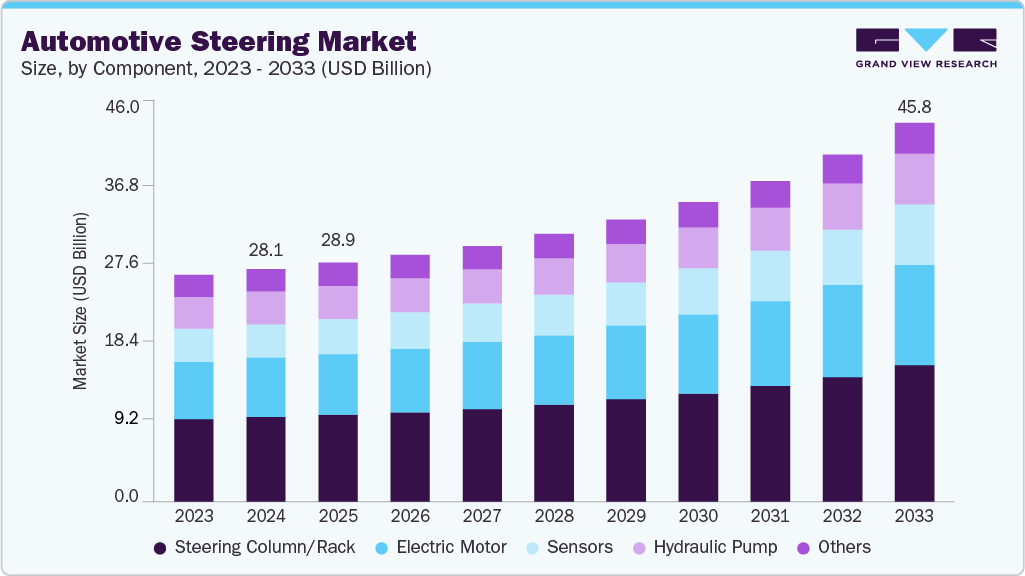
The global automotive steering market was valued at USD 28.08 billion in 2024 and is projected to reach USD 45.79 billion by 2033.
The global automotive steering market was valued at USD 28.08 billion in 2024 and is projected to reach USD 45.79 billion by 2033, expanding at a CAGR of 5.9% from 2025 to 2033. This growth is largely attributed to continuous technological advancements and changing consumer preferences.
One of the most notable shifts in the industry is the increasing adoption of Electric Power Steering (EPS), which is steadily replacing traditional hydraulic systems. EPS offers several advantages, including improved fuel efficiency, lower emissions, and enhanced driving comfort, making it a preferred choice across vehicle segments.
The demand for advanced steering technologies is also being propelled by the rise of autonomous and semi-autonomous vehicles. Systems such as steer-by-wire and adaptive steering integrate closely with Advanced Driver Assistance Systems (ADAS), contributing to safer and more responsive vehicle handling. Additionally, emerging innovations like AI-powered predictive steering and smart steering systems for commercial vehicles are further transforming the steering landscape.
The growing production of electric and hybrid vehicles is significantly accelerating the need for modern steering solutions. Electric Vehicles (EVs), due to their structural and efficiency requirements, particularly benefit from EPS and steer-by-wire systems, which eliminate the need for traditional, engine-driven hydraulic pumps. Moreover, regulatory pressures for clean mobility in regions such as Europe, China, and the United States are compelling original equipment manufacturers (OEMs) to develop lightweight and energy-efficient steering technologies that align with EV platform designs.
Order a free sample PDF of the Automotive Steering Market Intelligence Study, published by Grand View Research.
Key Market Trends & Insights
- Regional Outlook: In 2024, Asia Pacific held the largest share of the global automotive steering market, accounting for 38.94% of revenue. This dominance is fueled by high vehicle production volumes, a rapidly evolving automotive sector, and growing consumer demand for advanced and fuel-efficient vehicles. Countries like China, Japan, India, and South Korea play a critical role, backed by robust domestic markets, favorable policies, and heavy investments in electric vehicle development.
- By Component: The steering column/rack segment led the market with a 36.30% share in 2024, and is expected to grow at a CAGR of 5.8% through 2033. This segment’s dominance stems from its essential function of linking the steering wheel to the vehicle’s steering mechanism, ensuring accurate control and maneuverability.
- By Mechanism: Electronic Power Steering (EPS) accounted for the largest market share of 69.27% in 2024. Its preference over hydraulic systems is due to advantages like better fuel economy, reduced maintenance, and compatibility with modern vehicle frameworks. EPS removes the need for a hydraulic pump, thereby lowering engine load and boosting vehicle performance.
- By Vehicle Type: The passenger cars segment dominated in 2024 with a 71.36% revenue share. This was driven by high global sales and production of passenger vehicles, along with increasing consumer demand for safety and comfort. The widespread integration of EPS in passenger cars—especially compact and mid-sized models—has further strengthened this segment.
Market Size & Forecast
- 2024 Market Size: USD 28.08 Billion
- 2033 Projected Market Size: USD 45.79 Billion
- CAGR (2025-2033): 5.9%
- Asia Pacific: Largest market in 2024
Key Companies & Market Share Insights
The automotive steering market features several prominent players, with companies focusing heavily on research and development (R&D) to enhance performance, precision, and sustainability in their steering technologies.
Core areas of innovation include:
- Development of steer-by-wire systems
- Integration of advanced sensors and electronic control units (ECUs)
- Use of AI, IoT, and cloud-based diagnostics for real-time monitoring, predictive maintenance, and improved steering accuracy
Modern steering systems are increasingly designed to be compatible with ADAS and autonomous driving platforms, leveraging real-time data and geospatial intelligence to support safe and efficient vehicle operation.
Notable Companies:
- Showa Corporation (subsidiary of Hitachi Astemo), founded in 1938 and based in Saitama Prefecture, Japan, specializes in steering systems, electronic power steering, and components for both passenger vehicles and motorcycles.
- Nexteer Automotive Corporation, headquartered in Auburn Hills, Michigan (U.S.), is a global leader in motion control technologies, offering advanced steering and driveline systems with a strong presence across North America, Europe, and Asia Pacific.
Key Players
- ZF Friedrichshafen AG
- Showa Corporation
- Nexteer Automotive Corporation
- NSK Ltd
- JTEKT Corporation
- Robert Bosch GmbH
- Hyundai Mobis CO., Ltd
- Thyssenkrupp Presta
- Mando Corporation
- Sona Corporation
Explore Horizon Databook – The world's most expansive market intelligence platform developed by Grand View Research.
Conclusion
The global automotive steering market is poised for steady growth over the next decade, driven by the transition to electric and autonomous vehicles, along with technological innovation in steering systems. As consumer expectations for safety, comfort, and fuel efficiency continue to rise, manufacturers are investing in intelligent, energy-efficient steering solutions that align with the demands of modern vehicle design.
With Asia Pacific leading in production and innovation, and new technologies like steer-by-wire and AI-integrated steering gaining traction, the industry is evolving toward a more connected, adaptive, and sustainable future.