
Australia Switchgear Market Size, Share, Report 2026-2034
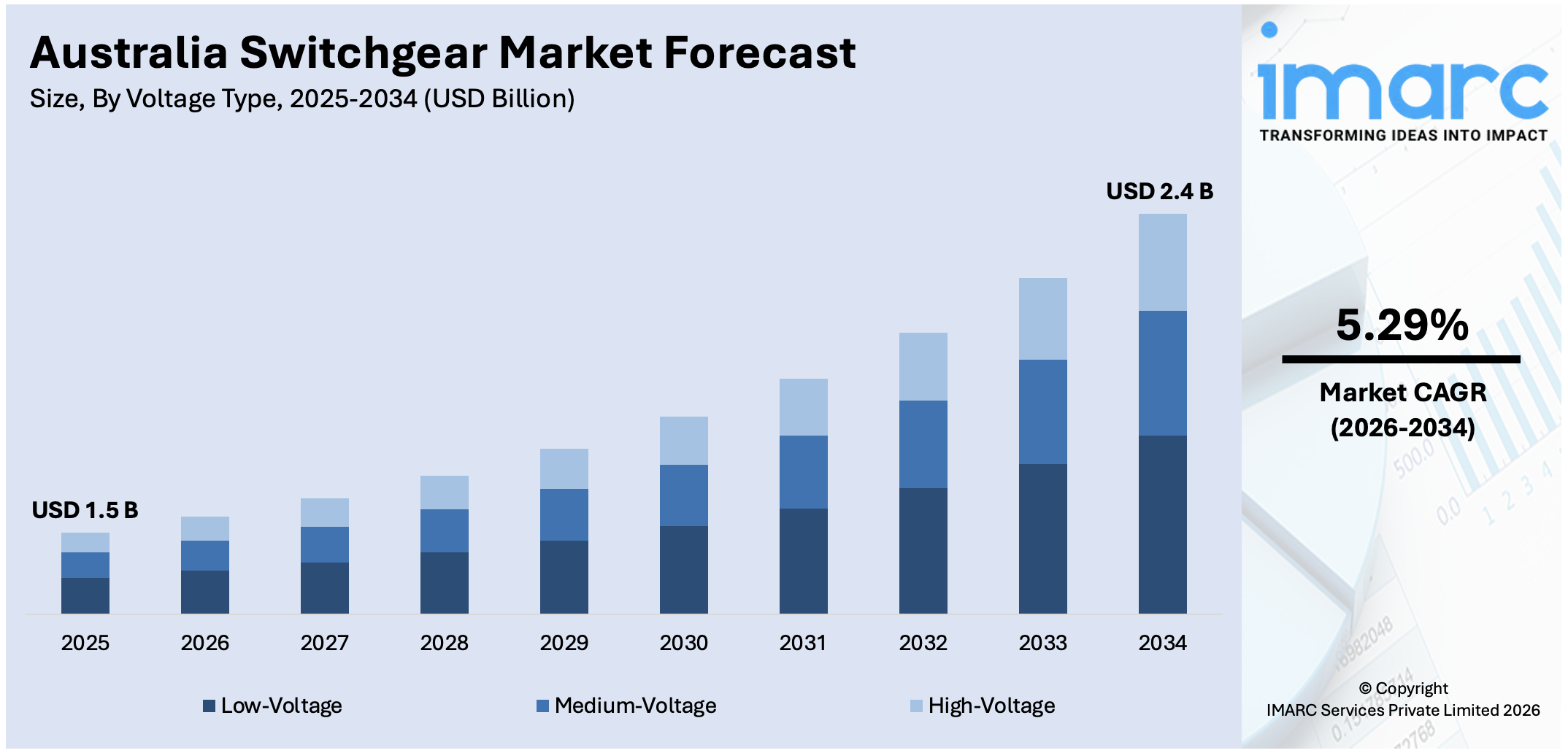
Australia switchgear market size reached USD 1.5 Billion in 2025. Looking forward, IMARC Group expects the market to reach USD 2.4 Billion by 2034, exhibiting a growth rate (CAGR) of 5.29% during 2026-2034.
Australia Switchgear Market Overview
The Australia switchgear market is witnessing steady growth, driven by the integration of renewable energy into the national grid, the urgent need to upgrade aging electrical infrastructure, stringent regulatory and environmental compliance requirements, and the rapid adoption of smart grid technologies that demand intelligent power distribution and protection solutions. According to IMARC Group, the Australia switchgear market size reached USD 1.5 Billion in 2025. Looking forward, IMARC Group expects the market to reach USD 2.4 Billion by 2034, exhibiting a growth rate (CAGR) of 5.29% during 2026-2034.
Australia's switchgear market is being fundamentally reshaped by the country's ambitious transition toward renewable energy and the accompanying need to modernize its electricity distribution infrastructure. As the share of wind and solar generation continues to expand within the national energy mix, the demand for advanced switchgear capable of managing intermittent power supplies, bidirectional energy flows, and distributed energy resource integration has intensified significantly. The electrification of Australia's grid infrastructure requires robust switchgear solutions across all voltage classifications, from low-voltage panels serving residential solar installations to high-voltage circuit breakers protecting major transmission corridors. Government and private sector investments in grid modernization are focused on replacing aging components that have reached end-of-life status, with many existing switchgear installations no longer meeting contemporary technical and safety standards set by regulations such as the Australian Standard AS 62271 for high-voltage switchgear and control gear assemblies.
The market's technological evolution is equally significant, with the rapid digitalization of Australia's power grid driving demand for smart switchgear equipped with IoT sensors, digital monitoring capabilities, and remote control functionalities. In July 2025, major utility providers announced grid infrastructure enhancement programs that included the installation of advanced medium-voltage switchgear with remote monitoring capabilities, aimed at improving network reliability, accelerating fault isolation, and supporting the integration of distributed renewable generation. Environmental sustainability has also become a critical consideration, exemplified by Ausgrid's landmark installation of Australia's first Siemens blue gas-insulated medium-voltage switchgear at Westfield Miranda in Sydney, which utilizes climate-neutral clean air instead of sulfur hexafluoride (SF6), a greenhouse gas 23,000 times more potent than carbon dioxide. These developments collectively underscore the market's trajectory toward smarter, greener, and more resilient switchgear solutions.
How AI is Reshaping the Future of the Australia Switchgear Market
Artificial intelligence is emerging as a transformative force in Australia's switchgear market, enabling predictive maintenance, intelligent fault detection, autonomous grid management, and optimized asset lifecycle planning that collectively enhance the reliability, safety, and efficiency of power distribution infrastructure.
• AI-Powered Predictive Maintenance and Condition Monitoring: AI-driven predictive maintenance systems are transforming how Australian utilities and industrial operators manage their switchgear assets, shifting from reactive and time-based maintenance schedules to condition-based approaches that optimize maintenance interventions. Machine learning algorithms continuously analyze data from IoT sensors embedded within switchgear equipment, including partial discharge measurements, temperature readings, contact wear indicators, and insulation gas pressure levels, to detect early signs of degradation before they develop into failures. These AI systems can predict component failures weeks or months in advance, enabling operators to schedule maintenance during planned outages rather than responding to emergency breakdowns. For Australia's geographically dispersed grid infrastructure, where physical access to remote switchgear installations can be costly and time-consuming, AI-powered remote condition monitoring delivers significant operational cost savings while improving overall network reliability.
• Intelligent Fault Detection and Self-Healing Networks: AI is enabling the development of intelligent fault detection and self-healing capabilities within Australia's switchgear-protected electrical networks. Machine learning models analyze real-time current, voltage, and power quality data to distinguish between genuine fault conditions and transient disturbances with far greater accuracy than conventional relay protection systems. This intelligent discrimination reduces unnecessary circuit breaker operations, minimizing supply interruptions and extending equipment lifespans. In advanced implementations, AI-powered switchgear systems can automatically reconfigure network topology following fault events, isolating damaged sections while rerouting power through alternative pathways to restore supply to affected customers within seconds. These self-healing capabilities are particularly valuable for supporting the reliability requirements of Australia's increasingly distributed and renewable-dependent energy grid.
• AI-Optimized Asset Lifecycle Management: AI-powered asset management platforms are enabling Australian utilities to optimize the lifecycle economics of their switchgear fleets, making data-driven decisions about equipment replacement, refurbishment, and capacity upgrades. Machine learning algorithms analyze historical maintenance records, operational stress data, environmental conditions, and manufacturer specifications to develop accurate remaining useful life predictions for individual switchgear components. These predictions enable utilities to prioritize replacement investments based on actual equipment condition rather than age-based assumptions, extracting maximum value from existing assets while ensuring that critical equipment is replaced before failure. For Australia's aging grid infrastructure, where many switchgear installations are approaching end-of-life, AI-driven asset lifecycle management helps utilities allocate limited capital budgets more effectively across their switchgear replacement and modernization programs.
• AI for Renewable Energy Grid Integration and Protection: As Australia's renewable energy penetration continues to accelerate, AI is becoming essential for adapting switchgear protection settings and operational parameters to the unique challenges posed by variable generation sources. Traditional protection relay settings are designed for unidirectional power flows from centralized generators, but the growth of distributed solar, wind, and battery storage creates bidirectional power flows that can confuse conventional protection systems. AI algorithms dynamically adjust switchgear protection settings based on real-time generation patterns, load conditions, and network configuration, ensuring optimal fault detection sensitivity while avoiding false tripping events. This adaptive protection capability is critical for maintaining grid stability and safety as renewable energy sources become the dominant generation technology across Australia's National Electricity Market.
• AI-Enhanced SF6 Gas Management and Environmental Compliance: AI-powered monitoring systems are improving the management of sulfur hexafluoride gas in existing gas-insulated switchgear installations, helping Australian utilities minimize environmental impact while the industry transitions toward SF6-free alternatives. Machine learning algorithms analyze gas pressure, temperature, and quality sensor data to detect micro-leaks and predict seal failures before significant gas release occurs. These AI systems optimize gas handling schedules, track emissions across switchgear fleets, and support compliance with increasingly stringent environmental reporting requirements. As the industry moves toward climate-neutral alternatives, demonstrated by Ausgrid's deployment of Siemens blue GIS using clean air insulation, AI systems are helping utilities manage the transition by identifying priority replacement candidates based on SF6 leakage risk, environmental impact, and operational criticality.
Request a Business Sample Report for Procurement & Investment Evaluation:
https://www.imarcgroup.com/australia-switchgear-market/requestsample
Australia Switchgear Market Trends
Smart Grid Digitalization Driving Intelligent Switchgear Adoption
The rapid digitalization of Australia's power distribution networks is driving a fundamental shift from conventional electromechanical switchgear toward intelligent, digitally connected systems that offer real-time monitoring, remote control, and advanced diagnostic capabilities. In July 2025, major Australian utility providers announced comprehensive grid infrastructure enhancement programs that specifically included the deployment of advanced medium-voltage switchgear with integrated remote monitoring capabilities, reflecting the industry's commitment to digital transformation. These smart switchgear systems incorporate IoT sensors that continuously monitor critical parameters including contact temperature, partial discharge activity, operating mechanism condition, and insulation integrity, transmitting data to centralized network management platforms for analysis and decision support. The integration of digital communication protocols enables remote switching operations, reducing the need for field crew deployments and accelerating fault response times. For Australian network operators managing vast geographic territories, the ability to remotely monitor and control switchgear installations delivers substantial operational efficiencies while improving network reliability. As the Australian Energy Market Operator (AEMO) continues to advance its distributed energy resource integration roadmap, digitally enabled switchgear that can communicate with grid management systems and respond to automated dispatch signals is becoming an essential component of the modern electricity distribution infrastructure.
Transition to Environmentally Sustainable SF6-Free Switchgear
The transition toward environmentally sustainable switchgear technologies that eliminate or minimize the use of sulfur hexafluoride represents a significant trend reshaping Australia's switchgear market. SF6 has been the dominant insulation and arc-quenching medium in gas-insulated switchgear for decades due to its exceptional dielectric properties, but its classification as one of the most potent greenhouse gases, with a global warming potential 23,000 times greater than carbon dioxide and an atmospheric persistence exceeding 3,000 years, has driven the development of climate-neutral alternatives. Ausgrid's installation of Australia's first Siemens blue gas-insulated medium-voltage switchgear at Westfield Miranda in Sydney marked a landmark milestone, demonstrating that SF6-free switchgear using clean air insulation can deliver equivalent performance without compromising operational reliability or economic feasibility. This installation serves as a proof-of-concept that is encouraging other Australian utilities and industrial operators to evaluate SF6-free alternatives for new switchgear deployments and planned replacements. Major global switchgear manufacturers including ABB, Siemens, Schneider Electric, and Eaton are expanding their portfolios of SF6-free products, offering Australian customers growing options across voltage classifications. The regulatory trajectory toward stricter greenhouse gas emissions reporting and potential future restrictions on SF6 use is accelerating the adoption curve for sustainable switchgear technologies across the Australian market.
Australia Switchgear Market Summary
The following bullet points provide a quick summary of the key insights from the Australia switchgear market report:
• Market Size (2025): USD 1.5 Billion
• Market Forecast (2034): USD 2.4 Billion
• CAGR (2026-2034): 5.29%
• Key Growth Drivers: Integration of renewable energy sources requiring advanced grid protection infrastructure, replacement and modernization of aging electrical grid components approaching end-of-life, stringent regulatory compliance standards including Australian Standard AS 62271, rapid smart grid digitalization driving demand for intelligent connected switchgear, and expanding commercial and industrial electricity demand across diverse sectors.
• Major Industry Players: ABB, Siemens, Schneider Electric, Eaton, Hitachi Energy, GE Vernova, Mitsubishi Electric, TGOOD Australia, Lucy Electric, Rynat Industries, NHP Electrical Engineering Products, and IPD Group.
Australia Switchgear Market Growth Drivers
Renewable Energy Integration Requiring Advanced Grid Infrastructure
Australia's ambitious renewable energy targets are a primary structural driver of the switchgear market, as the transition from centralized fossil fuel generation to distributed renewable sources fundamentally changes the demands placed on electrical protection and switching infrastructure. The rapid growth of wind farms, solar installations, and battery energy storage systems across the country requires switchgear solutions capable of managing intermittent power supplies, supporting bidirectional energy flows, and ensuring reliable fault protection within increasingly complex network configurations. Each new renewable energy installation, from large-scale wind and solar farms connecting at transmission voltage levels to rooftop solar systems feeding into low-voltage distribution networks, requires appropriate switchgear for safe connection, isolation, and protection. The Marinus Link interconnector project, for which Hitachi Energy was selected in May 2024 to supply high-voltage direct current technology connecting Tasmania to mainland Australia, exemplifies the scale of infrastructure investment driving switchgear demand. This 345-kilometer HVDC system will enable bidirectional renewable power transmission and require advanced converter station switchgear to stabilize the grid and integrate increasing volumes of renewable generation. As Australia's renewable energy capacity continues to expand, the cumulative demand for switchgear across all voltage levels and applications creates a sustained growth trajectory for the market.
Modernization of Aging Electrical Infrastructure
The replacement and modernization of aging electrical infrastructure across Australia represents a critical and enduring growth driver for the switchgear market. A substantial proportion of Australia's existing electrical grid components, including circuit breakers, disconnectors, and switchgear assemblies installed during the infrastructure build-out of the 1970s through 1990s, are reaching or have exceeded their designed operational lifespans. Aging switchgear presents increasing risks of failure, reduced energy efficiency, and non-compliance with current safety and environmental standards, compelling utilities and industrial operators to undertake systematic replacement programs. Modern switchgear technologies deliver significant advantages over legacy equipment, including improved arc-quenching performance, reduced maintenance requirements, compact footprints, digital monitoring capabilities, and environmental sustainability through SF6-free insulation options. The Australian government's Future Made in Australia Act, introduced in April 2024, supports this infrastructure modernization by leveraging the renewable energy transition to drive investment in advanced electrical equipment manufacturing and deployment. Government and private sector investments in grid enhancement projects are creating sustained demand for modern switchgear across commercial, residential, and industrial applications, with replacement cycles expected to drive consistent market growth throughout the forecast period as utilities work through their aging asset portfolios.
Australia Switchgear Market Segments
The Australia switchgear market report provides a detailed breakup and analysis of the market based on various segments:
Breakup by Voltage Type: Low-Voltage, Medium-Voltage, and High-Voltage.
Low-voltage switchgear serves the broadest application base within the Australian market, encompassing residential, commercial, and light industrial installations where circuit protection, load switching, and power distribution are required at voltages up to 1 kV. The rapid expansion of rooftop solar and residential battery storage systems has increased demand for low-voltage switchgear with bidirectional power handling capabilities. Medium-voltage switchgear operates at voltages between 1 kV and 36 kV, serving critical applications in utility distribution networks, commercial buildings, mining operations, and industrial facilities. The medium-voltage segment is experiencing strong growth driven by grid modernization programs and renewable energy substation construction. High-voltage switchgear, operating above 36 kV, is deployed in transmission substations, large-scale renewable energy connections, and major industrial installations. Demand for high-voltage switchgear is being driven by transmission infrastructure projects, including the Marinus Link HVDC interconnector, and large-scale wind and solar farm connections.
Breakup by Insulation: Gas Insulated Switchgear (GIS), Air Insulated Switchgear (AIS), and Others.
Gas insulated switchgear (GIS) offers compact, enclosed designs that are ideal for indoor installations, urban substations, and space-constrained environments where air-insulated alternatives would be impractical. The GIS segment is evolving rapidly with the introduction of SF6-free alternatives using clean air or vacuum insulation technology, as demonstrated by Ausgrid's installation of Siemens blue GIS at Westfield Miranda. Air insulated switchgear (AIS) remains widely deployed across outdoor substations, industrial plants, and rural network applications where space constraints are less critical and the open-air design facilitates maintenance access. AIS typically offers lower upfront costs compared to GIS, making it the preferred choice for price-sensitive applications and regions where land availability is not a constraint. The others category includes hybrid switchgear solutions that combine gas-insulated and air-insulated elements, as well as solid-insulated switchgear using epoxy resin or other solid dielectric materials.
Breakup by Installation: Indoor and Outdoor.
Indoor switchgear installations are prevalent in commercial buildings, data centers, hospitals, shopping centers, and urban substations where weather protection, space optimization, and aesthetic considerations favor enclosed equipment rooms. The growth of commercial real estate, data center construction, and urban infrastructure development is driving demand for compact indoor switchgear solutions, particularly gas-insulated and solid-insulated designs. Outdoor switchgear installations dominate in utility distribution substations, rural network applications, mining sites, and large-scale renewable energy facilities where equipment is exposed to ambient conditions and requires robust weatherproofing and corrosion resistance suited to Australia's diverse climatic environments.
Breakup by End Use: Commercial, Residential, and Industrial.
The commercial segment encompasses office buildings, retail complexes, hospitality venues, healthcare facilities, educational institutions, and data centers, all of which require reliable switchgear for power distribution, backup power switching, and electrical protection. The residential segment includes switchgear deployed within housing developments, apartment complexes, and individual homes, with growing demand driven by rooftop solar integration, home battery storage installations, and electric vehicle charging infrastructure. The industrial segment covers manufacturing plants, mining operations, oil and gas facilities, water treatment plants, and heavy industrial installations that require high-performance switchgear capable of handling heavy electrical loads, harsh operating environments, and continuous duty cycles.
Australia Switchgear Market Competitive Landscape
The competitive landscape of the Australia switchgear market features a combination of global electrical equipment manufacturers and specialized local suppliers competing across residential, commercial, and industrial segments. ABB maintains a leading market position through its comprehensive portfolio of low, medium, and high-voltage switchgear solutions, supported by strong local engineering and service capabilities. Siemens has demonstrated innovation leadership with the deployment of SF6-free blue GIS technology, positioning itself at the forefront of sustainable switchgear solutions for the Australian market. Schneider Electric competes with its extensive range of low and medium-voltage switchgear products tailored for commercial and industrial applications. Eaton offers integrated power distribution and protection solutions across multiple voltage levels. Hitachi Energy has strengthened its position through the Marinus Link HVDC project, supplying critical high-voltage direct current technology for the Tasmania-mainland interconnector. GE Vernova and Mitsubishi Electric provide high-voltage switchgear and protection solutions for utility and industrial customers. TGOOD Australia expanded its local manufacturing presence with the December 2023 opening of a renewable energy assembly facility in Rocklea, Queensland, creating 30 jobs and manufacturing critical substation equipment including switchgear for renewable energy projects. NHP Electrical Engineering Products and IPD Group serve as major local distributors and integrators of switchgear solutions. Lucy Electric provides specialist medium-voltage ring main units and compact switchgear for distribution network applications. Rynat Industries offers locally manufactured switchboard and switchgear solutions.
Latest News and Development in the Australia Switchgear Market
The following are some of the latest news and developments shaping the Australia switchgear market:
• July 2025: Major Australian utility providers announced grid infrastructure enhancement programs including the installation of advanced medium-voltage switchgear with remote monitoring capabilities, aimed at improving network reliability, accelerating fault isolation, and supporting the integration of distributed renewable generation.
• May 2024: Hitachi Energy was selected by Marinus Link Pty Ltd to supply high-voltage direct current technology for a 345-kilometer interconnector project between Tasmania and mainland Australia, enabling bidirectional renewable power transmission and utilizing advanced converter technology to stabilize the grid.
• April 2024: The Australian government introduced the Future Made in Australia Act, aimed at leveraging the renewable energy transition globally and capitalizing on Australia's clean energy resources, with a focus on transitioning to a carbon-neutral economy and supporting industries like battery manufacturing and renewable hydrogen.
• December 2023: TGOOD Australia opened a new renewable energy assembly facility in Rocklea, Queensland, creating 30 new jobs and manufacturing critical substation equipment including switchgear for renewable energy projects across the region.
• November 2023: Ausgrid installed Australia's first Siemens blue gas-insulated medium-voltage switchgear at Westfield Miranda in Sydney, utilizing climate-neutral clean air instead of sulfur hexafluoride (SF6), marking a significant milestone in emissions reduction for the power distribution sector.
Note: If you require any specific information not currently covered within the scope of the report, IMARC Group will provide it as part of customization.
Speak to an analyst:
https://www.imarcgroup.com/request?type=report&id=24643&flag=E
𝗔𝗯𝗼𝘂𝘁 𝗨𝘀
IMARC Group is a global management consulting firm that helps the world's most ambitious changemakers to create a lasting impact. The company provides a comprehensive suite of market entry and expansion services. IMARC offerings include thorough market assessment, feasibility studies, company incorporation assistance, factory setup support, regulatory approvals and licensing navigation, branding, marketing and sales strategies, and competitive landscape and benchmarking analyses. The company also offers ongoing operational support and strategic guidance to help businesses manage day-to-day operations and achieve long-term success in the market.
𝗖𝗼𝗻𝘁𝗮𝗰𝘁 𝗨𝘀
IMARC Group
134 N 4th St. Brooklyn, NY 11249, USA
Email: sales@imarcgroup.com
Tel No: (D) +91 120 433 0800
United States: +1-631-791-1145