
Australia Advertising Market 2026 | Worth USD 27.8 Billion by 2034
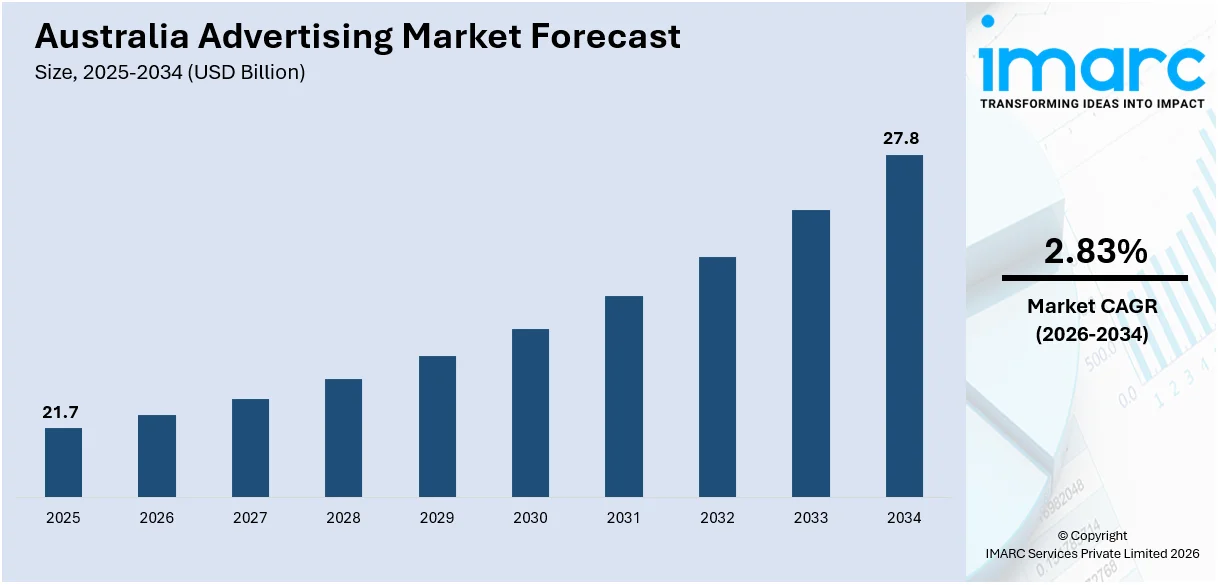
Australia advertising market size reached USD 21.7 Billion in 2025. Looking forward, IMARC Group expects the market to reach USD 27.8 Billion by 2034, exhibiting a growth rate (CAGR) of 2.83% during 2026-2034.
 Australia Advertising Market Overview
The Australia advertising market is undergoing a profound digital transformation, driven by the explosive growth of programmatic advertising, the emergence of retail media as a major channel, accelerating connected TV (CTV) ad spend, AI-powered personalization capabilities, and the ongoing shift of advertising budgets from traditional media to digital platforms. Australia's mature and highly connected consumer base—with one of the world's highest internet penetration and smartphone adoption rates—creates a sophisticated digital advertising ecosystem where data-driven targeting, real-time optimization, and cross-platform measurement are becoming standard practice. The Australia advertising market size reached USD 21.7 Billion in 2025. Looking forward, IMARC Group expects the market to reach USD 27.8 Billion by 2034, exhibiting a growth rate (CAGR) of 2.83% during 2026-2034. Australia's total ad market is forecast to reach approximately AUD 30.7 billion by the end of 2026, with digital ad spend growing at 12.7% annually to reach USD 16.88 billion, underscoring the dominant and accelerating role of digital channels in the nation's advertising landscape.
The market encompasses television advertising, print advertising (newspaper and magazine), radio advertising, outdoor advertising, internet advertising (search, display, classified, video), mobile advertising, and cinema advertising. Pure-play internet advertising now accounts for 75.9% of total ad revenue and is expected to climb to 83.5% by 2030, reflecting the structural shift away from traditional media. The programmatic advertising segment is growing at a remarkable CAGR of 23.55%, rising from USD 441.74 million in 2024 to a projected USD 2.96 billion by 2033, with 87.3% of all advertising revenue expected to be generated through programmatic channels by 2030. Google, Meta, Amazon, and YouTube continue to anchor digital advertising spend in Australia, with Meta projected to overtake Google in global digital ad revenue for the first time in 2026. Retail media has emerged as the fastest-growing advertising channel, with spending forecast to rise 28.1% in 2025 and a further 24.4% in 2026, as major retailers Woolworths (Cartology) and Coles (Coles 360) expand their digital advertising platforms into core components of national media planning.
Request for a sample copy of this report: https://www.imarcgroup.com/australia-advertising-market/requestsample
How AI is Reshaping the Future of the Australia Advertising Market
Artificial intelligence is fundamentally transforming the Australian advertising industry, elevating programmatic advertising from a performance tool to a strategic marketing imperative while enabling unprecedented levels of personalization, creative optimization, and campaign measurement across all channels and formats.
• AI-Powered Programmatic Advertising and Real-Time Bidding: Machine learning algorithms are the engine driving Australia's programmatic advertising boom—growing at 23.55% CAGR to reach USD 2.96 billion by 2033—by automating the buying, placement, and optimization of digital advertising in real time across websites, mobile apps, streaming services, and connected TV platforms. AI-powered demand-side platforms (DSPs) analyze billions of bidding opportunities per second, evaluating user context, behavioral signals, creative relevance, and conversion probability to determine optimal bid prices and ad placements within milliseconds. In June 2025, several Australian advertising agencies expanded their programmatic capabilities by adopting AI-driven analytics platforms that automate campaign optimization and improve targeting accuracy across multiple digital channels simultaneously.
• Dynamic Creative Optimization (DCO) and Personalization at Scale: AI-powered dynamic creative optimization systems are transforming advertising from one-size-fits-all messaging into hyper-personalized experiences that adapt in real time based on individual user data, context, and behavior. Machine learning models analyze consumer demographics, browsing history, purchase intent signals, weather conditions, time of day, and device type to automatically assemble and serve the most relevant creative combination from hundreds of pre-built elements—including headlines, images, calls-to-action, and product recommendations. These DCO platforms enable Australian advertisers to deliver thousands of creative variations simultaneously without manual production, dramatically improving engagement rates, click-through performance, and conversion metrics while reducing creative production costs.
• AI-Driven Audience Modeling and Privacy-Compliant Targeting: As Australia's Privacy Act review and the ACCC's Digital Platform Services Inquiry prompt changes in consent protocols, data collection, and algorithmic transparency, AI is enabling advertisers to maintain targeting effectiveness while respecting evolving privacy requirements. Machine learning models develop probabilistic audience segments using first-party data, contextual signals, and aggregated behavioral patterns that deliver personalized advertising without relying on individual-level tracking or third-party cookies. These privacy-preserving AI targeting solutions use techniques including federated learning, differential privacy, and cohort-based modeling to identify high-value audience segments while maintaining compliance with tightening Australian data protection regulations.
• AI-Enhanced Measurement and Attribution Modeling: Machine learning platforms are transforming advertising measurement from last-click attribution models to sophisticated multi-touch attribution and media mix modeling that accurately quantifies the contribution of each advertising touchpoint across increasingly complex consumer journeys. AI-powered measurement solutions analyze cross-platform data—spanning TV, digital display, social media, search, retail media, and out-of-home—to identify incremental lift, optimal frequency caps, and channel interaction effects that inform budget allocation decisions. As retail media platforms like Cartology and Coles 360 expand closed-loop measurement capabilities connecting ad exposure to in-store purchase, AI attribution models are enabling Australian CPG advertisers to demonstrate precise return on ad spend across the full purchase funnel.
• Generative AI for Content Creation and Campaign Development: Generative AI tools are transforming advertising content production by enabling rapid creation of copy, imagery, video scripts, and social media assets that maintain brand consistency while dramatically reducing production timelines and costs. Australian agencies and in-house marketing teams are deploying generative AI to produce localized creative variations, A/B test messaging alternatives, and generate personalized content at a scale that would be impossible with traditional production workflows. These AI creative tools are particularly impactful for Australia's diverse multicultural market, enabling cost-effective creation of culturally relevant advertising in multiple languages and cultural contexts without proportional increases in production budgets.
Australia Advertising Market Trends
Retail Media Emergence as a Major Advertising Channel
One of the most disruptive trends reshaping the Australia advertising market is the rapid emergence of retail media as a core advertising channel, with spending forecast to grow 28.1% in 2025 and a further 24.4% in 2026—making it the fastest-growing segment in the Australian advertising ecosystem. Major retailers including Woolworths Group and Coles have developed sophisticated digital advertising platforms—Cartology and Coles 360 respectively—that are now deeply embedded in national media planning, particularly among consumer packaged goods (CPG) advertisers seeking closed-loop measurement connecting ad exposure to purchase behavior. These retail media networks leverage first-party purchase data from millions of loyalty program members to offer advertisers precise targeting based on actual buying behavior rather than inferred intent, delivering superior ROI measurement and accountability compared to traditional digital advertising channels. The retail media opportunity extends beyond on-site sponsored product listings into off-site programmatic activation, in-store digital screens, and connected commerce experiences that bridge online advertising with physical retail environments. As capabilities in measurement, programmatic access, and audience targeting mature, more Australian brands are shifting significant advertising budget into retailer-owned platforms, creating a structural reallocation of ad spend that is reshaping competitive dynamics across the broader advertising market.
Connected TV and Video Advertising Transformation
A second defining trend in the Australian advertising market is the accelerating shift of video advertising budgets from linear television to connected TV (CTV) and digital video platforms, driven by changing consumer viewing habits, programmatic CTV buying capabilities, and superior audience targeting and measurement. As Australian consumers increasingly access content through streaming platforms, smart TVs, and ad-supported video-on-demand (AVOD) services, advertisers are following audiences to these digital environments that offer the premium, lean-back viewing experience of traditional television combined with the data-driven targeting precision of digital advertising. YouTube dominates video advertising particularly on connected TV screens, while programmatic CTV ad spending is forecast to increase substantially as demand-side platforms integrate CTV inventory alongside display, mobile, and social channels for unified cross-platform campaign management. The proliferation of ad-supported tiers on major streaming platforms—including Netflix, Disney+, and local broadcasters' BVOD services—is expanding available premium video inventory and creating new opportunities for advertisers to reach cord-cutting audiences who are no longer accessible through traditional television buying. QMS's partnership with Samba TV for digital out-of-home (DOOH) and television audience integration exemplifies the convergence of traditional and digital video measurement, enabling advertisers to plan and measure campaigns across both environments with consistent audience metrics.
Australia Advertising Market Summary
• Market Size (2025): USD 21.7 Billion
• Forecast Value (2034): USD 27.8 Billion
• Growth Rate (CAGR 2026-2034): 2.83%
• Key Segments: Internet Advertising (75.9% of revenue, largest), Programmatic Advertising (23.55% CAGR, fastest-growing), Retail Media (28.1% growth in 2025), Television, Print, Radio, Outdoor, Mobile, and Cinema Advertising
• Primary Growth Drivers: Digital transformation (12.7% digital ad spend growth), programmatic automation (87.3% of revenue by 2030), retail media expansion (Cartology, Coles 360), CTV/streaming video shift, AI-powered personalization, and e-commerce acceleration
Australia Advertising Market Growth Drivers
Digital Transformation and Programmatic Advertising Acceleration
A primary driver propelling the Australia advertising market is the accelerating digital transformation of media buying and the explosive growth of programmatic advertising that is automating and optimizing ad placement at unprecedented scale. The Australia programmatic advertising market is growing at a CAGR of 23.55%, rising from USD 441.74 million in 2024 to a projected USD 2.96 billion by 2033, with 87.3% of all advertising revenue expected to be generated through programmatic channels by 2030. Digital ad spend is growing at 12.7% annually to reach USD 16.88 billion by 2026, achieving a CAGR of 14.6% from 2026 to 2029 as brands accelerate the shift from traditional media buying to data-driven, automated digital channels. This programmatic revolution is underpinned by advances in AI and machine learning that enable real-time bidding optimization, dynamic creative personalization, and cross-platform audience targeting at a precision and scale impossible through manual media buying. The digital transformation extends across all advertising formats—search, display, video, social, connected TV, digital out-of-home, and audio—creating an integrated programmatic ecosystem where campaigns are planned, executed, and measured through unified platforms that maximize efficiency and ROI.
E-Commerce Growth and Performance Marketing Demand
Another critical growth driver for the Australian advertising market is the expanding e-commerce sector that creates sustained demand for performance-driven digital advertising across search, social commerce, retail media, and marketplace platforms. As Australian consumers increasingly purchase goods and services online, brands are investing heavily in digital advertising that drives measurable sales outcomes—from search ads that capture purchase intent to social commerce formats that enable in-platform transactions and retail media placements that influence buying decisions at the point of purchase. Google, Meta, Amazon, and YouTube continue to anchor digital advertising spend in Australia, with each platform offering sophisticated performance advertising products that connect ad investment directly to sales metrics. The growth of retail media—forecast to rise 28.1% in 2025 and 24.4% in 2026—reflects advertisers' appetite for closed-loop measurement environments where ad exposure can be directly linked to purchase behavior through first-party retailer data. This performance marketing imperative is driving advertising budget allocation toward measurable digital channels and away from brand-focused traditional media, creating a structural growth driver for the digital advertising ecosystem that will continue accelerating as e-commerce penetration deepens across Australian retail categories.
Australia Advertising Market Segments
The Australia advertising market is segmented by advertising type and region, reflecting the diverse media landscape and geographic distribution of advertising investment:
• Breakup by Type: The market encompasses television advertising, print advertising (newspaper and magazine), radio advertising, outdoor advertising, internet advertising (search, display, classified, video), mobile advertising, and cinema advertising. Internet advertising is the dominant segment accounting for 75.9% of total ad revenue and projected to reach 83.5% by 2030, driven by programmatic automation and digital video growth.
• Breakup by Digital Channel: Digital advertising spans search (Google dominant), social media (Meta projected to overtake Google in global ad revenue in 2026), video/CTV (YouTube leading on connected TV), retail media (Cartology, Coles 360 fastest-growing at 28.1%), display/programmatic (23.55% CAGR to USD 2.96B by 2033), and emerging audio/podcast formats.
• Breakup by Region: Regional segmentation covers Australia Capital Territory and New South Wales, Victoria and Tasmania, Queensland, Northern Territory and Southern Australia, and Western Australia. New South Wales and Victoria command the largest advertising expenditure driven by Sydney and Melbourne's positions as the primary corporate headquarters, media agency, and advertising industry hubs.
• Traditional Media Evolution: Television advertising is transitioning toward addressable TV and CTV formats, outdoor advertising is digitizing through programmatic DOOH networks, and radio is evolving into digital audio and podcast advertising. While traditional channels face structural budget pressure, premium formats that offer mass reach and brand-building continue to retain strategic value within integrated media plans.
• Emerging Formats: Connected TV, retail media, influencer marketing, podcast advertising, and commerce-enabled social media formats represent the fastest-growing segments within the broader advertising ecosystem, driven by consumer behavioral shifts, improved measurement capabilities, and AI-powered optimization tools.
Australia Advertising Market Competitive Landscape
The competitive landscape of the Australia advertising market features a complex ecosystem of global technology platforms, media owners, advertising agencies, retail media networks, and emerging ad-tech companies. Google dominates search advertising and maintains significant video market share through YouTube, particularly on connected TV screens. Meta (Facebook, Instagram) is projected to overtake Google in global digital ad revenue in 2026, leveraging advanced AI-powered ad targeting across its social platforms. Amazon Ads continues to scale through sponsored listings and display formats on Australia's growing e-commerce marketplace. Woolworths Group (Cartology) and Coles (Coles 360) have emerged as major retail media competitors, offering closed-loop measurement connecting ad exposure to in-store purchase. QMS leads in digital out-of-home advertising, launching a DOOH-TV partnership with Samba TV. Major holding company agencies including WPP, Omnicom, Publicis, Dentsu, and IPG operate extensive Australian networks providing media planning, creative, and programmatic services. Competition increasingly centres on data-driven targeting capabilities, AI-powered optimization, cross-platform measurement, privacy-compliant audience solutions, and retail media access.
Latest News and Development in the Australia Advertising Market
• 2026: Australia's total advertising market is forecast to reach AUD 30.7 billion, with digital ad spend growing 12.7% annually to USD 16.88 billion, as Meta is projected to overtake Google in global digital advertising revenue for the first time—generating approximately USD 243.46 billion worldwide versus Google's USD 239.54 billion.
• June 2025: Several Australian advertising agencies expanded their programmatic advertising capabilities by adopting AI-driven analytics platforms, enabling brands to automate campaign optimization and improve targeting accuracy across multiple digital channels simultaneously.
• 2025-2026: Retail media spending surged 28.1% in 2025 with a further 24.4% growth forecast for 2026, as Woolworths' Cartology and Coles 360 platforms expanded programmatic access, audience targeting, and closed-loop measurement capabilities that connected ad exposure directly to in-store and online purchase behavior.
• March 2024: QMS launched a digital out-of-home and television audience integration partnership with Samba TV, enabling cross-platform campaign planning and measurement that bridges DOOH and CTV advertising environments with consistent audience metrics.
• 2025-2026: Australia's Privacy Act review and the ACCC's ongoing Digital Platform Services Inquiry prompted changes in consent protocols, data collection, and algorithmic transparency, driving the advertising industry toward privacy-preserving AI targeting solutions including first-party data strategies, contextual advertising, and cohort-based audience modeling.
Note: If you require any specific information not currently covered within the scope of the report, IMARC Group will provide it as part of customization.
Speak to an analyst:
https://www.imarcgroup.com/request?type=report&id=24749&flag=E
𝗔𝗯𝗼𝘂𝘁 𝗨𝘀
IMARC Group is a global management consulting firm that helps companies in strategy, operations, technology, and mergers & acquisitions. We have been a trusted research partner for industry leaders, providing comprehensive market insights and strategic advisory services. Our extensive research network spans across 135+ countries, and we have assisted over 3,500 clients worldwide. We offer syndicated research reports, customized research solutions, and consulting services to help businesses make informed decisions and achieve their growth targets. With a team of over 500 analysts and consultants, IMARC Group is well-positioned to provide actionable insights and data-driven recommendations.
𝗖𝗼𝗻𝘁𝗮𝗰𝘁 𝗨𝘀
IMARC Group
134 N 4th St. Brooklyn, NY 11249, USA
Email: sales@imarcgroup.com
Tel No: (D) +91 120 433 0800
United States: +1-631-791-1145