Alpha Olefin Market: Application Trends in Polyethylene and Lubricants
The alpha olefin market is expected to experience steady growth through 2030, supported by rising polyethylene demand, expanding industrial applications, and continuous advancements in production technologies.
The global alpha olefin market was valued at USD 10.42 billion in 2023 and is projected to reach USD 14.63 billion by 2030, growing at a CAGR of 5.8% from 2024 to 2030. Market growth is largely driven by the increasing demand for polyethylene, which is extensively used across packaging, industrial manufacturing, consumer goods, and other end-use industries.
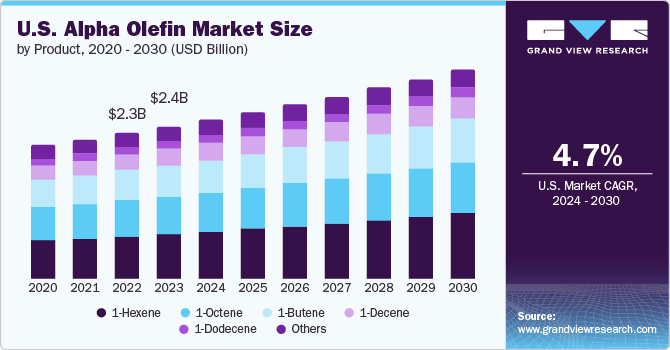
Alpha olefins are primarily produced through the oligomerization of ethylene, which remains the most widely adopted production method. This process yields products with even-numbered carbon chains, typically ranging from C4 to C30+, enabling their use across a broad spectrum of applications including plastics, synthetic lubricants, detergents, and specialty chemicals.
Key Market Trends & Insights
- North America dominated the global market with a revenue share of 39.3% in 2023.
- By product, 1-Hexene held the largest market share, accounting for 29.8% of revenue in 2023.
- By application, polyethylene dominated the market with a share of 55.0% in 2023.
Download a free sample PDF of the Alpha Olefin Market Intelligence Study by Grand View Research
Market Size & Forecast
- 2023 Market Size: USD 10.42 Billion
- 2030 Projected Market Size: USD 14.63 Billion
- CAGR (2024–2030): 5.8%
- Largest Market (2023): North America
Competitive Landscape
Market participants are primarily focused on new product development, long-term partnerships with raw material suppliers, and technological advancements to strengthen their competitive positioning. Key growth drivers include product portfolio diversity, pricing strategies, and advancements in manufacturing technologies.
Many leading manufacturers are large multinational corporations actively investing in research and development to create innovative and more sustainable alpha olefin production processes. Additionally, companies are expanding their manufacturing presence in developing economies to capitalize on emerging growth opportunities and rising regional demand.
Some of the key players operating in the market include:
- Chevron Phillips Chemical Company LLC offers a broad portfolio encompassing aromatics, olefins, polyethylene, performance pipe, drilling specialties, and specialty chemicals. The company provides alpha olefins under its normal alpha olefin product segment.
- Evonik Industries AG supplies a wide range of co- and terpolymers of propene, ethane, and 1-butene under its VESTOPLAST business segment. The company also offers modified amorphous poly-alpha olefins with silane functionalities for specialized applications.
Jam Petrochemicals (Malaysia) Sdn. Bhd. and INEOS Oligomers are among the emerging participants in the market:
- Jam Petrochemical produces Butene-1 linear olefin, along with by-products such as butadiene, methane, hydrogen, and fuel oil.
- INEOS Oligomers provides specialty oligomers used in lubricant additives, drilling fluids, specialty acids, agricultural chemicals, and plastic additives. The company also supplies linear alpha olefins used in synthetic lubricants, surfactant intermediates, and drag-reducing agents.
Prominent Companies
- Chevron Phillips Chemical Company LLC
- Exxon Mobil Corporation
- Petrochemicals (Malaysia) Sdn. Bhd.
- INEOS Oligomers
- Mitsubishi Chemical Corporation
- SABIC
- Sasol
- Shell plc
- Jam Petrochemical
- Dow
Explore Horizon Databook – the world’s most comprehensive market intelligence platform by Grand View Research.
Conclusion
The alpha olefin market is expected to experience steady growth through 2030, supported by rising polyethylene demand, expanding industrial applications, and continuous advancements in production technologies. Strategic investments, sustainable manufacturing initiatives, and expansion into emerging markets will continue to shape the competitive landscape and long-term outlook of the industry.